Buch-OWLOnline-Buchhandel

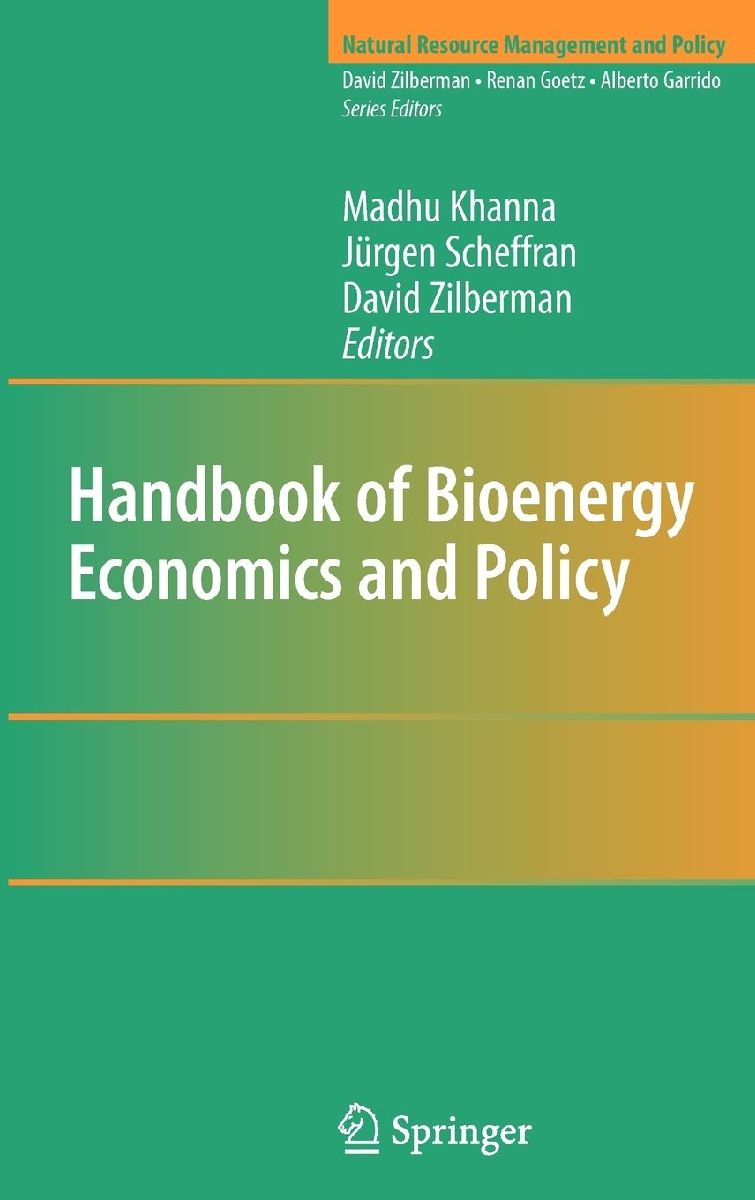
Handbook of Bioenergy Economics and Policy

von Madhu Khanna (Hrsg.)

Herausgegeben von: Madhu Khanna, Herausgegeben von: Jürgen Scheffran, Herausgegeben von: David Zilberman

Einband
Gebunden
Seiten
439
Sprache
Englisch
Erschienen
Dezember 2009
Verlag
Springer New York

Buchbeschreibung

Concerns about energy security, uncertainty about oil prices, declining oil reserves, and global climate change are fueling a shift towards bioenergy as a renewable alternative to fossil fuels.

Public policies and private investments around the globe are aiming to increase local capacity to produce biofuels. A key constraint to the expansion of biofuel production is the limited amount of land available to meet the needs for fuel, feed, and food in the coming decades.

Ganze Beschreibung lesenWeniger anzeigen

Large-scale biofuel production raises concerns about food versus fuel tradeoffs, about demands for natural resources such as water, and about potential impacts on environmental quality.

The book is organized into five parts. The introductory part provides a context for the emerging economic and policy challenges related to bioenergy and the motivations for biofuels as an energy source. The second part of the handbook includes chapters that examine the implications of expanded production of first generation biofuels for the allocation of land between food and fuel and for food/feed prices and trade in biofuels as well as the potential for technology improvements to mitigate the food vs. fuel competition for land.

Chapters in the third part examine the infrastructural and logistical challenges posed by large scale biofuel production and the factors that will influence the location of biorefineries and the mix of feedstocks they use. The fourth part includes chapters that examine the environmental implications of biofuels, their implications for the design of policies and the unintended environmental consequences of existing biofuel policies.

The final part presents economic analysis of the market, social welfare, and distributional effects of biofuel policies.

Inhaltsverzeichnis

  • Bioenergy Economics and Policy: Introduction and Overview
  • Are Biofuels the Best Use of Sunlight?
  • Perennial Grasses as Second-Generation Sustainable Feedstocks Without Conflict with Food Production
  • Present and Future Possibilities for the Deconstruction and Utilization of Lignocellulosic Biomass
  • Interactions Between Biofuels, Agricultural Markets and Trade
  • Price Transmission in the US Ethanol Market
  • Biofuels and Agricultural Growth: Challenges for Developing Agricultural Economies and Opportunities for Investment
  • Prospects for Ethanol and Biodiesel, 2008 to 2017 and Impacts on Agriculture and Food
Ganzes Inhaltsverzeichnis anzeigen (28 Einträge)Weniger anzeigen
  • The Global Bioenergy Expansion: How Large Are the Food?Fuel Trade-Offs?
  • Demand Behavior and Commodity Price Volatility Under Evolving Biofuel Markets and Policies
  • Designing the Infrastructure for Biofuels
  • Optimizing the Biofuels Infrastructure: Transportation Networks and Biorefinery Locations in Illinois
  • The Capital Efficiency Challenge of Bioenergy Models: The Case of Flex Mills in Brazil
  • Environmental Effects of Biofuels and Biofuel Policies
  • Could Bioenergy Be Used to Harvest the Greenhouse: An Economic Investigation of Bioenergy and Climate Change?
  • A Simple Framework for Regulation of Biofuels
  • Market and Social Welfare Effects of the Renewable Fuels Standard
  • US-Brazil Trade in Biofuels: Determinants, Constraints, and Implications for Trade Policy
  • Food and Biofuel in a Global Environment
  • Meeting Biofuels Targets: Implications for Land Use, Greenhouse Gas Emissions, and Nitrogen Use in Illinois
  • Corn Stover Harvesting: Potential Supply and Water Quality Implications
  • Economic Effects of Bioenergy Policies
  • International Trade Patterns and Policy for Ethanol in the United States
  • The Welfare Economics of Biofuel Tax Credits and Mandates
  • Biofuels, Policy Options, and Their Implications: Analyses Using Partial and General Equilibrium Approaches
  • Welfare and Equity Implications of Commercial Biofuel
  • European Biofuel Policy: How Far Will Public Support Go?
  • Conclusions

Details

Erscheinungstermin
Dezember 2009
Kategorie
Fremdsprachige Bücher
Einband
Gebunden
Seiten
439
Sprache
Englisch
Verlag
Springer New York
Format
24,4 × 16,3 cm
Dicke
3,5 cm
Gewicht
812 g
EAN / ISBN-13
9781441903686
Maßstabsgetreu: Deckel und Buchrücken neben einer Hand (18 cm).
Versand und Rückgabe

Standardversand: 1 bis 3 Werktage, 3,99 €, kostenlos ab 35 €

Liefergebiet: Deutschland

Rücksendung: 14 Tage Widerrufsrecht. Bei einem Widerruf tragen Sie die Kosten der Rücksendung. Bei einer Falschlieferung oder einem Fehler von uns erstatten wir Ihnen das Rückporto. Den Widerruf erklären Sie über den Knopf „Vertrag widerrufen“ im Fuß der Seite.

Hersteller und ProduktsicherheitSpringer Nature Customer Service Center GmbH
Springer Nature Customer Service Center GmbH
Europaplatz 3
69115 Heidelberg
Deutschland
ProductSafety@springernature.com

Mehr von Madhu Khanna

Ähnliche Titel

Bewertungen

Zu diesem Titel gibt es noch keine Bewertung. Bewerten kann, wer ihn bei uns gekauft hat.

So prüfen wir Bewertungen
Eine Bewertung kann bei uns nur abgeben, wer den Titel über sein Kundenkonto bei uns gekauft hat. Jede Bewertung ist fest mit der zugehörigen Bestellung verknüpft; anders kommt sie technisch gar nicht zustande. Deshalb trägt jede angezeigte Bewertung den Hinweis „Verifizierter Kauf". Wir zeigen positive wie negative Bewertungen und löschen nur bei Rechtsverstößen. Für Bewertungen gibt es keine Gegenleistung.
286,50 €

Inhalte ab 18

Cover von Titeln für Erwachsene, etwa erotische Romane, Manga oder Comics, bleiben unscharf, bis Sie bestätigen. Die Bestätigung gilt für alle Seiten und Tabs, bis Sie den Browser schließen.

Zurück zum Katalog