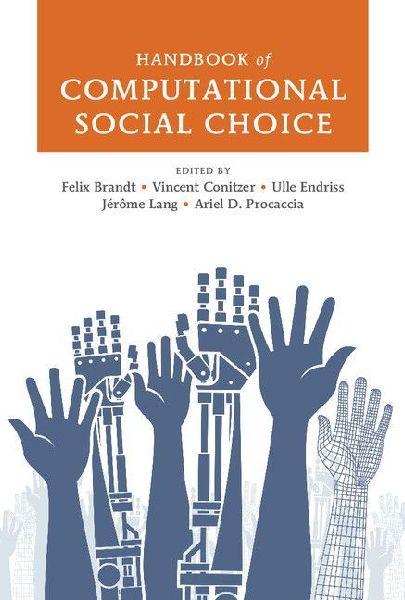
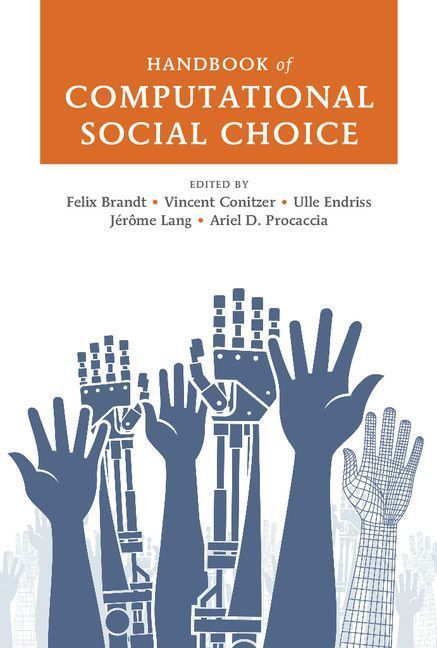
Handbook of Computational Social Choice
Herausgegeben von: Felix Brandt, Herausgegeben von: Vincent Conitzer, Herausgegeben von: Ulle Endriss
- Einband
- Gebunden
- Seiten
- 552
- Sprache
- Englisch
- Erschienen
- April 2016
- Verlag
- Cambridge University Press
Buchbeschreibung
The rapidly growing field of computational social choice, at the intersection of computer science and economics, deals with the computational aspects of collective decision making.
This handbook, written by thirty-six prominent members of the computational social choice community, covers the field comprehensively. Chapters devoted to each of the field's major themes offer detailed introductions.
Ganze Beschreibung lesenWeniger anzeigen
Topics include voting theory (such as the computational complexity of winner determination and manipulation in elections), fair allocation (such as algorithms for dividing divisible and indivisible goods), coalition formation (such as matching and hedonic games), and many more.
Graduate students, researchers, and professionals in computer science, economics, mathematics, political science, and philosophy will benefit from this accessible and self-contained book.
Inhaltsverzeichnis
- Foreword Hervé Moulin
- 1. Introduction to computational social choice Felix Brandt, Vincent Conitzer, Ulle Endriss, Jérôme Lang and Ariel D. Procaccia
- Part I. Voting: 2. Introduction to the theory of voting William S. Zwicker
- 3. Tournament solutions Felix Brandt, Markus Brill and Paul Harrenstein
- 4. Weighted tournament solutions Felix Fischer, Olivier Hudry and Rolf Niedermeier
- 5. Dodgson's rule and Young's rule Ioannis Caragiannis, Edith Hemaspaandra and Lane A. Hemaspaandra
- 6. Barriers to manipulation in voting Vincent Conitzer and Toby Walsh
- 7. Control and bribery in voting Piotr Faliszewski and Jörg Rothe
Ganzes Inhaltsverzeichnis anzeigen (20 Einträge)Weniger anzeigen
- 8. Rationalizations of voting rules Edith Elkind and Arkadii Slinko
- 9. Voting in combinatorial domains Jérôme Lang and Lirong Xia
- 10. Incomplete information and communication in voting Craig Boutilier and Jeffrey S. Rosenschein
- Part II. Fair Allocation: 11. Introduction to the theory of fair allocation William Thomson
- 12. Fair allocation of indivisible goods Sylvain Bouveret, Yann Chevaleyre and Nicolas Maudet
- 13. Cake cutting algorithms Ariel D. Procaccia
- Part III. Coalition Formation: 14. Matching under preferences Bettina Klaus, David F. Manlove and Francesca Rossi
- 15. Hedonic games Haris Aziz and Rahul Savani
- 16. Weighted voting games Georgios Chalkiadakis and Michael Wooldridge
- Part IV. Additional Topics: 17. Judgment aggregation Ulle Endriss
- 18. The axiomatic approach and the internet Moshe Tennenholtz and Aviv Zohar
- 19. Knockout tournaments Virginia Vassilevska-Williams.
Details
- Erscheinungstermin
- April 2016
- Kategorie
- Fremdsprachige Bücher
- Einband
- Gebunden
- Seiten
- 552
- Sprache
- Englisch
- Verlag
- Cambridge University Press
- Format
- 26,0 × 18,3 cm
- Dicke
- 3,4 cm
- Gewicht
- 1.159 g
- EAN / ISBN-13
- 9781107060432
Versand und Rückgabe
Standardversand: 1 bis 3 Werktage, 3,99 €, kostenlos ab 35 €
Liefergebiet: Deutschland
Rücksendung: 14 Tage Widerrufsrecht. Bei einem Widerruf tragen Sie die Kosten der Rücksendung. Bei einer Falschlieferung oder einem Fehler von uns erstatten wir Ihnen das Rückporto. Den Widerruf erklären Sie über den Knopf „Vertrag widerrufen“ im Fuß der Seite.
Hersteller und ProduktsicherheitCambridge University Press
Cambridge University Press
Europaallee 1
36244 Bad Hersfeld
Deutschland
gpsr@libri.de
Verantwortliche Person in der EU
Libri GmbHEuropaallee 1
36244 Bad Hersfeld
Deutschland
gpsr@libri.de
Mehr von Felix Brandt



Ähnliche Titel




Bewertungen
Zu diesem Titel gibt es noch keine Bewertung. Bewerten kann, wer ihn bei uns gekauft hat.
So prüfen wir Bewertungen
Eine Bewertung kann bei uns nur abgeben, wer den Titel über sein Kundenkonto bei uns gekauft hat. Jede Bewertung ist fest mit der zugehörigen Bestellung verknüpft; anders kommt sie technisch gar nicht zustande. Deshalb trägt jede angezeigte Bewertung den Hinweis „Verifizierter Kauf". Wir zeigen positive wie negative Bewertungen und löschen nur bei Rechtsverstößen. Für Bewertungen gibt es keine Gegenleistung.
76,00 €Voraussichtlich 4. bis 8. Dez.