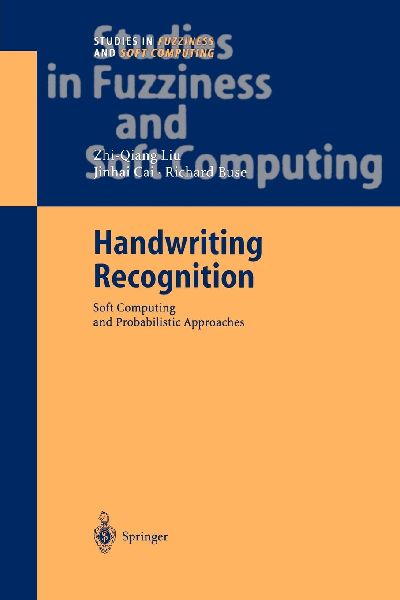
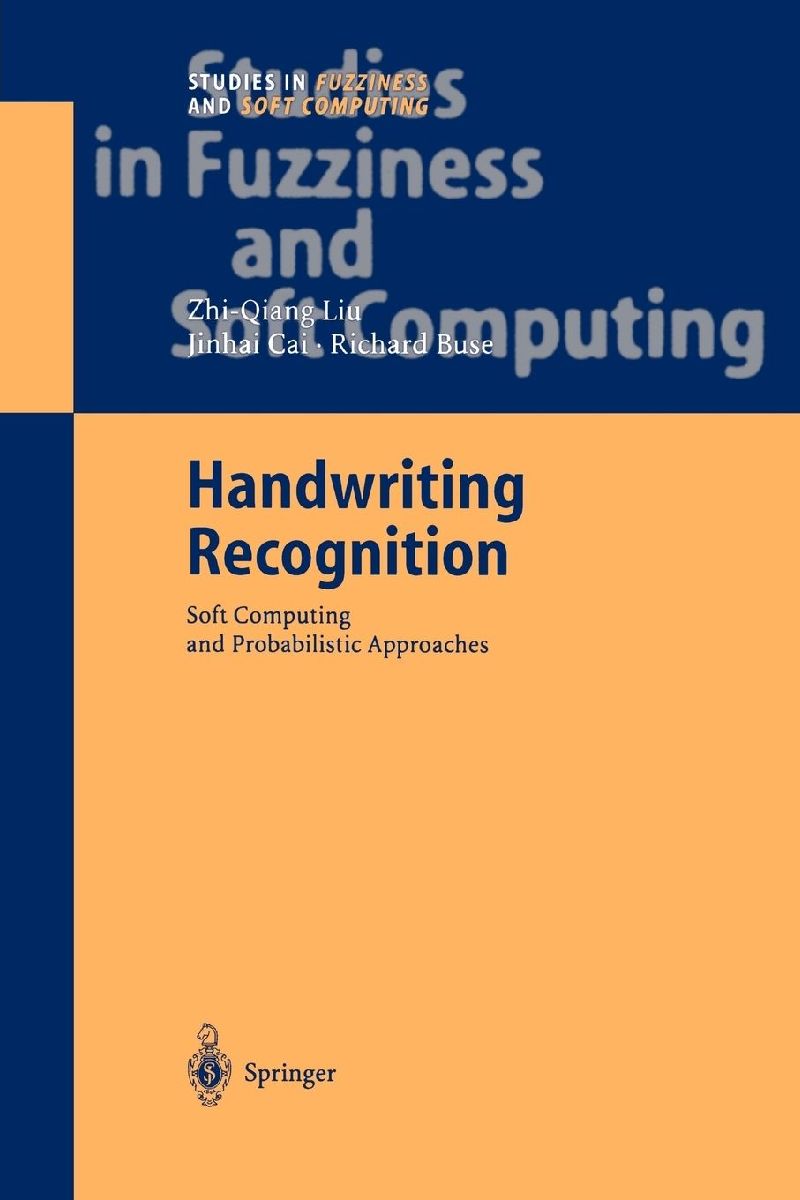
Handwriting Recognition
Soft Computing and Probabilistic Approaches
von Zhi-Qiang Liu, Jin-Hai Cai und Richard Buse
Aus der Reihe Studies in Fuzziness and Soft Computing
- Einband
- Kartoniert
- Seiten
- 252
- Sprache
- Englisch
- Erschienen
- Dezember 2010
- Verlag
- Springer
Buchbeschreibung
Over the last few decades, research on handwriting recognition has made impressive progress.
The research and development on handwritten word recognition are to a large degree motivated by many application areas, such as automated postal address and code reading, data acquisition in banks, text-voice conversion, security, etc.
Ganze Beschreibung lesenWeniger anzeigen
As the prices of scanners, com puters and handwriting-input devices are falling steadily, we have seen an increased demand for handwriting recognition systems and software pack ages.
Some commercial handwriting recognition systems are now available in the market. Current commercial systems have an impressive performance in recognizing machine-printed characters and neatly written texts. For in stance, High-Tech Solutions in Israel has developed several products for container ID recognition, car license plate recognition and package label recognition. Xerox in the U. S. has developed Text
Bridge for converting hardcopy documents into electronic document files. In spite of the impressive progress, there is still a significant perfor mance gap between the human and the machine in recognizing off-line unconstrained handwritten characters and words. The difficulties encoun tered in recognizing unconstrained handwritings are mainly caused by huge variations in writing styles and the overlapping and the interconnection of neighboring characters.
Furthermore, many applications demand very high recognition accuracy and reliability. For example, in the banking sector, although automated teller machines (ATMs) and networked banking sys tems are now widely available, many transactions are still carried out in the form of cheques.
Inhaltsverzeichnis
- Introduction
- Pre-processing and Feature Extraction
- Hidden Markov Model-Based Method for Recognizing Handwritten Digits
- Markov Models with Spectral Features for Handwritten Numeral Recognition
- Markov Random Field Model for Recognizing Handwritten Digits
- Markov Random Field Models for Recognizing Handwritten Words
- A Structural and Relational Approach to Handwritten Word Recognition
- Handwritten Word Recognition Using Fuzzy Logic
- Conclusion
Details
- Erscheinungstermin
- Dezember 2010
- Kategorie
- Fremdsprachige Bücher
- Einband
- Kartoniert
- Seiten
- 252
- Sprache
- Englisch
- Verlag
- Springer
- Reihe
- Studies in Fuzziness and Soft Computing
- Format
- 23,5 × 15,5 cm
- Dicke
- 1,4 cm
- Gewicht
- 388 g
- EAN / ISBN-13
- 9783642072802
Autorenporträt
Prof. Jia ZENG is currently working at the School of Computer Science and Technology, Soochow University, Suzhou 215006, China.
Mehr über die Autorin oder den AutorWeniger anzeigen
Before that, he was a Visiting Research Scholar with the Department of Computer Science, Hong Kong Baptist University from 2009 to 2010 and a Research Fellow in the Department of Electronic Engineering, City University of Hong Kong from 2006 to 2008. He obtained Ph. D. from School of Creative Media, City University of Hong Kong in October 2006, and B.Eng. with excellent academic honors at Wuhan University of Technology, China in 2002. His research interests have been mainly in the areas of type-2 fuzzy systems, probabilistic graphical models, pattern recognition and computational biology. He has authored and co-authored a number of publications appearing in high-profile journals and leading conferences. He won the 2006 Postgraduate Student Paper Contest, Second Prize, IEEE Region 10 and 2005 Postgraduate Student Paper Contest, First Prize, IEEE Region 10, respectively. He has also been invited to serve in a number of journals and conferences as the reviewer.
Prof Zhi-Qiang LIU received the M.A.Sc. degree in Aerospace Engineering from the Institute for Aerospace Studies, the University of Toronto, and the Ph. D. degree in Electrical Engineering from The University of Alberta, Canada. He is currently at the School of Creative Media, City University of Hong Kong. He has taught computer architecture, computer networks, artificial intelligence, programming languages, machine learning, pattern recognition, computer graphics, and art & technology. His interests are neural-fuzzy systems, machine learning, media computing and computer vision.
Versand und Rückgabe
Standardversand: 1 bis 3 Werktage, 3,99 €, kostenlos ab 35 €
Liefergebiet: Deutschland
Rücksendung: 14 Tage Widerrufsrecht. Bei einem Widerruf tragen Sie die Kosten der Rücksendung. Bei einer Falschlieferung oder einem Fehler von uns erstatten wir Ihnen das Rückporto. Den Widerruf erklären Sie über den Knopf „Vertrag widerrufen“ im Fuß der Seite.
Hersteller und ProduktsicherheitSpringer Nature Customer Service Center GmbH
Springer Nature Customer Service Center GmbH
Europaplatz 3
69115 Heidelberg
Deutschland
ProductSafety@springernature.com
Mehr aus der Reihe Studies in Fuzziness and Soft Computing


Fuzzy Logic, Smart Control, and the Future of Essential Oils
Zakiah Mohd Yusoff
Gebunden, Englisch
171,19 €


Ähnliche Titel
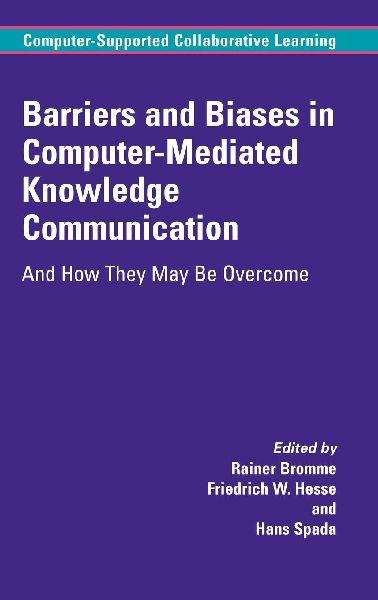
Barriers and Biases in Computer-Mediated Knowledge Communication
Rainer Bromme (Hrsg.)
Gebunden, Englisch, 2 Ausgaben
ab 160,49 €

Pedagogically Founded Courseware Generation for Web-Based Learning
Carsten Ullrich
Kartoniert, Englisch
53,49 €
Bewertungen
Zu diesem Titel gibt es noch keine Bewertung. Bewerten kann, wer ihn bei uns gekauft hat.
So prüfen wir Bewertungen
Eine Bewertung kann bei uns nur abgeben, wer den Titel über sein Kundenkonto bei uns gekauft hat. Jede Bewertung ist fest mit der zugehörigen Bestellung verknüpft; anders kommt sie technisch gar nicht zustande. Deshalb trägt jede angezeigte Bewertung den Hinweis „Verifizierter Kauf". Wir zeigen positive wie negative Bewertungen und löschen nur bei Rechtsverstößen. Für Bewertungen gibt es keine Gegenleistung.
106,99 €Voraussichtlich 2. bis 4. Dez.