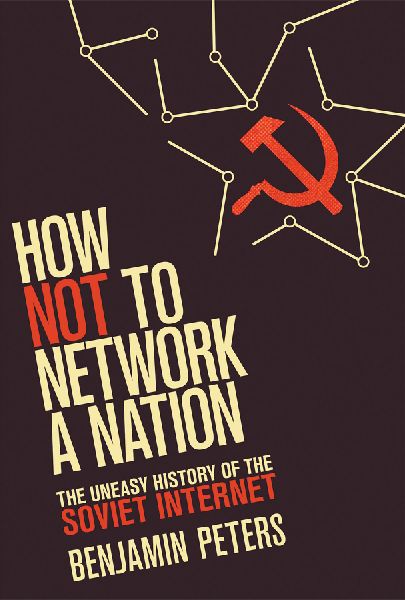
How Not to Network a Nation
The Uneasy History of the Soviet Internet
von Benjamin Peters
- Einband
- Kartoniert
- Seiten
- 314
- Sprache
- Englisch
- Erschienen
- September 2017
- Verlag
- MIT Press
Buchbeschreibung
How, despite thirty years of effort, Soviet attempts to build a national computer network were undone by socialists who seemed to behave like capitalists.
Between 1959 and 1989, Soviet scientists and officials made numerous attempts to network their nation—to construct a nationwide computer network. None of these attempts succeeded, and the enterprise had been abandoned by the time the Soviet Union fell apart.
Ganze Beschreibung lesenWeniger anzeigen
Meanwhile, ARPANET, the American precursor to the Internet, went online in 1969. Why did the Soviet network, with top-level scientists and patriotic incentives, fail while the American network succeeded?
In How Not to Network a Nation, Benjamin Peters reverses the usual cold war dualities and argues that the American ARPANET took shape thanks to well-managed state subsidies and collaborative research environments and the Soviet network projects stumbled because of unregulated competition among self-interested institutions, bureaucrats, and others.
The capitalists behaved like socialists while the socialists behaved like capitalists. After examining the midcentury rise of cybernetics, the science of self-governing systems, and the emergence in the Soviet Union of economic cybernetics, Peters complicates this uneasy role reversal while chronicling the various Soviet attempts to build a “unified information network.”
Drawing on previously unknown archival and historical materials, he focuses on the final, and most ambitious of these projects, the All-State Automated System of Management (OGAS), and its principal promoter, Viktor M. Glushkov.
Peters describes the rise and fall of OGAS—its theoretical and practical reach, its vision of a national economy managed by network, the bureaucratic obstacles it encountered, and the institutional stalemate that killed it. Finally, he considers the implications of the Soviet experience for today's networked world.
Details
- Erscheinungstermin
- September 2017
- Kategorie
- Fremdsprachige Bücher
- Einband
- Kartoniert
- Seiten
- 314
- Sprache
- Englisch
- Verlag
- MIT Press
- Format
- 22,9 × 15,2 cm
- Dicke
- 1,8 cm
- Gewicht
- 457 g
- EAN / ISBN-13
- 9780262534666
Über Benjamin Peters
Benjamin Peters is Associate Professor in the Department of Communication at the University of Tulsa and affiliated faculty at the Information Society Project at Yale Law School.
Versand und Rückgabe
Standardversand: 1 bis 3 Werktage, 3,99 €, kostenlos ab 35 €
Liefergebiet: Deutschland
Rücksendung: 14 Tage Widerrufsrecht. Bei einem Widerruf tragen Sie die Kosten der Rücksendung. Bei einer Falschlieferung oder einem Fehler von uns erstatten wir Ihnen das Rückporto. Den Widerruf erklären Sie über den Knopf „Vertrag widerrufen“ im Fuß der Seite.
Hersteller und ProduktsicherheitMIT Press
MIT Press
Europaallee 1
36244 Bad Hersfeld
Deutschland
gpsr@libri.de
Verantwortliche Person in der EU
Libri GmbHEuropaallee 1
36244 Bad Hersfeld
Deutschland
gpsr@libri.de
Ähnliche Titel




Bewertungen
Zu diesem Titel gibt es noch keine Bewertung. Bewerten kann, wer ihn bei uns gekauft hat.
So prüfen wir Bewertungen
Eine Bewertung kann bei uns nur abgeben, wer den Titel über sein Kundenkonto bei uns gekauft hat. Jede Bewertung ist fest mit der zugehörigen Bestellung verknüpft; anders kommt sie technisch gar nicht zustande. Deshalb trägt jede angezeigte Bewertung den Hinweis „Verifizierter Kauf". Wir zeigen positive wie negative Bewertungen und löschen nur bei Rechtsverstößen. Für Bewertungen gibt es keine Gegenleistung.
37,30 €Voraussichtlich 2. bis 4. Dez.