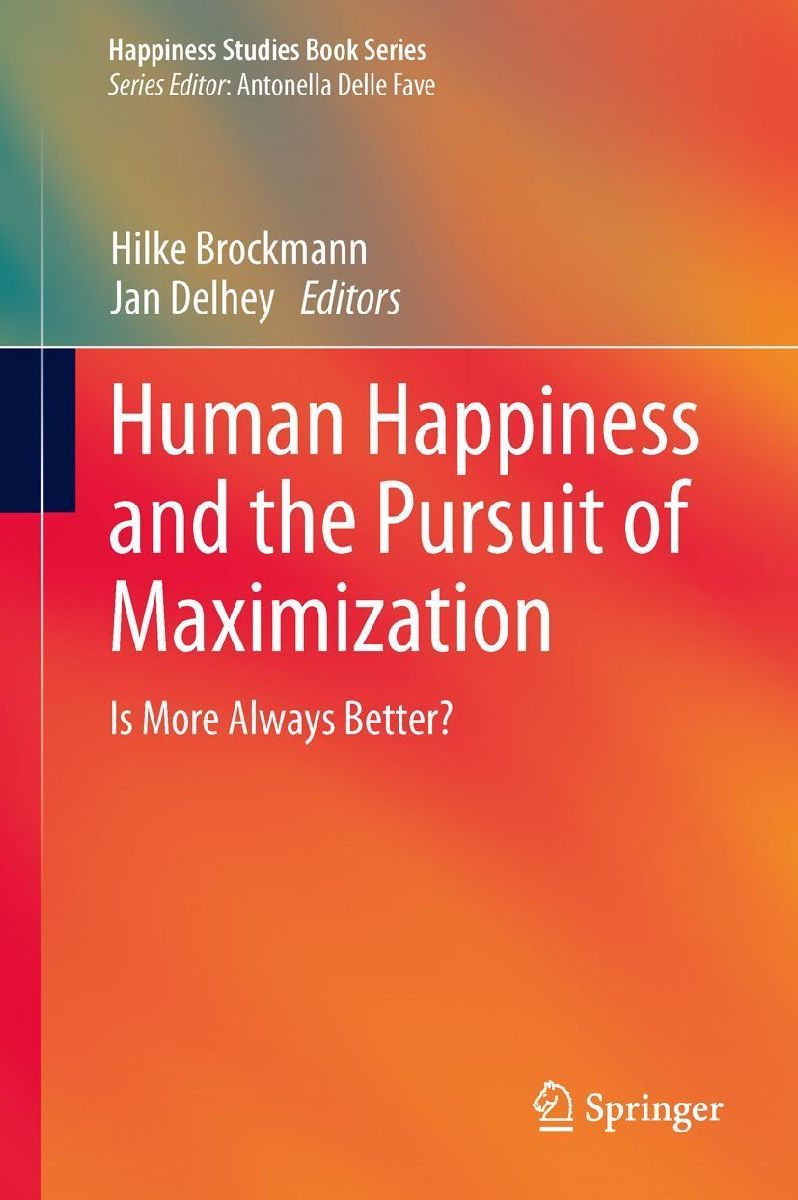
Human Happiness and the Pursuit of Maximization
Is More Always Better?
Herausgegeben von: Hilke Brockmann, Herausgegeben von: Jan Delhey
Aus der Reihe Happiness Studies Book Series
- Einband
- Gebunden
- Seiten
- 224
- Sprache
- Englisch
- Erschienen
- Juli 2013
- Verlag
- Springer Netherlands
Buchbeschreibung
This book tests the critical potential of happiness research to evaluate contemporary high-performance societies.
These societies, defined as affluent capitalist societies, emphasize competition and success both institutionally and culturally. Growing affluence improves life in many ways, for a large number of people. We lead longer, safer, and more comfortable lives than previous generations. But we also live faster, and are competition-toughened, like top athletes.
Ganze Beschreibung lesenWeniger anzeigen
As a result, we suspect limits and detect downsides of our high-speed lives. The ubiquitous maximization principle opens up a systematic gateway to the pleasures and pains of contemporary life. Using happiness as a reference point, this book explores the philosophical and empirical limits of the maximization rule.
It considers the answer to questions such as: Precisely, why did the idea of (economic) maximization gain so much ground in our Western way of thinking? When, and in which life domains, does maximization work, when does it fail? When do qualities and when do quantities matter? Does maximization yield a different (un)happiness dividend in different species, cultures, and societies? ¿
Inhaltsverzeichnis
- Chapter 1. Is More Always Better? An Introduction; Hilke Brockmann and Jan Delhey
- Chapter 2. When the Pursuit of More Backfires - The American Experiment; Peter Whybrow
- Chapter 3. More Nonsense and Less Happiness: The Unintended Effects of Artificial Competitions; Mathias Binswanger
- Chapter 4. Happiness by Maximization?; Kurt Bayertz
- Chapter 5. Maximization and the Good; Valerie Tiberius
- Chapter 6. How Wise is Mother Nature? Maximization, Optimization and Short-Sighted Resource Use in Biological Evolution; Hanna Kokko
- Chapter 7. Towards a Neuroscience of Well-being - Implications of Insights from Pleasure Research; Kent C. Berridge and Morten L. Kringelbach
- Chapter 8. From Treating Mental Dysfunction to Neuroenhancement; Michael Koch
Ganzes Inhaltsverzeichnis anzeigen (14 Einträge)Weniger anzeigen
- Chapter 9. Do Aspirations and Adaptation Impede the Maximization of Happiness?; Ulrich Schimmack and Hyunji Kim
- Chapter 10. My Car is Bigger than Yours. Consumption, Status Competition, and Happiness in Times of Affluence; Hilke Brockmann and Song Yan
- Chapter 11. Some Lessons from Happiness Economics for Environmental Sustainability; Heinz Welsch
- Chapter 12. Public Policy and Human Happiness: The Welfare State and the Market as Agents of Well-Being; Robert Davidson, Alexander C. Pacek, and Benjamin Radcliff
- Chapter 13 Should the State Care for the Happiness of Its Citizens?; Aloys Prinz
- Chapter 14. A "Happiness Test" for the New Measures of National Well-Being: How Much Better than GDP are they?; Jan Delhey and Christian Kroll
Details
- Erscheinungstermin
- Juli 2013
- Kategorie
- Fremdsprachige Bücher
- Einband
- Gebunden
- Seiten
- 224
- Sprache
- Englisch
- Verlag
- Springer Netherlands
- Reihe
- Happiness Studies Book Series
- Format
- 24,1 × 16,0 cm
- Dicke
- 1,7 cm
- Gewicht
- 454 g
- EAN / ISBN-13
- 9789400766082
Über Hilke Brockmann (Hrsg.)
Hilke Brockmann is a Professor of Sociology at Jacobs University, Bremen and an experienced expert in population aging and well-being research.
Mehr über Hilke Brockmann (Hrsg.)Weniger anzeigen
Her work deals with the individual and health related consequences of large-scale demographic, political and social changes. She has published in major international journals, is a member of the Editorial Board of Health Sociology Review, of several professional associations and an alumni of the Max Planck Society. She also counsels public health insurances, marketing boards, firms, and political parties. Jan Delhey, Professor of Sociology at Jacobs University, Bremen, is an internationally renowned expert in comparative quality of life research. He has published on living conditions, subjective well-being, trust, and social cohesion in leading European and international journals (his next piece of work on trust will appear in the American Sociological Review). He is a member of the Editorial Board of the Journal of Happiness Studies and member of the board of directors of the International Society for Quality-of-Life Studies. For the European Foundation for the Improvement of Living and Working Conditions he has worked as an expert advisor for European-wide social reporting. Contributor to the World Book of Happiness; numerous radio and newspaper interviews.
Versand und Rückgabe
Standardversand: 1 bis 3 Werktage, 3,99 €, kostenlos ab 35 €
Liefergebiet: Deutschland
Rücksendung: 14 Tage Widerrufsrecht. Bei einem Widerruf tragen Sie die Kosten der Rücksendung. Bei einer Falschlieferung oder einem Fehler von uns erstatten wir Ihnen das Rückporto. Den Widerruf erklären Sie über den Knopf „Vertrag widerrufen“ im Fuß der Seite.
Hersteller und ProduktsicherheitSpringer Nature Customer Service Center GmbH
Springer Nature Customer Service Center GmbH
Europaplatz 3
69115 Heidelberg
Deutschland
ProductSafety@springernature.com
Mehr aus der Reihe Happiness Studies Book Series
Humanistic Perspectives in Happiness Research
Luísa Magalhães (Hrsg.)
Gebunden, Englisch, 2 Ausgaben
ab 149,79 €
Metrics of Subjective Well-Being: Limits and Improvements
Gaël Brulé (Hrsg.)
Kartoniert, Englisch, 2 Ausgaben
ab 96,29 €
Well-Being in Contemporary Society
Johnny H. Søraker (Hrsg.)
Gebunden, Englisch, 2 Ausgaben
ab 106,99 €
Ähnliche Titel




Bewertungen
Zu diesem Titel gibt es noch keine Bewertung. Bewerten kann, wer ihn bei uns gekauft hat.
So prüfen wir Bewertungen
Eine Bewertung kann bei uns nur abgeben, wer den Titel über sein Kundenkonto bei uns gekauft hat. Jede Bewertung ist fest mit der zugehörigen Bestellung verknüpft; anders kommt sie technisch gar nicht zustande. Deshalb trägt jede angezeigte Bewertung den Hinweis „Verifizierter Kauf". Wir zeigen positive wie negative Bewertungen und löschen nur bei Rechtsverstößen. Für Bewertungen gibt es keine Gegenleistung.
106,99 €Voraussichtlich 7. bis 9. Dez.