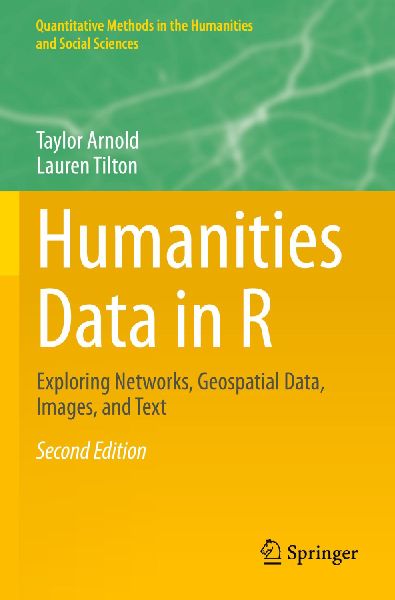
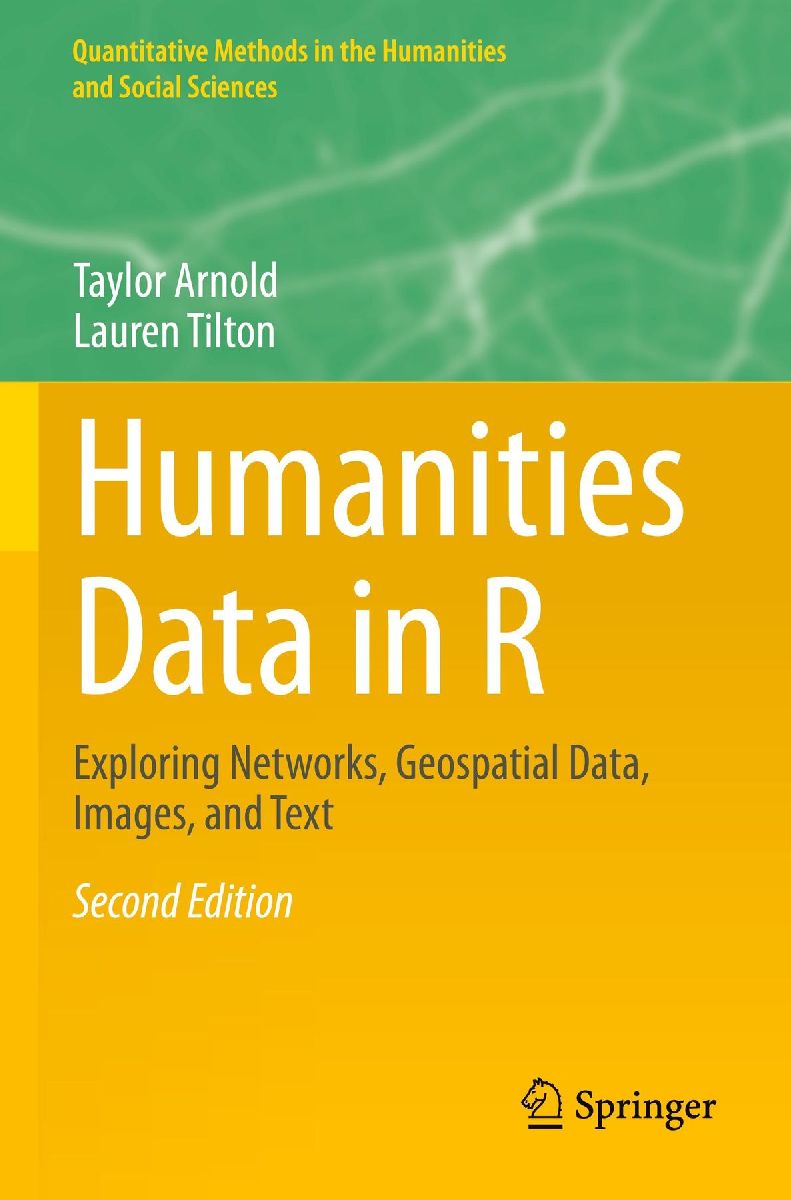
Humanities Data in R
Exploring Networks, Geospatial Data, Images, and Text
von Taylor Arnold und Lauren Tilton
Aus der Reihe Quantitative Methods in the Humanities and Social Sciences
- Einband
- Kartoniert
- Seiten
- 300
- Sprache
- Englisch
- Erschienen
- Juli 2025
- Verlag
- Springer
Buchbeschreibung
This book teaches readers to integrate data analysis techniques into humanities research practices using the R programming language.
Methods for general-purpose visualization and analysis are introduced first, followed by domain-specific techniques for working with networks, text, geospatial data, temporal data, and images. The book is designed to be a bridge between quantitative and qualitative methods, individual and collaborative work, and the humanities and social sciences.
Ganze Beschreibung lesenWeniger anzeigen
The second edition of the text is a significant revision, with almost every aspect of the text rewritten in some way. The most notable difference is the incorporation of new R packages such as ggplot2 and dplyr that center broad data-science concepts.
This 2nd edition of Humanities Data with R does not presuppose background programming experience. Early chapters take readers from R set-up to exploratory data analysis, with one chapter dedicated to each stage of the data-science pipeline (data collection, visualization, manipulation, and relational joins).
Following this, text analysis, networks, temporal data, geospatial data, and image analysis each have a dedicated chapter. These are grounded in examples to move readers beyond the intimidation of adding new tools to their research. The final section of the book extends the core material with additional computer science techniques for processing large datasets.
Everything is hands-on: image analysis is explained using digitized photographs from the 1930s, and networks are applied to page links on Wikipedia. After working through these examples with the provided data, code and book website, readers are prepared to apply new methods to their own work.
The open source R programming language, with its myriad packages and popularity within the sciences and social sciences, is particularly well-suited to working with humanities data. R packages are also highlighted in an appendix.
The methodology will have wide application in classrooms and self-study for the humanities, but also for use in linguistics, anthropology, and political science. Outside the classroom, this intersection of humanities and computing is particularly relevant for research and new modes of dissemination across archives, museums and libraries.
Inhaltsverzeichnis
- Part I Core
- Working with Data in R
- EDA I: Grammar of Graphics
- EDA II: Organizing Data
- EDA III: Restructuring Data
- Collecting Data
- Part II Data Types
- Textual Data
- Network Data
- Temporal Data
- Spatial Data
- Image Data
Ganzes Inhaltsverzeichnis anzeigen (15 Einträge)Weniger anzeigen
- Part III Additional Methods
- Programming in R
- Data Formats
Details
- Erscheinungstermin
- Juli 2025
- Kategorie
- Fremdsprachige Bücher
- Einband
- Kartoniert
- Seiten
- 300
- Sprache
- Englisch
- Verlag
- Springer
- Reihe
- Quantitative Methods in the Humanities and Social Sciences
- Format
- 23,5 × 15,5 cm
- Dicke
- 1,7 cm
- Gewicht
- 458 g
- EAN / ISBN-13
- 9783031625688
Über Taylor Arnold
Taylor Arnold is Professor of Data Science & Statistics at the University of Richmond and affiliated faculty in the interdisciplinary programs in linguistics and cognitive science.
Mehr über Taylor ArnoldWeniger anzeigen
His research applies and develops corpus-based techniques and software to study how messages are communicated through visual and multimodal forms. Arnold is the co-author of four books: Humanities Data in R: Exploring Networks, Geospatial Data, Images and Texts (Springer, 2015), A Computational Approach to Statistical Learning (CRC Press, 2019), Layered Lives (Stanford University Press, 2022), and Distant Viewing: Analyzing Visual Culture at Scale (MIT Press, 2023).Lauren Tilton is the E. Claiborne Robins Professor of Liberal Arts and Digital Humanities in the Department of Rhetoric and Communication Studies at the University of Richmond. Her research focuses on 20th and 21st century U.S. visual culture. She is director of Photogrammar, a digital public humanities project mapping New Deal and World War II documentary expression funded by the ACLS and NEH, and author of Humanities Data in R: Exploring Networks, Geospatial Data, Images and Texts (Springer, 2015), Layered Lives (Stanford University Press, 2022), and Distant Viewing: Analyzing Visual Culture at Scale (MIT Press, 2023). Her scholarship has appeared in journals such as American Quarterly, Archive Journal, Digital Humanities Quarterly, and Digital Scholarship in the Humanities. She is the co-editor of Computational Humanities (Debates in the Digital Humanities), currently in production with the University of Minnesota Press.
Versand und Rückgabe
Standardversand: 1 bis 3 Werktage, 3,99 €, kostenlos ab 35 €
Liefergebiet: Deutschland
Rücksendung: 14 Tage Widerrufsrecht. Bei einem Widerruf tragen Sie die Kosten der Rücksendung. Bei einer Falschlieferung oder einem Fehler von uns erstatten wir Ihnen das Rückporto. Den Widerruf erklären Sie über den Knopf „Vertrag widerrufen“ im Fuß der Seite.
Hersteller und ProduktsicherheitSpringer Nature Customer Service Center GmbH
Springer Nature Customer Service Center GmbH
Europaplatz 3
69115 Heidelberg
Deutschland
ProductSafety@springernature.com
Mehr aus der Reihe Quantitative Methods in the Humanities and Social Sciences
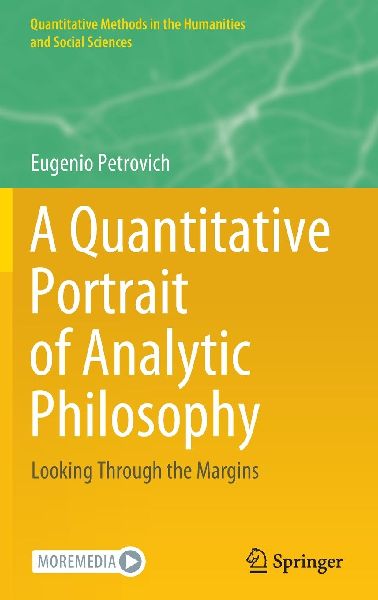
A Quantitative Portrait of Analytic Philosophy
Eugenio Petrovich
Gebunden, Englisch, 2 Ausgaben
ab 117,69 €

Bewertungen
Zu diesem Titel gibt es noch keine Bewertung. Bewerten kann, wer ihn bei uns gekauft hat.
So prüfen wir Bewertungen
Eine Bewertung kann bei uns nur abgeben, wer den Titel über sein Kundenkonto bei uns gekauft hat. Jede Bewertung ist fest mit der zugehörigen Bestellung verknüpft; anders kommt sie technisch gar nicht zustande. Deshalb trägt jede angezeigte Bewertung den Hinweis „Verifizierter Kauf". Wir zeigen positive wie negative Bewertungen und löschen nur bei Rechtsverstößen. Für Bewertungen gibt es keine Gegenleistung.
74,89 €Voraussichtlich 1. bis 3. Dez.