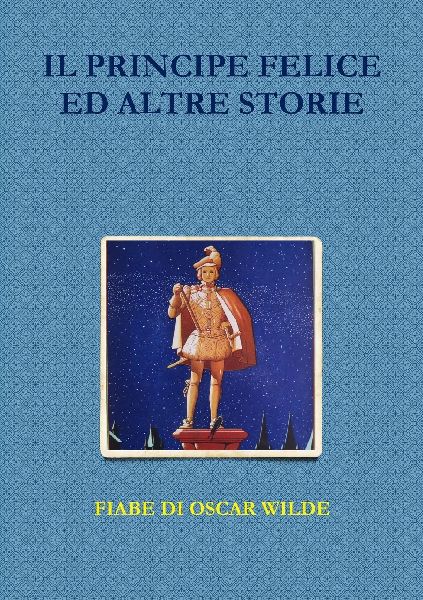
Il Principe Felice ed Altre Storie
von Oscar Wilde
- Einband
- Kartoniert
- Seiten
- 140
- Sprache
- Italienisch
- Erschienen
- August 2015
- Verlag
- Lulu.com
Buchbeschreibung
IL PRINCIPE FELICE ED ALTRE STORIE Fiabe di Oscar Wilde Titolo originale: The Happy Prince and Other Tales 5 FIABE INCLUSE IL PRINCIPE FELICE L'USIGNOLO E LA ROSA IL GIGANTE EGOISTA L'AMICO DEVOTO IL RAZZO ECCEZIONALE
Details
- Erscheinungstermin
- August 2015
- Kategorie
- Fremdsprachige Bücher
- Einband
- Kartoniert
- Seiten
- 140
- Sprache
- Italienisch
- Verlag
- Lulu.com
- Format
- 21,0 × 14,8 cm
- Dicke
- 0,8 cm
- Gewicht
- 192 g
- EAN / ISBN-13
- 9781329436169
Über Oscar Wilde
The Decay of Lying: An Observation By Oscar Wilde"The Decay of Lying - An Observation" is an essay by Oscar Wilde included in his collection of essays titled Intentions, published in 1891.
Mehr über Oscar WildeWeniger anzeigen
This is a significantly revised version of the article that first appeared in the January 1889 issue of The Nineteenth Century.
Wilde presents the essay in a Socratic dialogue between with Vivian and Cyril, two characters named after his own sons. Their conversation, though playful and whimsical, promotes Wilde's view of Romanticism over Realism. Vivian tells Cyril of an article he has been writing called "The Decay Of Lying: A Protest". According to Vivian, the decay of Lying "as an art, a science, and a social pleasure" is responsible for the decline of modern literature, which is excessively concerned with the representation of facts and social reality. He writes, "if something cannot be done to check, or at least to modify, our monstrous worship of facts, Art will become sterile and beauty will pass away from the land." Moreover, Vivian defends the idea that Life imitates Art far more than vice versa. Nature, he argues, is no less an imitation of Art than Life. Vivian also contends that Art is never representative of a time or place: rather, "the highest art rejects the burden of the human spirit [...] She develops purely on her own lines. She is not symbolic of any age." Vivian thus defends Aestheticism and the concept of "art for art's sake". At Cyril's behest, Vivian briefly summarizes the doctrines of the "new aesthetics" in the following terms:
Art never expresses anything but itself.
All bad art comes from returning to Life and Nature, and elevating them into ideals.
Life imitates Art far more than Art imitates Life. It follows as a corollary that external Nature also imitates Art.
Lying, the telling of beautiful untrue things, is the proper aim of Art.
The essay ends with the two characters going outside, as Cyril asked Vivian to do at the beginning of the essay. Vivian finally complies, saying that twilight nature's "chief use" may be to "illustrate quotations from the poets."As Michèle Mendelssohn points out, "in an era when sociology was still in its infancy, psychology wasn't yet a discipline, and theories of performativity were still a long way off, Wilde's essay touched on a profound truth about human behaviour in social situations. The laws of etiquette governing polite society were, in fact, a mask. Tact was merely an elaborate art of impression management."
Versand und Rückgabe
Standardversand: 1 bis 3 Werktage, 3,99 €, kostenlos ab 35 €
Liefergebiet: Deutschland
Rücksendung: 14 Tage Widerrufsrecht. Bei einem Widerruf tragen Sie die Kosten der Rücksendung. Bei einer Falschlieferung oder einem Fehler von uns erstatten wir Ihnen das Rückporto. Den Widerruf erklären Sie über den Knopf „Vertrag widerrufen“ im Fuß der Seite.
Hersteller und ProduktsicherheitLulu.com
Lulu.com
Europaallee 1
36244 Bad Hersfeld
Deutschland
gpsr@libri.de
Verantwortliche Person in der EU
Libri GmbHEuropaallee 1
36244 Bad Hersfeld
Deutschland
gpsr@libri.de
Mehr von Oscar Wilde
Ähnliche Titel
Manuale di urbanistica, impiantistica e sicurezza degli edifici
Piero Antonio Esposito
Kartoniert, Italienisch
62,90 €
Bewertungen
Zu diesem Titel gibt es noch keine Bewertung. Bewerten kann, wer ihn bei uns gekauft hat.
So prüfen wir Bewertungen
Eine Bewertung kann bei uns nur abgeben, wer den Titel über sein Kundenkonto bei uns gekauft hat. Jede Bewertung ist fest mit der zugehörigen Bestellung verknüpft; anders kommt sie technisch gar nicht zustande. Deshalb trägt jede angezeigte Bewertung den Hinweis „Verifizierter Kauf". Wir zeigen positive wie negative Bewertungen und löschen nur bei Rechtsverstößen. Für Bewertungen gibt es keine Gegenleistung.
15,70 €Voraussichtlich 3. bis 7. Dez.