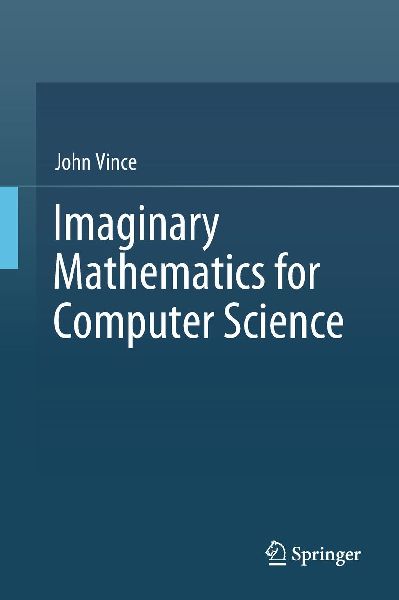
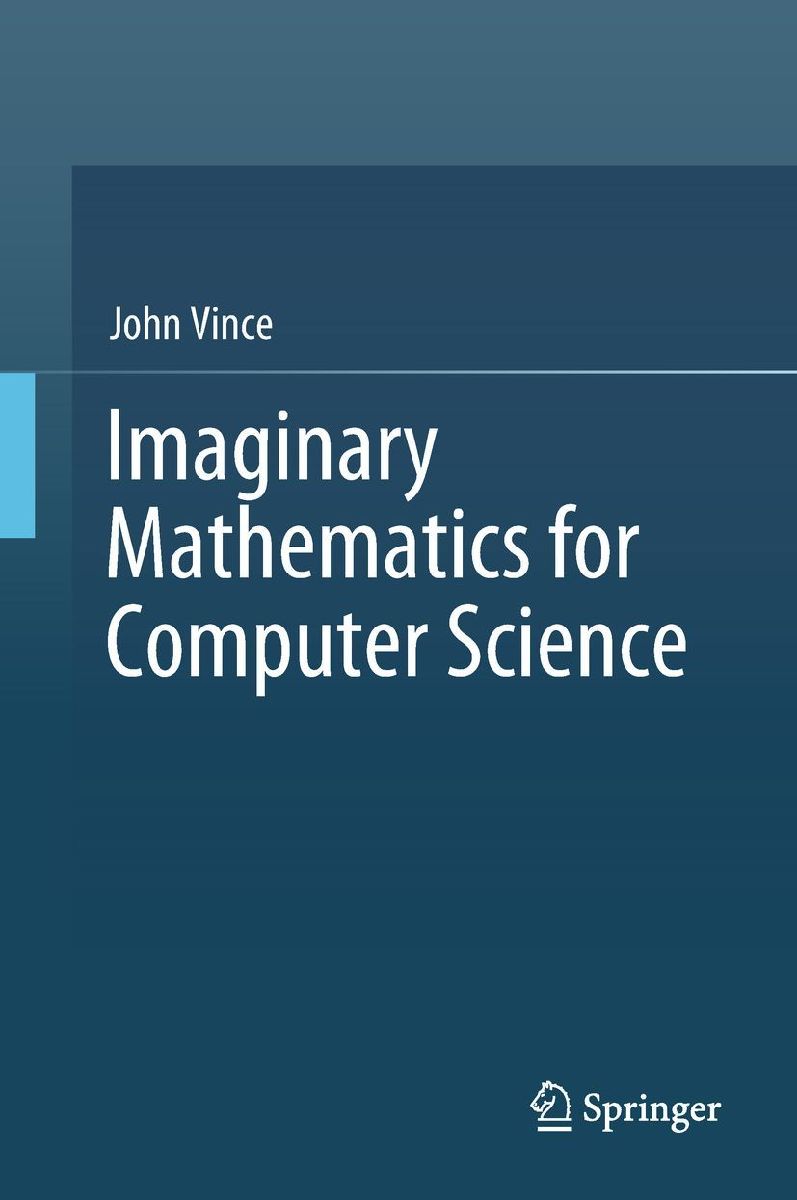
Imaginary Mathematics for Computer Science
von John Vince
- Einband
- Gebunden
- Sprache
- Englisch
- Erschienen
- September 2018
- Verlag
- Springer
Buchbeschreibung
The imaginary unit i = ¿-1 has been used by mathematicians for nearly five-hundred years, during which time its physical meaning has been a constant challenge.
Unfortunately, René Descartes referred to it as "imaginary", and the use of the term "complex number" compounded the unnecessary mystery associated with this amazing object.
Ganze Beschreibung lesenWeniger anzeigen
Today, i = ¿-1 has found its way into virtually every branch of mathematics, and is widely employed in physics and science, from solving problems in electrical engineering to quantum field theory.
John Vince describes the evolution of the imaginary unit from the roots of quadratic and cubic equations, Hamilton's quaternions, Cayley's octonions, to Grassmann's geometric algebra. In spite of the aura of mystery that surrounds the subject, John Vince makes the subject accessible and very readable. The first two chapters cover the imaginary unit and its integration with real numbers.
Chapter 3 describes how complex numbers work with matrices, and shows how to compute complex eigenvalues and eigenvectors. Chapters 4 and 5 cover Hamilton's invention of quaternions, and Cayley's development of octonions, respectively. Chapter 6 provides a brief introduction to geometric algebra, which possesses many of the imaginary qualities of quaternions, but works in space of any dimension.
The second half of the book is devoted to applications of complex numbers, quaternions and geometric algebra. John Vince explains how complex numbers simplify trigonometric identities, wave combinations and phase differences in circuit analysis, and how geometric algebra resolves geometric problems, and quaternions rotate 3D vectors.
There are two short chapters on the Riemann hypothesis and the Mandelbrot set, both of which use complex numbers. The last chapter references the role of complex numbers in quantum mechanics, and ends with Schrödinger's famous wave equation. Filled with lots of clear examples and useful illustrations, this compact book provides an excellent introduction to imaginary mathematics for computer science.
Inhaltsverzeichnis
- Introduction
- Complex Numbers
- Matrix Algebra
- Quaternions
- Octonions
- Geometric Algebra
- Trigonometric Identities using Complex Numbers
- Combining Waves using Complex Numbers
- Circuit Analysis using Complex Numbers
- Geometry Using Geometric Algebra
- Rotating Vectors using Quaternions
- Complex Numbers and the Riemann Hypothesis
Ganzes Inhaltsverzeichnis anzeigen (15 Einträge)Weniger anzeigen
- The Mandelbrot Set
- Conclusion
- Index
Details
- Erscheinungstermin
- September 2018
- Kategorie
- Fremdsprachige Bücher
- Einband
- Gebunden
- Sprache
- Englisch
- Verlag
- Springer
- Format
- 24,1 × 16,0 cm
- Dicke
- 2,2 cm
- Gewicht
- 653 g
- EAN / ISBN-13
- 9783319946368
Über John Vince
Professor John Vince began working in computer graphics at Middlesex Polytechnic in 1968. His research activities centered on computer animation software and resulted in the PICASO and PRISM animation systems.
Mehr über John VinceWeniger anzeigen
Whilst at Middlesex, he designed the UK's first MSc course in Computer Graphics and developed a popular program of short courses in computer animation for television designers. In 1986 he joined Rediffusion Simulation as a Research Consultant and worked on the development of real-time computer systems for commercial flight simulators. In 1992 he was appointed Chief Scientist of Thomson Training Simulation Ltd. In 1995 he was appointed Professor of Digital Media at the National Centre for Computer Animation at Bournemouth University and in 1999 he was made Head of Academic Group for Computer Animation. He was awarded a DSc by Brunel University in recognition of his work in computer graphics. He has written and edited over 40 books on computer graphics, computer animation and virtual reality, including the following Springer titles:
Mathematics for Computer Graphics (2014) ¿ Calculus for Computer Graphics (2013)
Matrix Transforms for Computer Games and Animation (2012)
Expanding the Frontiers of Visual Analytics and Visualization (2012)
Quaternions for Computer Graphics (2011)
Rotation Transforms for Computer Graphics (2011)
Versand und Rückgabe
Standardversand: 1 bis 3 Werktage, 3,99 €, kostenlos ab 35 €
Liefergebiet: Deutschland
Rücksendung: 14 Tage Widerrufsrecht. Bei einem Widerruf tragen Sie die Kosten der Rücksendung. Bei einer Falschlieferung oder einem Fehler von uns erstatten wir Ihnen das Rückporto. Den Widerruf erklären Sie über den Knopf „Vertrag widerrufen“ im Fuß der Seite.
Hersteller und ProduktsicherheitSpringer Nature Customer Service Center GmbH
Springer Nature Customer Service Center GmbH
Europaplatz 3
69115 Heidelberg
Deutschland
ProductSafety@springernature.com
Mehr von John Vince
Ähnliche Titel


Studies in Theoretical and Applied Statistics
Nicola Salvati (Hrsg.)
Gebunden, Englisch, 2 Ausgaben
ab 246,09 €
Bewertungen
Zu diesem Titel gibt es noch keine Bewertung. Bewerten kann, wer ihn bei uns gekauft hat.
So prüfen wir Bewertungen
Eine Bewertung kann bei uns nur abgeben, wer den Titel über sein Kundenkonto bei uns gekauft hat. Jede Bewertung ist fest mit der zugehörigen Bestellung verknüpft; anders kommt sie technisch gar nicht zustande. Deshalb trägt jede angezeigte Bewertung den Hinweis „Verifizierter Kauf". Wir zeigen positive wie negative Bewertungen und löschen nur bei Rechtsverstößen. Für Bewertungen gibt es keine Gegenleistung.
85,59 €Voraussichtlich 3. bis 7. Dez.