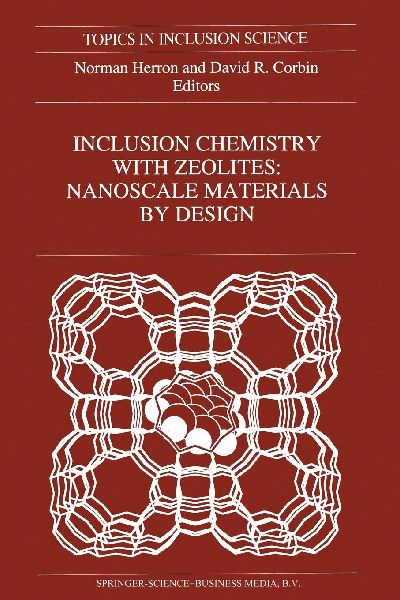
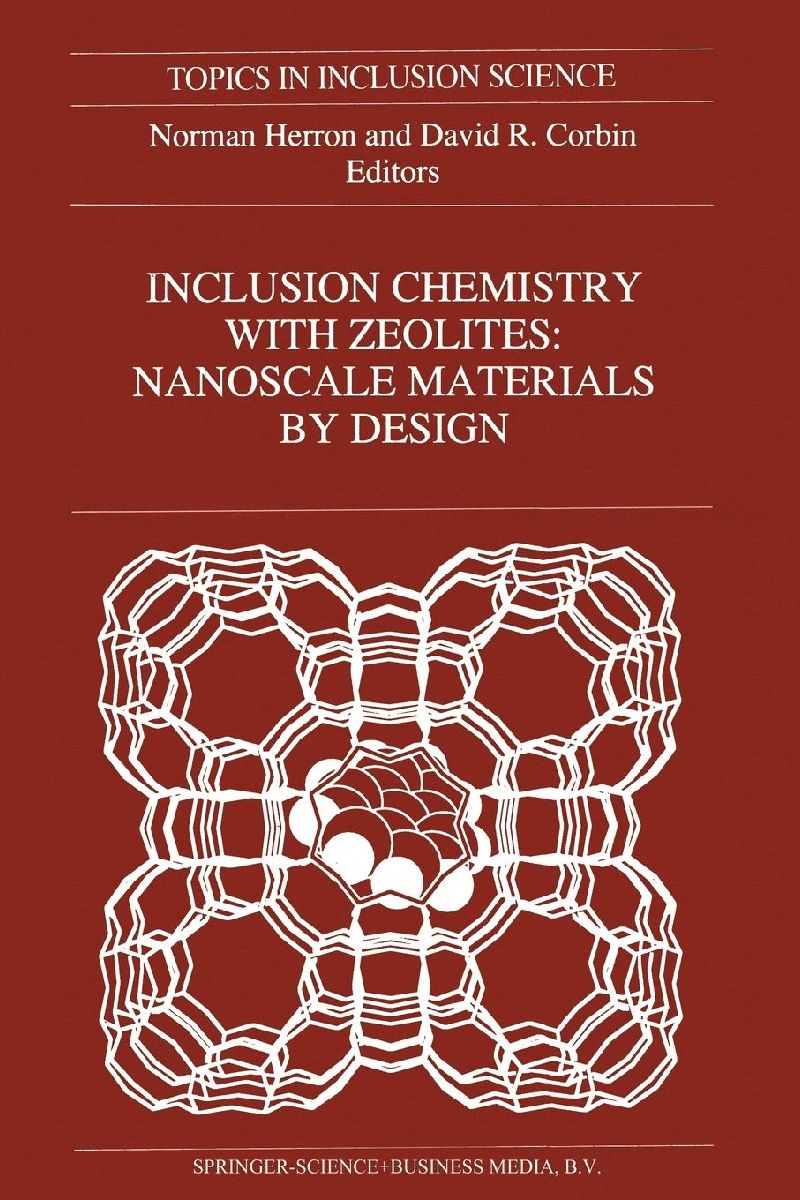
Inclusion Chemistry with Zeolites: Nanoscale Materials by Design
Herausgegeben von: D. R. Corbin, Herausgegeben von: N. Herron
Aus der Reihe Topics in Inclusion Science
- Einband
- Kartoniert
- Seiten
- 360
- Sprache
- Englisch
- Erschienen
- Oktober 2012
- Verlag
- Springer
Buchbeschreibung
Zeolites, with their crystalline microporous structures, are cordial hosts to a wide variety of guests.
However, it was the abrupt and unexpected departure of one of these guests (water) from a host (stilbite) on heating which led Cronstedt, in 1756, to coin the term "zeolite" (from the Greek meaning "boiling stone") to describe this material. Since that time, approximately 40 different naturally-occurring zeolites have been discovered on earth.
Ganze Beschreibung lesenWeniger anzeigen
Recent studies of meteorite compositions have shown that these guest-host materials (e. g. , sodalite) occur in other parts of the universe as well. However, it wasn't until the twentieth century that synthetic routes to zeolites and other non-aluminosilicate molecular sieves were discovered. In addition, with the development of X-ray diffraction and the various spectroscopies, better understanding of the nature of the cavities, cages, and channels of these materials has led to the industrial exploitation of their guest-host properties.
The world of zeolites has now expanded into a greater than 2 billion pound per year business, with major applications in detergent formulations, catalysis, and as adsorbents and desiccants. Their economic impact is difficult to determine; however, the improvement in gasoline yields alone (from catalytic cracking) must account for hundreds ofbillions ofdollars in increased GDP.
In this volume, we have brought together a sampling of recent developments in various areas of guest-host or inclusion chemistry in zeolites.
Inhaltsverzeichnis
- 1. Probing intrazeolite space
- 1. Introduction
- 2. Considerations
- 3. Characteristic absorption values for zeolite rho
- 4. Distortion of the zeolite rho lattice
- 5. Comparison of rho with other 8-ring zeolites
- 6. Characterization of ZSM-5 by sorption measurements
- 7. Quantitative aspects of adsorption measurements
Ganzes Inhaltsverzeichnis anzeigen (70 Einträge)Weniger anzeigen
- 8. Catalysis and reactions using molecular sieves as supports
- 9. Summary and conclusions
- 2. Structure-direction in zeolite synthesis
- 1. Introduction
- 2. Clathrasils
- 3. Thermochemical stability of high-silica zeolites
- 4. Kinetics of zeolite crystallization
- 5. Pure-silica large-pore materials
- 6. Heteroatoms and the structure-directing effect of organic molecules
- 7. Examples of structure-direction
- 8. Summary
- 3. Structural case studies of inclusion phenomena in zeolites: Xe in RHO and stilbene in ZSM-5
- 1. Introduction
- 2. Xenon in zeolite rho
- 3. Stilbene in ZSM-5
- 4. Zeolite-included molecules studied by NMR
- 1. Introduction
- 2. Effect of exchange in NMR spectroscopy
- 3. Xenon in zeolites
- 4. Deuterium-containing aromatics in zeolites
- 5. Summary
- 5. Absorbed molecules in microporous hosts: computational aspects
- 1. Introduction
- 2. Theoretical techniques
- 3. Examples
- 4. Conclusions
- 6. Zeolite encapsulated metal complexes
- 1. Introduction
- 2. Synthesis of zeolite encapsulated complexes
- 3. Characterization of intrazeolite complexes
- 4. Reactivity
- 5. Future trends
- 7. Coordination chemistry in zeolites
- 1. Introduction
- 2. Synthesis of complexes in zeolites
- 3. Coordination of transition metal ions with monodentate ligands
- 4. Coordination of transition metal ions with bi-or polydentate ligands
- 5. Conclusions
- 8. Zeolite guest-host interactions: implications in formation, catalysis, and photochemistry
- 1. Introduction
- 2. Entrapment as a monitor for zeolite assembly
- 3. Entrapment of organometallic complexes in zeolite Y cages
- 9. Photochemistry of organic molecules within zeolites: role of cations
- 1. Introduction
- 2. Zeolite cavities viewed as nanoscopic reaction vessels
- 3. Cation-guest interaction: light-atom effect
- 4. Cation-guest interaction: heavy-atom effect
- 5. Cation-guest interaction: acid-base interaction
- 6. Cations as reaction cavity free volume controllers: Lebensraum effect
- 7. Role of hydrated cations
- 8. Summary
- 10. Zeolites as hosts for novel optical and electronic materials
- 1. Introduction
- 2. Metal clusters in zeolites
- 3. Semiconductors in zeolites
- 4. Conducting polymers in zeolites
- 5. Summary and prospects
- 11. Alkali-metal clusters as prototypes for electron solvation in zeolites
- 1. Introduction
- 2. Methods for the preparation of alkali-metal clusters
- 3. Spectroscopic properties of alkali-metal clusters and what they tell us about them
- 4. Prospects for the future
Details
- Erscheinungstermin
- Oktober 2012
- Kategorie
- Fremdsprachige Bücher
- Einband
- Kartoniert
- Seiten
- 360
- Sprache
- Englisch
- Verlag
- Springer
- Reihe
- Topics in Inclusion Science
- Format
- 24,0 × 16,0 cm
- Dicke
- 2,0 cm
- Gewicht
- 575 g
- EAN / ISBN-13
- 9789401040570
Versand und Rückgabe
Standardversand: 1 bis 3 Werktage, 3,99 €, kostenlos ab 35 €
Liefergebiet: Deutschland
Rücksendung: 14 Tage Widerrufsrecht. Bei einem Widerruf tragen Sie die Kosten der Rücksendung. Bei einer Falschlieferung oder einem Fehler von uns erstatten wir Ihnen das Rückporto. Den Widerruf erklären Sie über den Knopf „Vertrag widerrufen“ im Fuß der Seite.
Hersteller und ProduktsicherheitSpringer Nature Customer Service Center GmbH
Springer Nature Customer Service Center GmbH
Europaplatz 3
69115 Heidelberg
Deutschland
ProductSafety@springernature.com
Mehr aus der Reihe Topics in Inclusion Science

Spectroscopic and Computational Studies of Supramolecular Systems
J. E. Davies (Hrsg.)
Gebunden, Englisch, 2 Ausgaben
ab 160,49 €
Ähnliche Titel
Transformation of Organometallics into Common and Exotic Materials: Design and Activation
R. M. Laine (Hrsg.)
Kartoniert, Englisch, 2 Ausgaben
ab 53,49 €


Metallocorroles for Attenuation of Atherosclerosis
Adi Haber
Gebunden, Englisch, 2 Ausgaben
ab 106,99 €
Bewertungen
Zu diesem Titel gibt es noch keine Bewertung. Bewerten kann, wer ihn bei uns gekauft hat.
So prüfen wir Bewertungen
Eine Bewertung kann bei uns nur abgeben, wer den Titel über sein Kundenkonto bei uns gekauft hat. Jede Bewertung ist fest mit der zugehörigen Bestellung verknüpft; anders kommt sie technisch gar nicht zustande. Deshalb trägt jede angezeigte Bewertung den Hinweis „Verifizierter Kauf". Wir zeigen positive wie negative Bewertungen und löschen nur bei Rechtsverstößen. Für Bewertungen gibt es keine Gegenleistung.
53,49 €Voraussichtlich 1. bis 3. Dez.