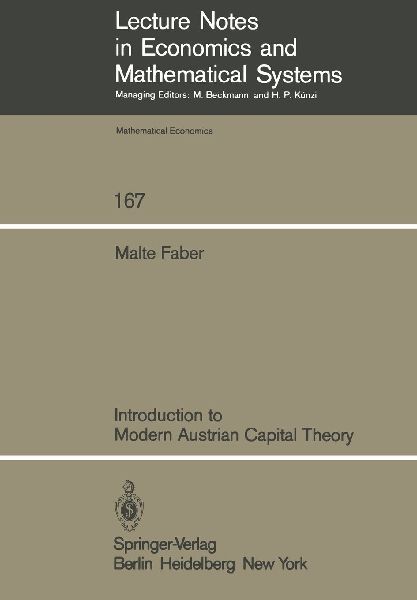
Introduction to Modern Austrian Capital Theory
von Malte Faber
Aus der Reihe Lecture Notes in Economics and Mathematical Systems
- Einband
- Kartoniert
- Seiten
- 212
- Sprache
- Englisch
- Erschienen
- März 1979
- Verlag
- Springer
Buchbeschreibung
During the fifties and the sixties the neoclassical concept of the production function was criticized in numerous papers.
In particular, the aggregation of different capital goods into a single number was reprehended. A second essential disadvantage, namely the neglect of the time structure of the production process, found, however, rela tively little attention.
Ganze Beschreibung lesenWeniger anzeigen
While up to the thirties the Austrian capital theory which stressed the time aspect of production was an important school, it fell into oblivion after the great capital controversies of the thirties.
It took over thirty years, i. e. till the beginning of the seventies be fore it came to a renaissance of the Austrian capital theory by var ious writers. We may roughly classify the different attempts of Hits rebirth in modern economics" into three groups: 1. The approach of ~ [1970, 1973, 1973a] has received most of the attention in the literature (Burmeister [1974], Faber [1975], Fehl [1975], ~[1975], Hagemann and ~ [1976]). It will be shown in Chapter 9 that ~ is only in so far a Neo-Austrian as he does explicitly take into consideration the vertical time structure of the production process. But he does not use the Austrian concepts of superiority of roundabout methods, of time preference and of the period of production. 2. The latter concept has been revived by the second group, to which Tintner [1970], von Weizs~cker [1971a, 1971b, 1974], ~ [1971, 1976 and ~ [1973, 1975, 1976] belong.
Inhaltsverzeichnis
- I: Austrian Capital Theory and the von Neumann-Model
- 1. Introduction
- 2. The Austrian Theory of Interest
- 3. The von Neumann-Model and its Relations to Austrian Capital and Interest Theory
- II: Modern Austrian Capital Theory
- 4. A Two-Period Two-Sector Neo-Austrian Model
- 5. A Multiperiod Two-Sector Model
- 6. A Multisector Model
Ganzes Inhaltsverzeichnis anzeigen (14 Einträge)Weniger anzeigen
- 7. The Schumpeter-von Böhm-Bawerk Controversy on the Rate of Interest in the Stationary State
- III: Relationship to other Approaches to Capital Theory
- 8. A Comparison with Results of Neoclassical Capital and Growth Theory
- 9. Hicks' Neo-Austrian Theory of Capital
- References
- Author Index
Details
- Erscheinungstermin
- März 1979
- Kategorie
- Fremdsprachige Bücher
- Einband
- Kartoniert
- Seiten
- 212
- Sprache
- Englisch
- Verlag
- Springer
- Reihe
- Lecture Notes in Economics and Mathematical Systems
- Format
- 24,4 × 17,0 cm
- Dicke
- 1,2 cm
- Gewicht
- 375 g
- EAN / ISBN-13
- 9783540091219
Versand und Rückgabe
Standardversand: 1 bis 3 Werktage, 3,99 €, kostenlos ab 35 €
Liefergebiet: Deutschland
Rücksendung: 14 Tage Widerrufsrecht. Bei einem Widerruf tragen Sie die Kosten der Rücksendung. Bei einer Falschlieferung oder einem Fehler von uns erstatten wir Ihnen das Rückporto. Den Widerruf erklären Sie über den Knopf „Vertrag widerrufen“ im Fuß der Seite.
Hersteller und ProduktsicherheitSpringer Nature Customer Service Center GmbH
Springer Nature Customer Service Center GmbH
Europaplatz 3
69115 Heidelberg
Deutschland
ProductSafety@springernature.com
Mehr von Malte Faber




Mehr aus der Reihe Lecture Notes in Economics and Mathematical Systems

Quantitative Methods for Applied Development Economics and Policy Analysis
Deep Mukherjee (Hrsg.)
Kartoniert, Englisch
106,99 €



Advanced Mathematical Methods for Economic Efficiency Analysis
Pedro Macedo (Hrsg.)
Kartoniert, Englisch
128,39 €
Ähnliche Titel




Bewertungen
Zu diesem Titel gibt es noch keine Bewertung. Bewerten kann, wer ihn bei uns gekauft hat.
So prüfen wir Bewertungen
Eine Bewertung kann bei uns nur abgeben, wer den Titel über sein Kundenkonto bei uns gekauft hat. Jede Bewertung ist fest mit der zugehörigen Bestellung verknüpft; anders kommt sie technisch gar nicht zustande. Deshalb trägt jede angezeigte Bewertung den Hinweis „Verifizierter Kauf". Wir zeigen positive wie negative Bewertungen und löschen nur bei Rechtsverstößen. Für Bewertungen gibt es keine Gegenleistung.
53,49 €Voraussichtlich 1. bis 3. Dez.