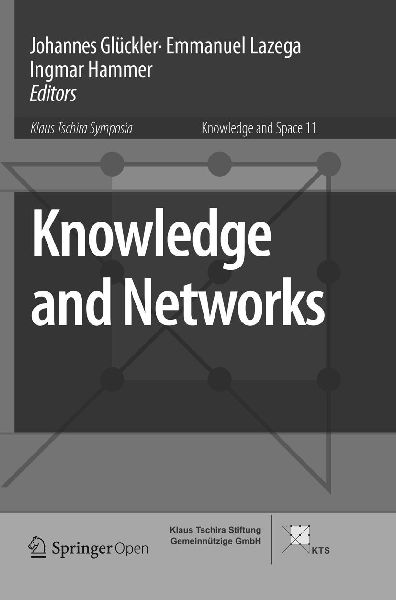
Knowledge and Networks
Herausgegeben von: Johannes Glückler, Herausgegeben von: Emmanuel Lazega, Herausgegeben von: Ingmar Hammer
Aus der Reihe Knowledge and Space
- Einband
- Kartoniert
- Seiten
- 400
- Sprache
- Englisch
- Erschienen
- Juli 2018
- Verlag
- Springer

Buchbeschreibung
This book discusses a core question in many fields of the social sciences, namely how to create, share and adopt new knowledge.
It creates an original space for conversation between two lines of research that have developed largely in parallel for a long time: social network theory and the geography of knowledge.
Ganze Beschreibung lesenWeniger anzeigen
This book considers that relational thinking has become increasingly important for scholars to capture societal outcomes by studying social relations and networks, whereas the role of place, space and spatial scales has been somewhat neglected outside an emergent geography of knowledge.
The individual contributions help integrate network arguments of connectivity, geographical arguments of contiguity and contextuality into a more comprehensive understanding of the ways in which people and organizations are constrained by and make use of space and networks for learning and innovation.
Experts in the fields of geography, sociology, economics, political science, psychology, management and organizational studies develop conceptual models and propose empirical research that illustrates the ways in which networks and geography play together in processes of innovation, learning, leadership, and power. This book is open access under a CC BY 4.0 license.
Inhaltsverzeichnis
- Exploring the Interaction of Space and Networks in the Creation of Knowledge: An Introduction: Johannes Glückler, Emmanuel Lazega, and Ingmar Hammer
- I: The Significance of Knowledge About Networks: The Relational Dimension as a Bridging Principle Between Economic, Social, and Geographic Issues: Reversing the Instrumentality of the Social for the Economic: A Critical Agenda for 21st-Century Knowledge Networks: Nancy Ettlinger
- Interpersonal Networks in Foreign Assignments and Intercultural Learning Processes: Erika Spieß
- Family Networks for Learning and Knowledge Creation in Developing Regions: Pengfei Li
- Studying Networks Geographically: World Political Regionalization in the United Nations General Assembly (1985–2010): Laurent Beauguitte
- (Post)graduate Education Markets and the Formation of Mobile Transnational Economic Elites: Sarah Hall
- II: Relational Opportunity: Network Evolution and Its Impact on Individuals and Regions: Organized Mobility and Relational Turnover as Context for Social Mechanisms: A Dynamic Invariant at the Heart of Stability from Movement: Emmanuel Lazega
- Trajectory Types Across Network Positions: Jazz Evolution from 1930 to 1969: Charles Kirschbaum
Ganzes Inhaltsverzeichnis anzeigen (18 Einträge)Weniger anzeigen
- Topology and Evolution of Collaboration Networks: The Case of a Policy-anchored District: Laura Prota, Maria Prosperina Vitale, and Maria Rosaria D¿Esposito
- Platforming for Path-Breaking? The Case of Regional Electromobility Initiatives in Germany: Jörg Sydow and Friedemann Koll
- Brokering Trust to Enhance Leadership: A Self-Monitoring Approach to Leadership Emergence: Martin Kilduff, Ajay Mehra, Dennis A. Gioia, and Stephen Borgatti
- III: Network Geographies of Learning: How Social Networks in Space Lead to Innovation: How Atypical Combinations of Scientific Ideas Are Related to Impact: The General Case and the Case of the Field of Geography: Satyam Mukherjee, Brian Uzzi, Ben Jones, and Michael Stringer
- Connectivity in Contiguity: Conventions and Taboos of Imitation in Colocated Networks: Johannes Glückler and Ingmar Hammer
- Are Gatekeepers Important for the Renewal of the Local Knowledge Base? Evidence from U.S. Cities: Stefano Breschi and Camilla Lenzi
- Learning Networks Among Swedish Municipalities: Is Sweden a Small World?: Christopher Ansell, Martin Lundin, and Per Ola Öberg
- The Coevolution of Innovative Ties, Proximity, and Competencies: Toward a Dynamic Approach to Innovation Cooperation: Uwe Cantner, Susanne Hinzmann, and Tina Wolf
- The Klaus Tschira Foundation
- Index
Details
- Erscheinungstermin
- Juli 2018
- Kategorie
- Fremdsprachige Bücher
- Einband
- Kartoniert
- Seiten
- 400
- Sprache
- Englisch
- Verlag
- Springer
- Reihe
- Knowledge and Space
- Format
- 23,5 × 15,5 cm
- Dicke
- 2,1 cm
- Gewicht
- 677 g
- EAN / ISBN-13
- 9783319831893
Über Johannes Glückler (Hrsg.)
Johannes Glückler is Professor of Economic and Social Geography and Fellow of the Marsilius Center of Advanced Studies at Heidelberg University.
Mehr über Johannes Glückler (Hrsg.)Weniger anzeigen
His research follows a relational perspective and builds on theories of organization, networks and institutions in the analysis of the space economy. He serves on several boards of journals in the field of economic geography as well as a partner of the Schader Foundation in the area of social network research. As part of the European ERASMUS Teaching Mobility program, he is a regular visiting professor at the University of Salamanca. He is also co-founder of the M.Sc. Governance of Risks and Resources at the Heidelberg Center for Latin America in Santiago de Chile. He recently co-authored, with Harald Bathelt, The Relational Economy, Oxford University Press, 2011.
Emmanuel Lazega is professor of sociology at the Institut d'Etudes Politiques de Paris, a membre of the Centre de Sociologie des Organisations (CNRS), and current president of the European Academy of Sociology. His current research focuses on the dynamics of multilevel (individual and organizational) networks. He recently co-edited, with Tom A.B. Snijders, Multilevel Network Analysis for the Social Sciences: Theory, Methods and Applications, Springer, 2016.
Ingmar Hammer is research associate at the University of Heidelberg. He studied geography, business and GIS at the University of Stuttgart and wrote his diploma thesis on innovation networks in biotechnology. Furthermore, Ingmar Hammer has worked in various companies in the high-tech sector. Among his research interests are innovation and business networks, methods of the social network analysis and their application to the analysis of business networks as well as geographies of services.
Versand und Rückgabe
Standardversand: 1 bis 3 Werktage, 3,99 €, kostenlos ab 35 €
Liefergebiet: Deutschland
Rücksendung: 14 Tage Widerrufsrecht. Bei einem Widerruf tragen Sie die Kosten der Rücksendung. Bei einer Falschlieferung oder einem Fehler von uns erstatten wir Ihnen das Rückporto. Den Widerruf erklären Sie über den Knopf „Vertrag widerrufen“ im Fuß der Seite.
Hersteller und ProduktsicherheitSpringer Nature Customer Service Center GmbH
Springer Nature Customer Service Center GmbH
Europaplatz 3
69115 Heidelberg
Deutschland
ProductSafety@springernature.com
Mehr von Johannes Glückler




Mehr aus der Reihe Knowledge and Space

Bewertungen
Zu diesem Titel gibt es noch keine Bewertung. Bewerten kann, wer ihn bei uns gekauft hat.
So prüfen wir Bewertungen
Eine Bewertung kann bei uns nur abgeben, wer den Titel über sein Kundenkonto bei uns gekauft hat. Jede Bewertung ist fest mit der zugehörigen Bestellung verknüpft; anders kommt sie technisch gar nicht zustande. Deshalb trägt jede angezeigte Bewertung den Hinweis „Verifizierter Kauf". Wir zeigen positive wie negative Bewertungen und löschen nur bei Rechtsverstößen. Für Bewertungen gibt es keine Gegenleistung.
53,49 €Voraussichtlich 2. bis 4. Dez.