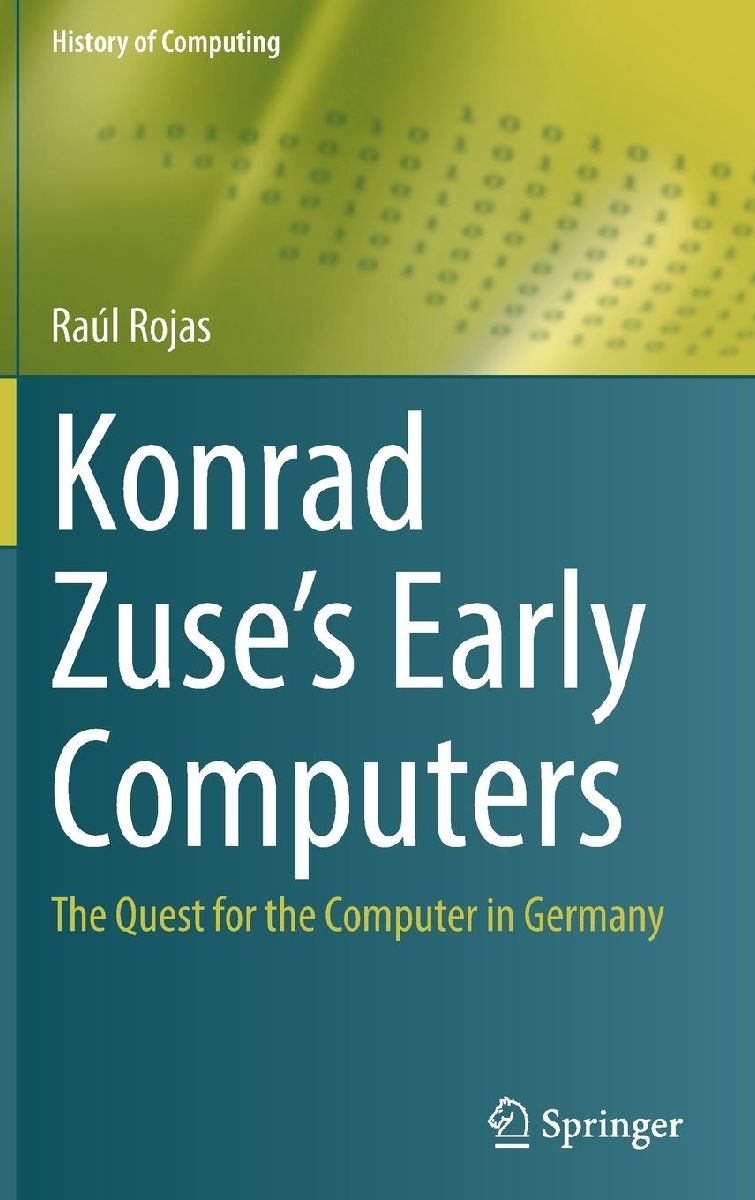
Konrad Zuse's Early Computers
The Quest for the Computer in Germany
von Raúl Rojas
Aus der Reihe History of Computing
- Einband
- Gebunden
- Seiten
- 252
- Sprache
- Englisch
- Erschienen
- Oktober 2023
- Verlag
- Palgrave Macmillan
Buchbeschreibung
This book describes the historical development of the architectures of the first computers built by the German inventor Konrad Zuse in Berlin between 1936 and 1945. Zuse's machines are historically important because they anticipated many features of modern computers.
Ganze Beschreibung lesenWeniger anzeigen
Specifically, these include the separation of processor and memory, the ability to compute with floating-point numbers, a hardware architecture based on microprogramming of the instruction set, and a layered design with a high-level programming language on top. In fact, Zuse's early computers are closer to modern computers than the Harvard Mark I or ENIAC, two other contenders for the title of "world's first computer."
The theoretical program first conceived by Zuse in 1936/37 was fulfilled with a series of machines built before and during World War II: the Z1, Z2, Z3, and Z4. Separate chapters deal with the architecture of each computer, culminating in the description of Plankalkül, the first proposal for a high-level programming language.
Students of the sciences and practitioners of computer science should have no trouble following the material. The concise introductory summary sets the reader on the historical path to retrace this remarkable intellectual adventure.
Inhaltsverzeichnis
- 1. Konrad Zuse and the Dawn of the Computer Age
- 2. The Race to Build the Computer in World War II
- 3. The Z1: Architecture and Algorithms of Zuse's First Computer
- 4. The Z2 and the Cipher Machine
- 5. The Architecture of the Z3
- 6. How to Make Zuse's Z3 a Universal Computer
- 7. The S1 and S2: Zuse's Work for the German Military 1941-1945
- 8. The Architecture of the Z4
Ganzes Inhaltsverzeichnis anzeigen (14 Einträge)Weniger anzeigen
- 9. The Conditional Jump: Making the Z4 Universal
- 10. Plankalkül
- 11. Zuse's Computer for Binary Logic
- 12. The First Code for Computer Chess
- 13. The Reconstruction of Konrad Zuse's Z3
- 14. Epilogue
Details
- Erscheinungstermin
- Oktober 2023
- Kategorie
- Fremdsprachige Bücher
- Einband
- Gebunden
- Seiten
- 252
- Sprache
- Englisch
- Verlag
- Palgrave Macmillan
- Reihe
- History of Computing
- Format
- 24,1 × 16,0 cm
- Dicke
- 2,0 cm
- Gewicht
- 495 g
- EAN / ISBN-13
- 9783031398759
Über Raúl Rojas
Raul Rojas is Professor of Mathematics and Statistics at the University of Nevada, Reno. He was Professor of Artificial Intelligence at the Freie Universität Berlin from 1997 to 2020.
Mehr über Raúl RojasWeniger anzeigen
Previously, he held professorships at the Martin Luther University Halle-Wittenberg and the Technical University of Vienna. Raul Rojas' field of research is the theory and applications of artificial intelligence algorithms. He has published two books on neural networks with Springer-Verlag, as well as the book "Die Rechenmaschinen von Konrad Zuse" (1998), a volume that finds its continuation in this new book. Prof. Rojas is a member of the Mexican Academy of Sciences, received the National Science Prize of Mexico in 2015, and was named Professor of the Year in Germany in 2014.
Versand und Rückgabe
Standardversand: 1 bis 3 Werktage, 3,99 €, kostenlos ab 35 €
Liefergebiet: Deutschland
Rücksendung: 14 Tage Widerrufsrecht. Bei einem Widerruf tragen Sie die Kosten der Rücksendung. Bei einer Falschlieferung oder einem Fehler von uns erstatten wir Ihnen das Rückporto. Den Widerruf erklären Sie über den Knopf „Vertrag widerrufen“ im Fuß der Seite.
Hersteller und ProduktsicherheitSpringer Nature Customer Service Center GmbH
Springer Nature Customer Service Center GmbH
Europaplatz 3
69115 Heidelberg
Deutschland
ProductSafety@springernature.com
Mehr aus der Reihe History of Computing




Ähnliche Titel


Bewertungen
Zu diesem Titel gibt es noch keine Bewertung. Bewerten kann, wer ihn bei uns gekauft hat.
So prüfen wir Bewertungen
Eine Bewertung kann bei uns nur abgeben, wer den Titel über sein Kundenkonto bei uns gekauft hat. Jede Bewertung ist fest mit der zugehörigen Bestellung verknüpft; anders kommt sie technisch gar nicht zustande. Deshalb trägt jede angezeigte Bewertung den Hinweis „Verifizierter Kauf". Wir zeigen positive wie negative Bewertungen und löschen nur bei Rechtsverstößen. Für Bewertungen gibt es keine Gegenleistung.
37,44 €Voraussichtlich 3. bis 7. Dez.