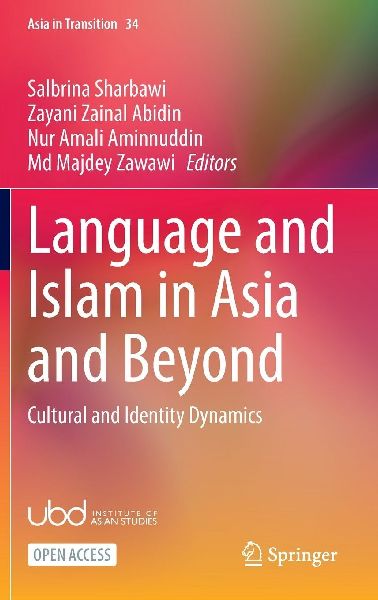
Language and Islam in Asia and Beyond
Cultural and Identity Dynamics
Herausgegeben von: Salbrina Sharbawi, Herausgegeben von: Zayani Zainal Abidin, Herausgegeben von: Nur Amali Aminnuddin, und weitere
Aus der Reihe Asia in Transition
- Einband
- Gebunden
- Seiten
- 376
- Sprache
- Englisch
- Erschienen
- Oktober 2026
- Verlag
- Springer
Buchbeschreibung
This open access volume explores the various interplays between language and religion, with a particular focus on Islam and Muslim communities.
With topics ranging from how conflicting religious values and secular viewpoints have impacted language use, shaped language policies and informed pedagogies, to the reciprocity between language, education, and religion in the shaping of Muslim identity, the book collates interdisciplinary perspectives with examples from different parts of the Muslim world.
Ganze Beschreibung lesenWeniger anzeigen
In doing so, the book provides insights into the ways Islam and the diverse languages and cultures of the Muslim constituencies intertwine. Despite the burgeoning push for secularism and the growing popularity of English as the world’s lingua franca, the authors show that the Arabic language remains central to Islam and forms the bedrock of everyday Islamic expression.
The book also discusses the respective conflicts and collaborations between tradition and modernity in Islamic teaching and values. Relevant to scholars and students in Islamic studies, education, Asian cultural landscapes, and Asian and Middle Eastern languages, this is a seminal work that establishes an intersection between applied linguistics and religious studies in the Muslim world.
Inhaltsverzeichnis
- Introduction
- Part I Scripts, Languages, and Vernacular Practices of Faith
- Influence of Language in Practising Islam: Case of Urdu and Other Languages in Pakistan and India
- Religious Language in Malaysia: The Interreligious Issue and Challenge
- The Unmaking of Traditions: Islam, language, and The Loss of Pluralism in Modern Bangladesh
- Displaying Languages and Identities Locally and Globally: The Case of Textbooks versus e-Books in One Mauritian Madrasa
- Muslimness as Semiotic Practice: The Case of Chinese Islamic Arts
- Part II Pluralism, Power, and Language Hegemony
Ganzes Inhaltsverzeichnis anzeigen (22 Einträge)Weniger anzeigen
- The Mutuality of Religion, Language Learning, and Identity Construction
- Language and Sunnah Observance among Bruneian Youth: Negotiating Faith in a Multilingual Society
- Linguistic Choices of Bruneian Malay Muslims: An Integrative Framework on Exploring Identity Construction Through the Lenses of Ihsan Self-Regulation
- Part III Identity, Youth, and Religious Expression
- The Malay Language and the Muslim identity in Southern Thailand
- Language Use and Religious Identity: The Hijab and Awrah in Young Malay Muslims of Brunei
- Part IV Policy, Authority, and the Sacred Order
- Language Currency in An Islamic System of Governance: Contextualising Brunei Darussalam’s Language Policy
- Islamic Language Policies and Sociolinguistic Reflections
- Female Authorship and Religious Authority Among Malay Muslims: Agency, Controversy, and the Role of Language (1920s–2020s)
- Part V Islam in Digital Spaces: Discourse, Da’wah, and Mediation
- The Many Voices of Digital Da’wah
- Collocational and Semantic Anomaly Detection in Digitally Mediated Islamic Discourse: A Corpus-Based Analysis of Translated Friday Sermons in Brunei
- Conclusion
Details
- Erscheinungstermin
- Oktober 2026
- Kategorie
- Fremdsprachige Bücher
- Einband
- Gebunden
- Seiten
- 376
- Sprache
- Englisch
- Verlag
- Springer
- Reihe
- Asia in Transition
- Format
- 24,1 × 16,0 cm
- Dicke
- 2,6 cm
- Gewicht
- 677 g
- EAN / ISBN-13
- 9789819243235
Über Salbrina Sharbawi (Hrsg.)
Salbrina Sharbawi received her doctorate in Applied Linguistics from Nanyang Technological University, Singapore (PhD 2009).
Mehr über Salbrina Sharbawi (Hrsg.)Weniger anzeigen
She is currently Senior Assistant Professor of English Studies at Universiti Brunei Darussalam, where she teaches at both undergraduate and graduate levels. Her research focuses primarily on socio-phonetics and World Englishes, particularly the pronunciation of the English variety spoken in Brunei. Her work has culminated in a series of publications, including ‘Brunei English: A New Variety in a Multilingual Society’ (2024), the first monograph to offer a detailed linguistic analysis of the English language situation in Brunei. She has also published papers documenting the dynamic development of contemporary Brunei English and its socio-cultural implications, including those tied to religion.
Zayani Zainal Abidin is a PhD candidate in Applied Linguistics at the Faculty of Arts and Social Sciences, Universiti Brunei Darussalam. Her research interests include corpus linguistics, discourse analysis, pragmatics, and World Englishes, with a particular focus on emerging grammatical patterns and language variation in Brunei English and other Asian Englishes. Zayani has co-authored studies examining the intersections of language use, social interaction, identity, and religiosity in the Bruneian context. She is also involved in the development of the Corpus of Brunei English.
Nur Amali Aminnuddin is Lecturer at the Sultan Omar ‘Ali Saifuddien Centre for Islamic Studies, Universiti Brunei Darussalam. With a background in political science, psychology, and Brunei studies, he has published research on work ethics, discrimination, education, personality, and behaviour. His research interests revolve around the psychology of religion, social psychology, and behavioural sciences. Islam is a central theme in his work, and his current research focuses on Muslims, religiosity, and society.
Majdey Zawawi holds a PhD in Islamic Governance from the Institute of Policy Studies, Universiti Brunei Darussalam, and is among the first scholars worldwide to graduate with this degree and specialisation. His diverse experiences enable him to adopt a broad range of approaches in analysing Islamic Governance and Muslim politics. While his primary research centres on Islamic Governance, he is also keen on interdisciplinary research traversing multiple disciplines. His expertise lies in employing Maq¿¿id al-Shar¿¿ah as an analytical framework to assess Muslim societal power dynamics.
Versand und Rückgabe
Standardversand: 1 bis 3 Werktage, 3,99 €, kostenlos ab 35 €
Liefergebiet: Deutschland
Rücksendung: 14 Tage Widerrufsrecht. Bei einem Widerruf tragen Sie die Kosten der Rücksendung. Bei einer Falschlieferung oder einem Fehler von uns erstatten wir Ihnen das Rückporto. Den Widerruf erklären Sie über den Knopf „Vertrag widerrufen“ im Fuß der Seite.
Hersteller und ProduktsicherheitSpringer Nature Customer Service Center GmbH
Springer Nature Customer Service Center GmbH
Europaplatz 3
69115 Heidelberg
Deutschland
ProductSafety@springernature.com
Mehr von Salbrina Sharbawi
Mehr aus der Reihe Asia in Transition
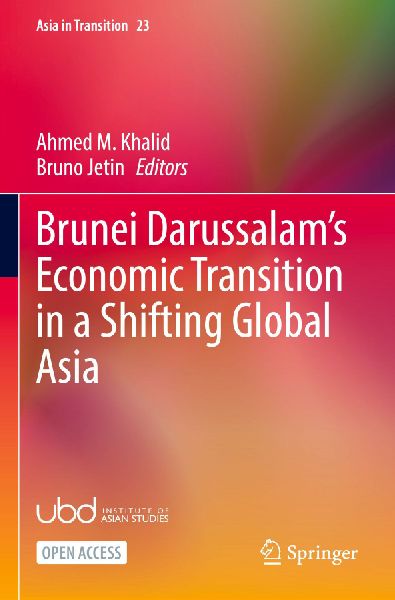
Brunei Darussalam's Economic Transition in a Shifting Global Asia
Ahmed M. Khalid (Hrsg.)
Kartoniert, Englisch, 2 Ausgaben
ab 42,79 €
Ähnliche Titel
Articulating Islam: Anthropological Approaches to Muslim Worlds
Magnus Marsden (Hrsg.)
Gebunden, Englisch, 2 Ausgaben
ab 106,99 €
Historical Mosques in Indonesia and the Malay World
Bagoes Wiryomartono
Gebunden, Englisch, 2 Ausgaben
ab 139,09 €
American Muslim Perspectives on Radicalization
Nahid Afrose Kabir
Gebunden, Englisch, 2 Ausgaben
ab 149,79 €
Bewertungen
Zu diesem Titel gibt es noch keine Bewertung. Bewerten kann, wer ihn bei uns gekauft hat.
So prüfen wir Bewertungen
Eine Bewertung kann bei uns nur abgeben, wer den Titel über sein Kundenkonto bei uns gekauft hat. Jede Bewertung ist fest mit der zugehörigen Bestellung verknüpft; anders kommt sie technisch gar nicht zustande. Deshalb trägt jede angezeigte Bewertung den Hinweis „Verifizierter Kauf". Wir zeigen positive wie negative Bewertungen und löschen nur bei Rechtsverstößen. Für Bewertungen gibt es keine Gegenleistung.
53,49 €Voraussichtlich 4. bis 8. Dez.