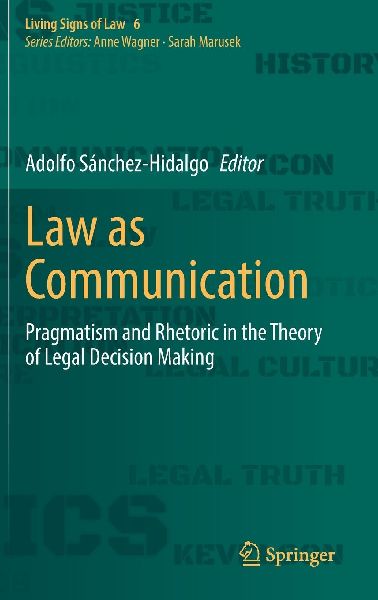
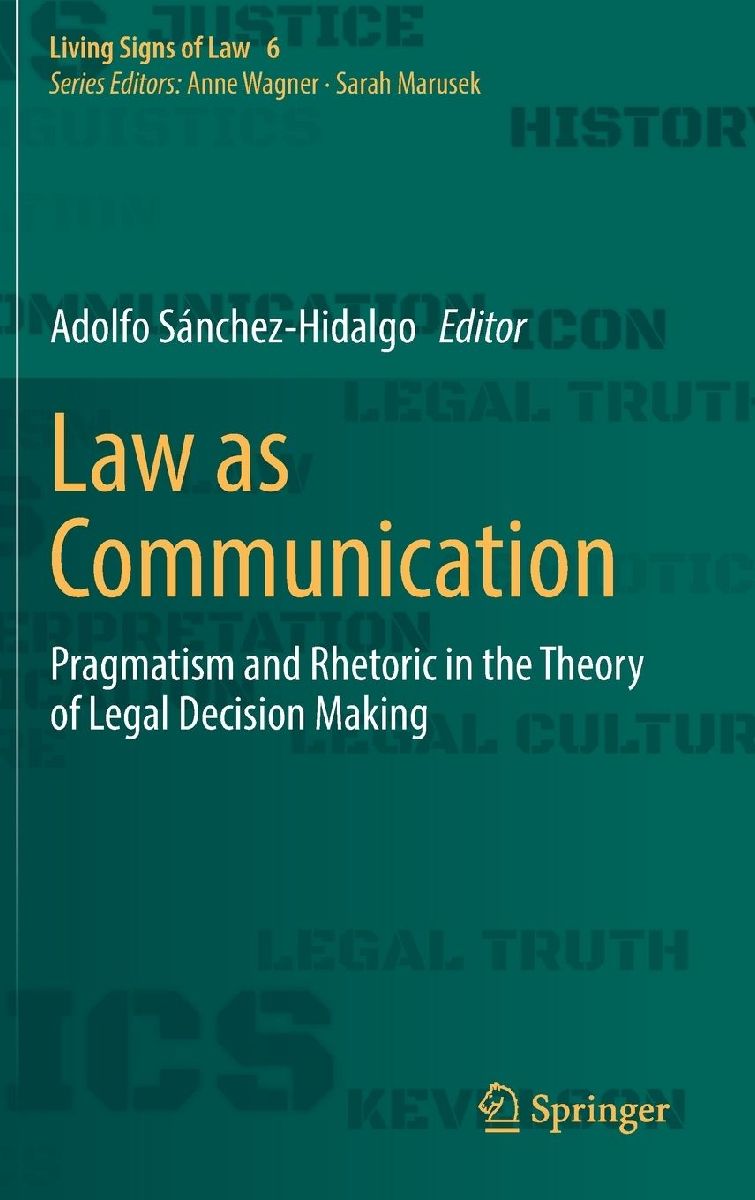
Law as Communication
Pragmatism and Rhetoric in the Theory of Legal Decision Making
von Adolfo Sánchez-Hidalgo (Hrsg.)
Herausgegeben von: Adolfo Sánchez-Hidalgo
Aus der Reihe Living Signs of Law
- Einband
- Gebunden
- Seiten
- 328
- Sprache
- Englisch
- Erschienen
- April 2025
- Verlag
- Palgrave Macmillan
Buchbeschreibung
The Communicational Theory of Law (CTL) is a successful synthesis of the hermeneutic and analytical postulates, proceeding under the assumption that Law is the heritage of jurists and can be enriched by a rational and systematic reconstruction of the legal order.
Ganze Beschreibung lesenWeniger anzeigen
CTL offers an original perspective on the classic tension between normativity and institutionality, between Legal Theory and Legal Sociology, helping readers rediscover the value of Theory of Law in terms of explaining and advancing a range of legal functions.
It wouldn’t be saying too much to claim that through CTL, the contributions of the European philosophy of law from the 19th and 20th centuries (jurisprudence of concepts, legal sociology, legal positivism, institutionalism, etc.) can be reclaimed and now coordinated from a communicational and philosophy of language perspective, offering us a complete and useful Theory of Law.
CTL does not avoid the problem of the idea of justice; rather, it confronts it by distinguishing between the Theory of Justice and ambital justice. As such, readers are equipped to verify the originality of the Theory of Legal Decision in the CTL framework and, thus, will find new tools for critically assessing the performance of courts and public authorities.
This book details the epistemological presuppositions on which CTL is built, but also offers new lines of critical development, which reflect CTL’s theoretical and philosophical potential.
In the studies presented here, readers will find original answers to classic problems of the Theory of Law, together with examples of CTL’s practical application to the great challenges of our time, such as interculturalism, legal AI, populist demagogy, the transparency of public powers, etc. – all without forgetting the challenges of the future of Law.
Inhaltsverzeichnis
- Introduction
- Part I Epistemological axis of the Communicational Theory of Law
- Epistemological analysis and Communicational Theory of Law
- Legal communication as a Semiosphere
- The dialogue between authoring, authorship and legal authorities from the perspective of the Communicational Theory of Law
- Ambital and extra-ambital justice in the Communicational Theory of Law
- A look from the spanish judicial ethics
- When claims for justice become rhetorical statements
Ganzes Inhaltsverzeichnis anzeigen (27 Einträge)Weniger anzeigen
- A comparative analysis between Alasdair macintyre’s philosophical proposal and Gregorio Robles’ Communicational Theory of Law
- Part II Language, hermeneutics and Law
- Hermeneutics and the words of law (Law as Communicative Action)
- Legal Hermeneutics and Discourse in the Judicial Interpretation
- Theoretic-pragmatic principles for a “rhetoric of agreement”: the concordant function of theoretical art
- Communicational Theory of Law and Text: An analysis from José Ortega y Gasset Theory
- Part III Applied Communicational Theory of Law
- The principle of Human Dignity: empty concept or linguistic expression of an objective reality?
- Can motherhood be promised? Immoral promises, surrogate gestation, and law as a performative act in Reinach’s work
- Semantic and Rhetoric regarding the understanding of the Constitution
- Shariah through the Lens of Communicational Theory of Law: Is it a Legal Order?
- What does it mean to be transparent? Semiotic analysis of the semantic and pragmatic implications of the term "transparency"
- PART IV Law, Communication and AI
- AI and Communicational theory of law
- Technological singularity and personal identity
- Reflections for an ethical-legal debate
- Law and communication in the age of Metaverse
- New instruments to think and decide
- The last word in the “algo-cratic” era and human leadership in the “algor-ethical” context: what Law?
Details
- Erscheinungstermin
- April 2025
- Kategorie
- Fremdsprachige Bücher
- Einband
- Gebunden
- Seiten
- 328
- Sprache
- Englisch
- Verlag
- Palgrave Macmillan
- Reihe
- Living Signs of Law
- Format
- 24,1 × 16,0 cm
- Dicke
- 2,4 cm
- Gewicht
- 607 g
- EAN / ISBN-13
- 9783031857157
Über Adolfo Sánchez-Hidalgo (Hrsg.)
Adolfo Jorge Sánchez Hidalgo is Associate Professor of Philosophy of Law at the University of Córdoba.
Mehr über Adolfo Sánchez-Hidalgo (Hrsg.)Weniger anzeigen
He has been a resident student at the College of Spain (Paris) at Paris II Pantheon Assas; he has been at the University of Catania and at the University of Padua. Adolfo is corresponding member of the Spanish Royal Academy of Jurisprudence and Legislation and secretary of its section of Philosophy of Law. His main research interests are Legal Methodology, History of the Philosophy of Law, Law and New Technologies, Communicational Theory of Law, and Philosophy of Sport. He is a member of the research group SEJ-050 Communication, Language and Law, and is part of the Ibero-American Research Network on Sport Management and Law.
Versand und Rückgabe
Standardversand: 1 bis 3 Werktage, 3,99 €, kostenlos ab 35 €
Liefergebiet: Deutschland
Rücksendung: 14 Tage Widerrufsrecht. Bei einem Widerruf tragen Sie die Kosten der Rücksendung. Bei einer Falschlieferung oder einem Fehler von uns erstatten wir Ihnen das Rückporto. Den Widerruf erklären Sie über den Knopf „Vertrag widerrufen“ im Fuß der Seite.
Hersteller und ProduktsicherheitSpringer Nature Customer Service Center GmbH
Springer Nature Customer Service Center GmbH
Europaplatz 3
69115 Heidelberg
Deutschland
ProductSafety@springernature.com
Mehr aus der Reihe Living Signs of Law



Exploring the Boundaries of Law
Ana Margarida Gaudêncio (Hrsg.)
Gebunden, Englisch, 2 Ausgaben
ab 267,49 €

Ähnliche Titel


Applied Philosophy of Law - Orientation in a Nervous World?
Eckardt Buchholz-Schuster (Hrsg.)
Kartoniert, Englisch
129,00 €


Bewertungen
Zu diesem Titel gibt es noch keine Bewertung. Bewerten kann, wer ihn bei uns gekauft hat.
So prüfen wir Bewertungen
Eine Bewertung kann bei uns nur abgeben, wer den Titel über sein Kundenkonto bei uns gekauft hat. Jede Bewertung ist fest mit der zugehörigen Bestellung verknüpft; anders kommt sie technisch gar nicht zustande. Deshalb trägt jede angezeigte Bewertung den Hinweis „Verifizierter Kauf". Wir zeigen positive wie negative Bewertungen und löschen nur bei Rechtsverstößen. Für Bewertungen gibt es keine Gegenleistung.
213,99 €Voraussichtlich 4. bis 8. Dez.