Nanotechnological Advances in Environmental, Cyber and CBRN Security
Plamen Petkov (Hrsg.)
Kartoniert, Englisch, 2 Ausgaben
ab 171,19 €
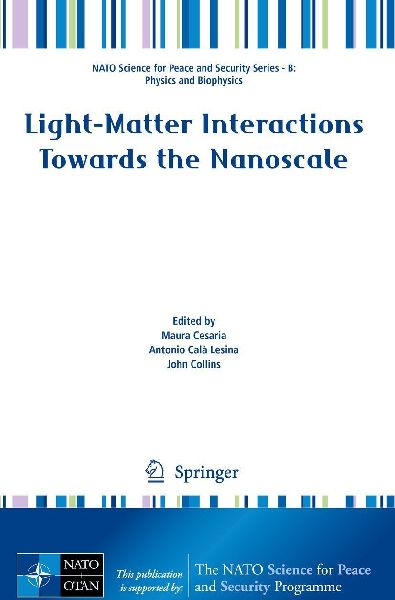
Herausgegeben von: Maura Cesaria, Herausgegeben von: Antonio Calà Lesina, Herausgegeben von: John Collins
Aus der Reihe NATO Science for Peace and Security Series B: Physics and Biophysics
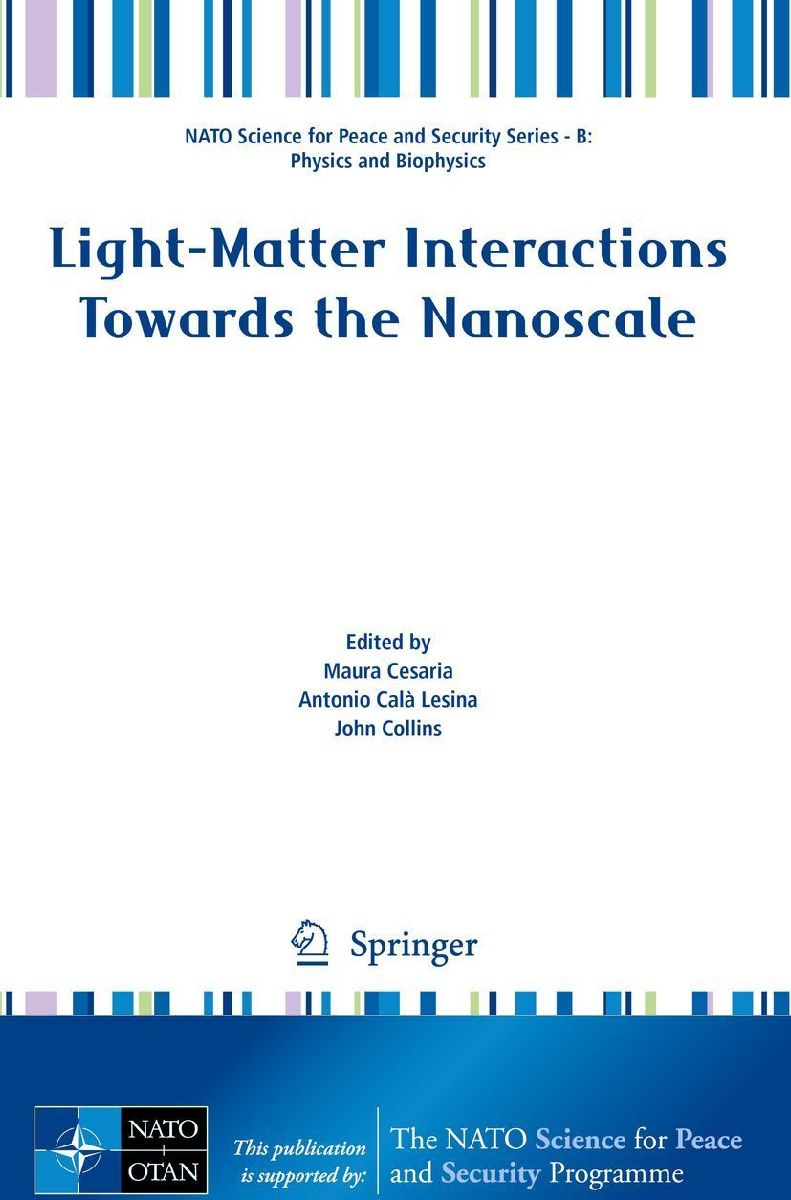
The investigation of light-matter interactions in materials, especially those on the nanoscale, represents perhaps the most promising avenue for scientific progress in the fields of photonics and plasmonics.
This book examines a variety of topics, starting from fundamental principles, leading to the current state of the art research.
For example, this volume includes a chapter on the sensing of biological molecules with optical resonators (microspheres) combined with plasmonic systems, where the response this system are described in a fundamental and elegant manner using coupled mode theory.
Symmetry plays a major role in the book. One chapter on time reversal symmetry in electromagnetic theory describes how to control the properties of light (e.g. scattering and directionality of the flow of light) in materials with certain topological invariants.
Another chapter where symmetry is prominent reformulates, using a gentle and pedagogical approach, Maxwell'sEquations into a new set of fields that reveal a "handedness" symmetry in electromagnetic theory, which can be applied to photonic systems in, for example, the sensing of chiral molecules and understanding the conditions for zero reflection.
Also, for students and researchers starting in the field of nanoplasmonics, the book includes a tutorial on the finite element time domain simulation of nanoplasmonic systems. Other topics include photonic systems for quantum computing, nanoplasmonics, and optical properties of nano and bulk materials.
The authors take a pedagogical approach to their topic, making the book an excellent reference for graduate students and scientists starting in the fields of photonics or plasmonics.
Dr. Cesaria graduated in Physics cum laude in 2008 and received her Ph. D. degree in Physics in 2012 at the University of Salento (Lecce, Italy).
From then on, she worked for the University of Florence and the IMM-CNR Institute (unit of Lecce-Italy). Currently, she is a Research Fellow at the Physics Department of the University of Salento. Since 2013 she contributed to the organization of the biannual Spectroscopy School held at the Majorana Foundation (Erice, Italy) and to studies on white-light emitting nanophosphors as a Visiting Scholar at Boston College (MA, USA). Her main research experiences include itinerant ferromagnetism, pulsed laser deposition of bulk and nanostructured inorganic/organic materials, microfluidics, liposomes, colloidal lithography, gold nano holes, inorganic perovskites, and neutron detectors.
Antonio Calà Les ina is an Associate Professor (tenure-track) at Leibniz University Hannover, Germany, since 2020. His research interests focus on nanophotonics design, topology optimization, and large-scale multiphysics simulation. He obtained his B.Sc. in electronics engineering (2006) and M.Sc. in telecommunications engineering (2009) from the University of Catania, Italy, and his Ph. D. in computational electromagnetics (2013) from the University of Trento, Italy. From 2013 to 2020, he was a researcher at the University of Ottawa, Canada, working on computational nanophotonics, plasmonic colouring, and nonlinear/tunable optical metasurfaces. He attended three NATO Institutes on nanophotonics in Erice, Italy, in 2015, 2017 and 2019 (the latter as a member of the organizing team). Prof. Collins received his Ph. D. from Boston College in 1987, and has been a member in the Department of Physics and Astronomy at Wheaton College since 1989. His research interests are in the general area of the interaction of radiation with matter. He is an experimental physicist trained in the field of luminescence spectroscopy of solids doped with transition metal and rare earth ions. Specific areas of interest include energy transfer, non radiative processes, luminescence in nanosystems, and plasmonic effects on radiative and non-radiative processes of excited ions in solids. Prof. Collins has co-edited several books and journal volumes on topics such as spectroscopy of solids, nano-optics, biophotonics, and visible and infrared phosphors, and has authored or co-authored numerous articles and book chapters.
Standardversand: 1 bis 3 Werktage, 3,99 €, kostenlos ab 35 €
Liefergebiet: Deutschland
Rücksendung: 14 Tage Widerrufsrecht. Bei einem Widerruf tragen Sie die Kosten der Rücksendung. Bei einer Falschlieferung oder einem Fehler von uns erstatten wir Ihnen das Rückporto. Den Widerruf erklären Sie über den Knopf „Vertrag widerrufen“ im Fuß der Seite.
Plamen Petkov (Hrsg.)
Kartoniert, Englisch, 2 Ausgaben
ab 171,19 €
Igor Vladymyrskyi (Hrsg.)
Kartoniert, Englisch, 2 Ausgaben
ab 160,49 €
Dorin Radu (Hrsg.)
Gebunden, Englisch, 2 Ausgaben
ab 171,19 €
Florin-Catalin Cirstoiu (Hrsg.)
Gebunden, Englisch, 2 Ausgaben
ab 171,19 €
Zu diesem Titel gibt es noch keine Bewertung. Bewerten kann, wer ihn bei uns gekauft hat.