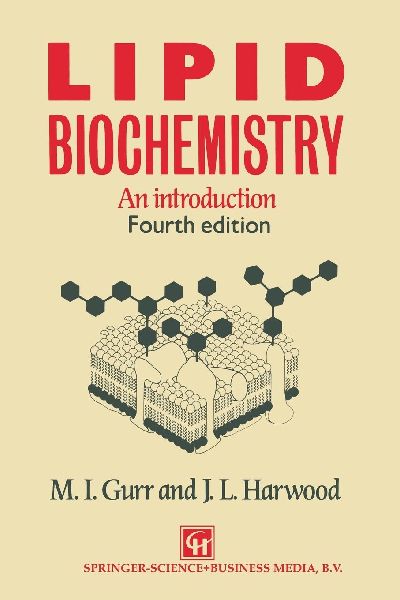
Lipid Biochemistry
An Introduction
von J. L. Harwood und M. I. Gurr
- Einband
- Kartoniert
- Seiten
- 416
- Sprache
- Englisch
- Erschienen
- Februar 1991
- Verlag
- Springer
Buchbeschreibung
Lipids can usually be extracted easily from tissues by making use of their hydrophobic characteristics.
However, such extractions yield a complex mixture of different lipid classes which have to be purified further for quantitative analysis. Moreover, the crude lipid extract will be contami nated by other hydrophobic molecules, e.g. by intrinsic membrane proteins. Of the various types of separation processes, thin layer and column chromatography are most useful for intact lipids.
Ganze Beschreibung lesenWeniger anzeigen
High performance liquid chromatography (HPLC) is also rapidly becoming more popular, especially for the fractionation of molecular species of a given lipid class. The most powerful tool for quantitation of the majority of lipids is gas liquid chromatography (GLC). The method is very sensitive and, if adapted with capillary columns, can provide information with regard to such subtle features as the position or configuration of substitutions along acyl chains.
By coupling GLC or HPLC to a radioactivity detector, then the techniques are also very useful for metabolic measurements. Although research laboratories use generally sophisticated analytical methods such as GLC to analyse and quantify lipid samples, chemical derivatie:ations are often used in hospitals.
For these methods, the lipid samples are derivatized to yield a product which can be measured simply and accurately-usually by colour. Thus, total triacylglycerol, cholesterol or phospholipid-phosphorus can be quantitated conveniently without bothering with the extra information of molecular species, etc. which might be determined by more thorough analyses. REFERENCES Christie, w.w. (1982) Lipid Analysis, 2nd edn, Pergamon Press, Oxford.
Inhaltsverzeichnis
- 1 The nature of lipids and their place in living things
- 2 Isolation, separation and detection of lipids
- 3 Fatty acid structure and metabolism
- 4 Lipids as energy stores
- 5 Dietary lipids: implications for health and disease
- 6 Lipids in cellular structures
- 7 Metabolism of structural lipids
- 8 Lipid functions
Details
- Erscheinungstermin
- Februar 1991
- Kategorie
- Fremdsprachige Bücher
- Einband
- Kartoniert
- Seiten
- 416
- Sprache
- Englisch
- Verlag
- Springer
- Format
- 23,5 × 15,5 cm
- Dicke
- 2,3 cm
- Gewicht
- 628 g
- EAN / ISBN-13
- 9780412266201
Versand und Rückgabe
Standardversand: 1 bis 3 Werktage, 3,99 €, kostenlos ab 35 €
Liefergebiet: Deutschland
Rücksendung: 14 Tage Widerrufsrecht. Bei einem Widerruf tragen Sie die Kosten der Rücksendung. Bei einer Falschlieferung oder einem Fehler von uns erstatten wir Ihnen das Rückporto. Den Widerruf erklären Sie über den Knopf „Vertrag widerrufen“ im Fuß der Seite.
Hersteller und ProduktsicherheitSpringer Nature Customer Service Center GmbH
Springer Nature Customer Service Center GmbH
Europaplatz 3
69115 Heidelberg
Deutschland
ProductSafety@springernature.com
Ähnliche Titel




Bewertungen
Zu diesem Titel gibt es noch keine Bewertung. Bewerten kann, wer ihn bei uns gekauft hat.
So prüfen wir Bewertungen
Eine Bewertung kann bei uns nur abgeben, wer den Titel über sein Kundenkonto bei uns gekauft hat. Jede Bewertung ist fest mit der zugehörigen Bestellung verknüpft; anders kommt sie technisch gar nicht zustande. Deshalb trägt jede angezeigte Bewertung den Hinweis „Verifizierter Kauf". Wir zeigen positive wie negative Bewertungen und löschen nur bei Rechtsverstößen. Für Bewertungen gibt es keine Gegenleistung.
53,49 €Voraussichtlich 1. bis 3. Dez.