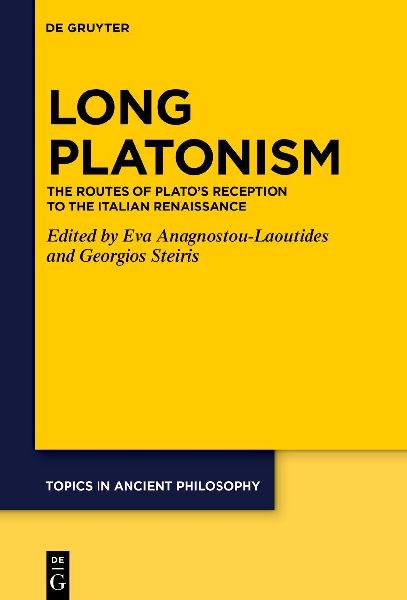
Long Platonism
The Routes of Plato's Reception to the Italian Renaissance
von Eva Anagnostou-Laoutides (Hrsg.)
Herausgegeben von: Eva Anagnostou-Laoutides, Herausgegeben von: Georgios Steiris
- Einband
- Gebunden
- Seiten
- 647
- Sprache
- Englisch
- Erschienen
- März 2026
- Verlag
- Walter de Gruyter
Buchbeschreibung
The impact of Platonism in shaping the Abrahamic traditions is yet to be fully explored.
The papers in this volume examine the influence of Plato and his commentators in the conception and articulation of theological issues in late antique and medieval Christianity, but also in Islamic and Jewish traditions. The contributions are arranged chronologically and address key authors and themes in the reception of Platonic thought from the third to the sixteenth century.
Ganze Beschreibung lesenWeniger anzeigen
Neoplatonic debates on the Demiurgic Intellect, imagination, and contemplation informed Christian ideas about our ability to grasp God. Gregory of Nyssa played a key role in the reception of Platonic ideas about the nature of God in Christian and Jewish thinkers, while Neoplatonic schools continued to inculcate Platonic ideals in Christian leaders and intellectuals to the fifth century.
Later Platonists, like Hermias, Porphyry, and Philoponus, subtly but creatively reworked Platonic theses to harmonize Plato's and Aristotle's philosophies, while paving the way for Psellus' theory of spiritual illumination. Plotinus and Proclus offer examples of the uneasy and even polemical reception of Neoplatonic concepts both in eastern and western Christianity, including medieval Georgia.
The influence of Platonic themes in Islamic thought and Jewish mysticism is traced back to the Qu'ran and John Damascene. Plato's reception by Eriugena and Thomas Aquinas is also re-examined. Finally, the concept of the Platonic city in Medieval Islamic culture and Christian Florence is considered.
By revealing the historical trajectories of Platonic themes across the Abrahamic traditions, the volume aims to serve as foundational resource for Long Platonism. "This impressive collection of articles edited by Eva Anagnostou-Laoutides and Georgios Steiris concerns the history of Plato's reception from the time of the first Neoplatonic schools to the Platonic Academy of Florence. The thinkers and works under discussion range over a chronological period of approximately fifteen centuries. They belong to different schools, geographical areas, cultural environments, and religious traditions: from Plato to Plotinus, Proclus, St Augustine, the Church fathers, the ancient commentators, John Scottus, Nicolas of Methone, St Thomas Acquinas, Byzantine philosophers and hagiographers, Jewish and Islamic authors, and Plato's reception of Plato by the Florentines in the Renaissance. Separately or jointly, the chapters of the volume highlight the extraordinary richness of the material, illustrate a variety of perspectives from which it can be studied, and open new and exciting avenues for future research." Voula Tsouna, Philosophy Department, UCSB
Details
- Erscheinungstermin
- März 2026
- Kategorie
- Fremdsprachige Bücher
- Einband
- Gebunden
- Seiten
- 647
- Sprache
- Englisch
- Verlag
- Walter de Gruyter
- Format
- 23,1 × 16,4 cm
- Dicke
- 3,9 cm
- Gewicht
- 1.048 g
- EAN / ISBN-13
- 9783111430980
Über Eva Anagnostou-Laoutides (Hrsg.)
Eva Anagnostou-Laoutides, Macquarie University, Sydney, Australia; Georgios Steiris, The National and Kapodistrian University of Athens, Athens, Greece.
Versand und Rückgabe
Standardversand: 1 bis 3 Werktage, 3,99 €, kostenlos ab 35 €
Versandbeginn: in der Regel am selben oder am nächsten Werktag
Liefergebiet: Deutschland
Rücksendung: 14 Tage Widerrufsrecht. Bei einem Widerruf tragen Sie die Kosten der Rücksendung. Bei einer Falschlieferung oder einem Fehler von uns erstatten wir Ihnen das Rückporto. Den Widerruf erklären Sie über den Knopf „Vertrag widerrufen“ im Fuß der Seite.
Hersteller und ProduktsicherheitDe Gruyter GmbH
Mehr von Eva Anagnostou-Laoutides

Ähnliche Titel
Bewertungen
Zu diesem Titel gibt es noch keine Bewertung. Bewerten kann, wer ihn bei uns gekauft hat.
So prüfen wir Bewertungen
Eine Bewertung kann bei uns nur abgeben, wer den Titel über sein Kundenkonto bei uns gekauft hat. Jede Bewertung ist fest mit der zugehörigen Bestellung verknüpft; anders kommt sie technisch gar nicht zustande. Deshalb trägt jede angezeigte Bewertung den Hinweis „Verifizierter Kauf". Wir zeigen positive wie negative Bewertungen und löschen nur bei Rechtsverstößen. Für Bewertungen gibt es keine Gegenleistung.
149,95 €Voraussichtlich 27. Nov. bis 1. Dez.