Mathematical Transformations and Wavelet Filters for Source Coding and Signal Processing Systems
William A. Pearlman
Gebunden, Englisch, 2 Ausgaben
ab 48,14 €
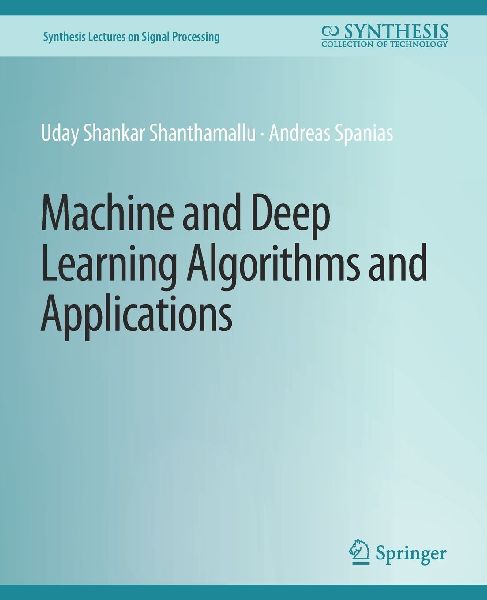
von Uday Shankar Shanthamallu und Andreas Spanias
Aus der Reihe Synthesis Lectures on Signal Processing
This book introduces basic machine learning concepts and applications for a broad audience that includes students, faculty, and industry practitioners.
We begin by describing how machine learning provides capabilities to computers and embedded systems to learn from data. A typical machine learning algorithm involves training, and generally the performance of a machine learning model improves with more training data.
Deep learning is a sub-area of machine learning that involves extensive use of layers of artificial neural networks typically trained on massive amounts of data.
Machine and deep learning methods are often used in contemporary data science tasks to address the growing data sets and detect, cluster, and classify data patterns. Although machine learning commercial interest has grown relatively recently, the roots of machine learning go back to decades ago. We note that nearly all organizations, including industry, government, defense, and health, are using machine learning toaddress a variety of needs and applications.
The machine learning paradigms presented can be broadly divided into the following three categories: supervised learning, unsupervised learning, and semi-supervised learning. Supervised learning algorithms focus on learning a mapping function, and they are trained with supervision on labeled data. Supervised learning is further sub-divided into classification and regression algorithms.
Unsupervised learning typically does not have access to ground truth, and often the goal is to learn or uncover the hidden pattern in the data. Through semi-supervised learning, one can effectively utilize a large volume of unlabeled data and a limited amount of labeled data to improve machine learning model performances. Deep learning and neural networks are also covered in this book.
Deep neural networks have attracted a lot of interest during the last ten years due to the availability of graphics processing units (GPU) computational power, big data, and new software platforms. They have strong capabilities in terms of learning complex mapping functions for different types of data. We organize the book as follows.
The book starts by introducing concepts in supervised, unsupervised, and semi-supervised learning. Several algorithms and their inner workings are presented within these three categories. We then continue with a brief introduction to artificial neural network algorithms and their properties. In addition, we cover an array of applications and provide extensive bibliography. The book ends with a summary of the key machine learning concepts.
Uday Shankar Shanthamallu received his Ph. D. degree in 2021 from the school of Electrical, Computer, and Energy Engineering at Arizona State University.
He received his Master's degree in electrical engineering from Arizona State University in 2018 and a Bachelor's degree in electronics and communication engineering from the National Institute of Engineering, India, in 2011. His research interests include representation learning for graphs using machine learning and deep learning techniques. He also has experience on sensor data analytics for anomaly detection. His internship with NXP Semiconductors (2016) focused on algorithm development for sensor data analytics. He also interned with Lawrence Livermore National Laboratory during the summer of 2019 and 2020 where he built predictive models for human brain connectomes.
Andreas Spanias is Professor in the School of Electrical, Computer, and Energy Engineering at Arizona State University. He is also the director of the Sensor Signal and Information Processing (SenSIP) center and the founder of the SenSIP industry consortium (also an NSF I/UCRC site). His research interests are in the areas of adaptive signal processing, speech processing, machine learning and sensor systems. He and his student team developed the computer simulation software Java-DSP and its award-winning iPhone/iPad and Android versions. He is author of two textbooks: Audio Processing and Coding by Wiley and DSP: An Interactive Approach (2nd ed.). He contributed to more than 350 papers, 11 monographs, 11 full patents, 10 provisional patents, and 12 patent pre-disclosures. He served as Associate Editor of the IEEE Transactions on Signal Processing and as General Co-chair of IEEE ICASSP-99. He also served as the IEEE Signal Processing Vice-President for Conferences. Andreas Spanias is co-recipient of the 2002 IEEE Donald G. Fink paper prize award and was elected Fellow of the IEEE in 2003. He served as Distinguished Lecturer for the IEEE Signal Processing Society in 2004. He is a series editor for the Morgan & Claypool lecture series on algorithms and software. He received the 2018 IEEE Phoenix Chapter award with citation: "For significant innovations and patents in signal processing for sensor systems." He also received the 2018 IEEE Region 6 Outstanding Educator Award (across 12 states) with citation: "For outstanding research and education contributions in signal processing." He was elected recently to Senior Member of the National Academy of Inventors (NAI).
Standardversand: 1 bis 3 Werktage, 3,99 €, kostenlos ab 35 €
Liefergebiet: Deutschland
Rücksendung: 14 Tage Widerrufsrecht. Bei einem Widerruf tragen Sie die Kosten der Rücksendung. Bei einer Falschlieferung oder einem Fehler von uns erstatten wir Ihnen das Rückporto. Den Widerruf erklären Sie über den Knopf „Vertrag widerrufen“ im Fuß der Seite.
William A. Pearlman
Gebunden, Englisch, 2 Ausgaben
ab 48,14 €
Abhishek Sehgal
Kartoniert, Englisch
58,84 €
Stephen Gedney
Kartoniert, Englisch
42,79 €
Zu diesem Titel gibt es noch keine Bewertung. Bewerten kann, wer ihn bei uns gekauft hat.