Protein Misfolding, Aggregation and Conformational Diseases
Vladimir N. Uversky (Hrsg.)
Gebunden, Englisch, 2 Ausgaben
ab 213,99 €
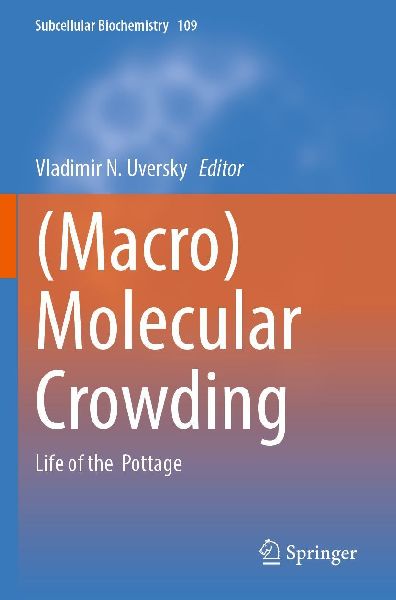
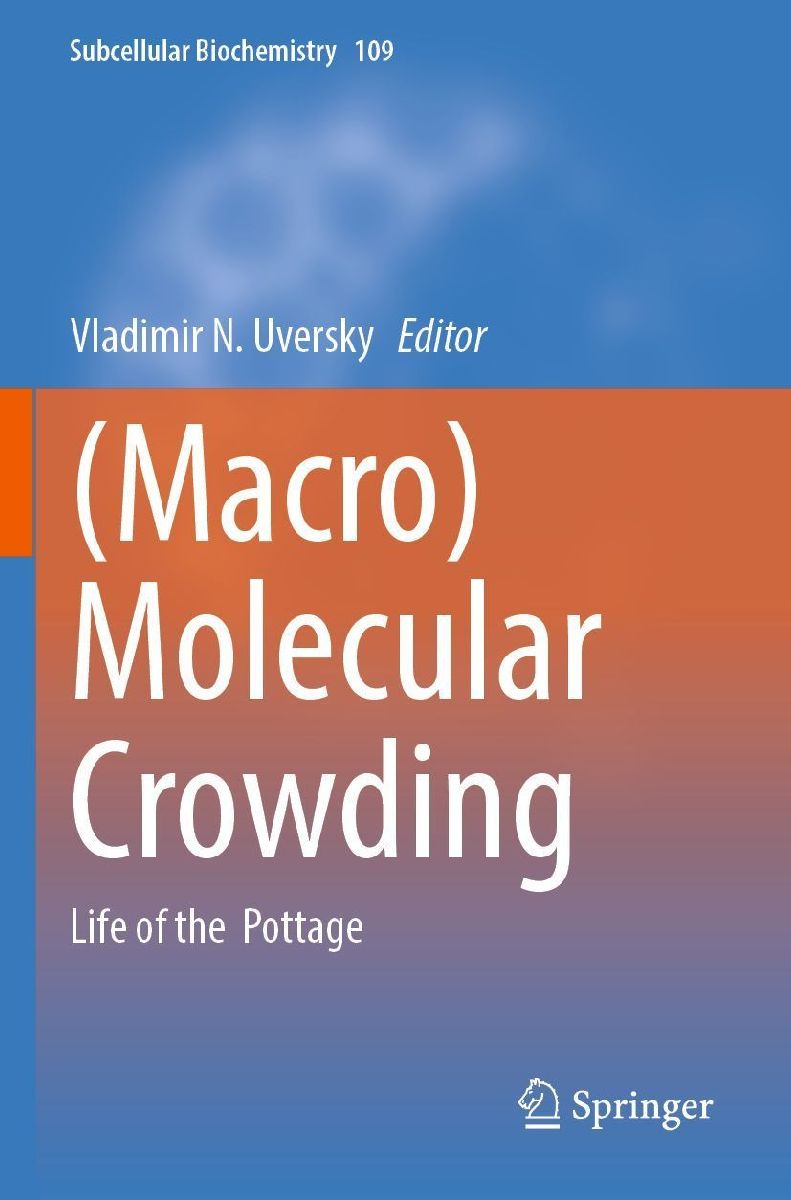
Life of the Pottage
von Vladimir N. Uversky (Hrsg.)
Herausgegeben von: Vladimir N. Uversky
Aus der Reihe Subcellular Biochemistry
This book presents a comprehensive overview of macromolecular crowding, a fundamental biological phenomenon that arises from the high concentration of macromolecules, such as proteins, nucleic acids, and carbohydrates, within living cells. Such crowded environment significantly reduces the amount of free water and alters key physical properties of media, such as viscosity and water activity.
One of the most notable effects is volume exclusion, where the space taken up by macromolecules becomes unavailable to others, influencing molecular interactions and reaction dynamics.
Cellular crowding can dramatically impact the stability and behavior of biological macromolecules, affect their folding, aggregation, and association, as well as alter the rates of chemical reactions. However, these effects are still not fully understood, largely because traditional biochemical research is conducted in dilute solutions failing to replicate the crowded conditions inside cells.
To address this gap, researchers are developing experimental models that simulate macromolecular crowding and confinement, allowing for more accurate studies of biomolecular behavior under realistic conditions. These models are essential for understanding how crowding influences molecular function and cellular processes.
Recent discoveries have revealed that macromolecular crowding is not uniform throughout the cell. Instead, it exhibits spatio-temporal heterogeneity, with regions of extreme crowding formed by membrane-less organelles and biological condensates—dense liquid droplets created through liquid-liquid phase separation.
These dynamic structures often emerge in response to environmental changes and play critical roles in cellular organization and regulation.
This book brings together leading experts to explore the foundational principles and cutting-edge developments in this field. It covers the physics of crowding, experimental techniques for characterizing these phenomena, and examples of well-understood systems. It also serves as a practical guide for researchers, helping them design experiments and generate hypotheses relevant to their study systems.
Designed for both early-career scientists and those entering the field from other disciplines, this volume offers a structured and accessible introduction to macromolecular crowding. It provides curated access to essential literature and equips readers with the tools needed to navigate this complex and rapidly evolving area of research.
Prof. Vladimir Uversky is a Professor at the Department of Molecular Medicine at the Morsani College of Medicine, University of South Florida (USF). He obtained Ph. D. from the Moscow Institute of Physics and Technology (1991) and a D.Sc.
from the Institute of Experimental and Theoretical Biophysics (1998).He obtained pre- and postdoctoral training in Structural Biology, Biochemistry, and Biophysics (1991-1998, Institute of Protein Research, Russian Academy of Sciences) and spent his early career working on protein folding at the Institute of Protein Research and the Institute for Biological Instrumentation (Russia). In 1998, he moved to the University of California Santa Cruz, where for six years he was studying protein folding, misfolding, protein conformation diseases, and protein intrinsic disorder phenomenon. In 2004, he was invited to join the Indiana University School of Medicine as a Senior Research Professor to work on intrinsically disordered proteins. Since 2010, he has been with USF, where he continues to study intrinsically disordered proteins, protein folding and misfolding processes, as well as liquid-liquid phase transitions and their applications in biology.
He has authored over 1500 scientific publications and edited several books and book series on protein structure, function, folding, and misfolding. Among his most recent edited volumes are "Droplets of Life: Membrane-less Organelles, Biomolecular Condensates, and Biological Liquid-Liquid Phase Separation" (ISBN: 9780128239674), "Structure and Intrinsic Disorder in Enzymology" (together with Munishwar Gupta, ISBN: 9780323995337), and “The Three Functional States of Proteins: Structured, Intrin-sically Disordered, and Phase Separated” (together with Prof. Timir Tripathi, ISBN: 9780443218095. He is also an editor of several scientific journals. In 2021, he was elected as a Fellow of the Royal Society of Biology and a Fellow of the Royal Society of Chemistry, and in 2024, he was elected as a Fellow of the American Institute for Medical and Biological Engineering and a Fellow of the American Association for the Advancement of Science.
Standardversand: 1 bis 3 Werktage, 3,99 €, kostenlos ab 35 €
Liefergebiet: Deutschland
Rücksendung: 14 Tage Widerrufsrecht. Bei einem Widerruf tragen Sie die Kosten der Rücksendung. Bei einer Falschlieferung oder einem Fehler von uns erstatten wir Ihnen das Rückporto. Den Widerruf erklären Sie über den Knopf „Vertrag widerrufen“ im Fuß der Seite.
Vladimir N. Uversky (Hrsg.)
Gebunden, Englisch, 2 Ausgaben
ab 213,99 €
Vladimir N. Uversky (Hrsg.)
Gebunden, Englisch, 2 Ausgaben
ab 106,99 €
Vladimir N. Uversky (Hrsg.)
Kartoniert, Englisch, 2 Ausgaben
ab 213,99 €
Narasimham L. Parinandi (Hrsg.)
Gebunden, Englisch, 2 Ausgaben
ab 160,49 €
Valquiria Bueno (Hrsg.)
Gebunden, Englisch, 2 Ausgaben
ab 192,59 €
Zu diesem Titel gibt es noch keine Bewertung. Bewerten kann, wer ihn bei uns gekauft hat.