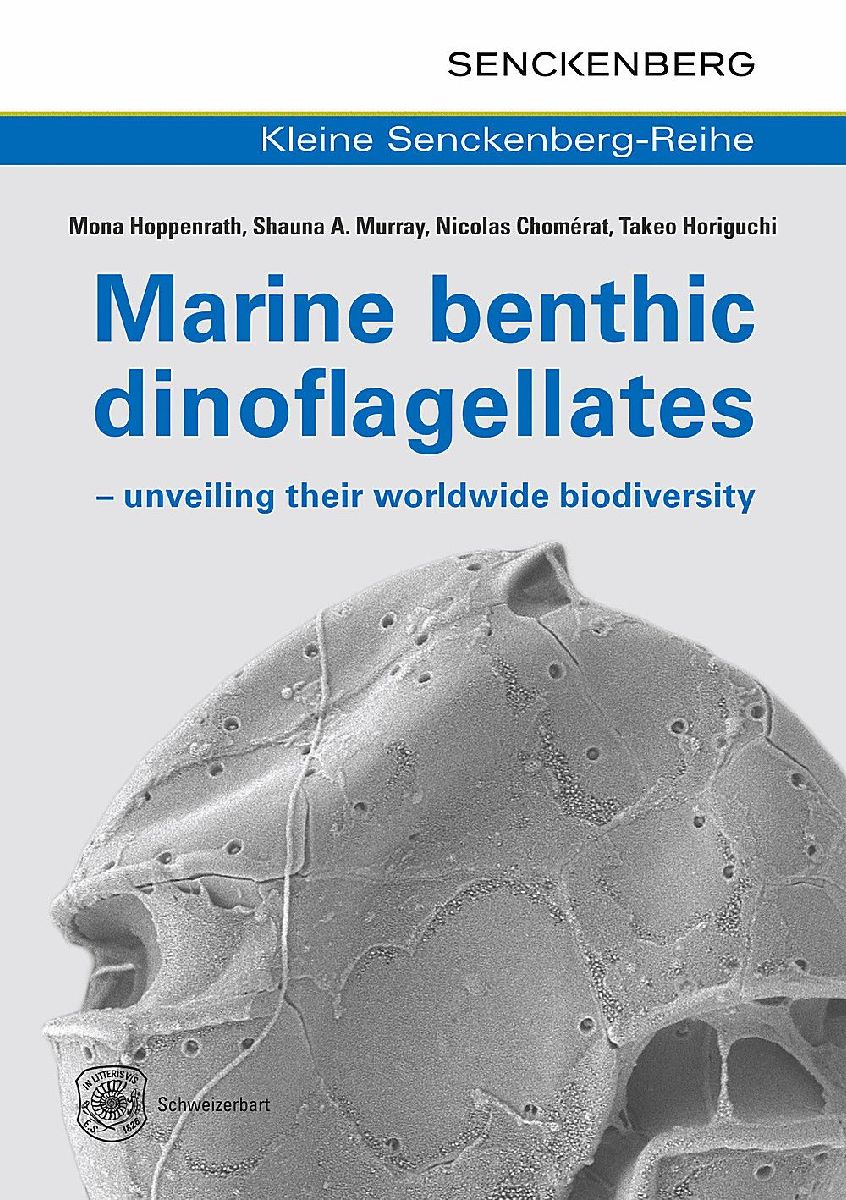
Marine benthic dinoflagellates - unveiling their worldwide biodiversity
Herausgegeben von: Mona Hoppenrath, Herausgegeben von: Shauna A. Murray, Herausgegeben von: Nicolas Chomérat, und weitere
Aus der Reihe Kleine Senckenberg-Reihe
- Einband
- Kartoniert
- Seiten
- 276
- Sprache
- Englisch
- Erschienen
- Juli 2014
- Verlag
- Schweizerbart Sche Vlgsb.
Buchbeschreibung
This publication presents the first summary of our knowledge of benthic dinoflagellate species.
Dinoflagellates are important primary producers and symbionts, but, at the same time, also consumers and parasites. Species compositions of benthic habitats are quite distinct from those of planktonic habitats. Less than 10% of the approximately 2000 described extant dinoflagellate species appear to be benthic.
Ganze Beschreibung lesenWeniger anzeigen
They occur in different types of habitats (chapter II) and their morphology, their behavior, and some of their life cycles (chapter VI) seem to be well adapted to the benthic lifestyle. Information on their geographic distribution is still very limited and is compiled herein (chapter V). The study of harmful benthic dinoflagellates started in the late 1970s when it was suspected that a benthic species, later named Gambierdiscus toxicus, was responsible for ciguatera fish poisoning, a type of human poisoning linked to the consumption of certain species of tropical reef fish.
As the number of ciguatera fish poisoning incidents increases, and the distribution of toxin producing benthic taxa seems to be expanding, detailed understanding of the species diversity and the ability to accurately identify them is becoming increasingly important (chapter VII). Dinoflagellate classification is currently undergoing changes and far from being settled, as new species and genera are discovered and systematic entities are rearranged.
Many benthic dinoflagellate genera have unusual morphologies and appear to be only remotely related to known planktonic taxa, so that molecular phylogenetic analyses frequently show little statistical support for any relationship (chapter IV). Benthic species display unique thecal plate arrangements compared to planktonic species, e.g. Adenoides, Amphidiniella, Cabra, Planodinium, Sabulodinium, Rhinodinium (chapter III). Therefore, no classification on higher rank levels (e.g. family, order) was used throughout this book.
Genera (and species within a genus) are presented in alphabetical order. The book presents the first comprehensive identification help for benthic dinoflagellates. At the same time it aims to lend support in order to improve monitoring efforts worldwide. About 190 species in 45 genera are presented in detail, illustrated with more than 200 color images, approximately 150 scanning electron micrographs, and more than 250 drawings.
Details
- Erscheinungstermin
- Juli 2014
- Kategorie
- Fremdsprachige Bücher
- Einband
- Kartoniert
- Seiten
- 276
- Sprache
- Englisch
- Verlag
- Schweizerbart Sche Vlgsb.
- Reihe
- Kleine Senckenberg-Reihe
- Format
- 20,8 × 14,6 cm
- Dicke
- 2,0 cm
- Gewicht
- 602 g
- EAN / ISBN-13
- 9783510614028
Versand und Rückgabe
Standardversand: 1 bis 3 Werktage, 3,99 €, kostenlos ab 35 €
Versandbeginn: in der Regel am selben oder am nächsten Werktag
Liefergebiet: Deutschland
Rücksendung: 14 Tage Widerrufsrecht. Bei einem Widerruf tragen Sie die Kosten der Rücksendung. Bei einer Falschlieferung oder einem Fehler von uns erstatten wir Ihnen das Rückporto. Den Widerruf erklären Sie über den Knopf „Vertrag widerrufen“ im Fuß der Seite.
Hersteller und ProduktsicherheitE. Schweizerbart'sche Verlagsbuchhandlung (Nägele u. Obermiller)
E. Schweizerbart'sche Verlagsbuchhandlung (Nägele u. Obermiller)
Johannesstraße 3a
70176 Stuttgart
Deutschland
mail@schweizerbart.de
Ähnliche Titel


Bacterial Invasion into Eukaryotic Cells
Tobias A. Oelschlaeger (Hrsg.)
Gebunden, Englisch, 2 Ausgaben
ab 320,99 €


Extracellular Sugar-Based Biopolymers Matrices
Ephraim Cohen (Hrsg.)
Gebunden, Englisch, 2 Ausgaben
ab 160,49 €
Bewertungen
Zu diesem Titel gibt es noch keine Bewertung. Bewerten kann, wer ihn bei uns gekauft hat.
So prüfen wir Bewertungen
Eine Bewertung kann bei uns nur abgeben, wer den Titel über sein Kundenkonto bei uns gekauft hat. Jede Bewertung ist fest mit der zugehörigen Bestellung verknüpft; anders kommt sie technisch gar nicht zustande. Deshalb trägt jede angezeigte Bewertung den Hinweis „Verifizierter Kauf". Wir zeigen positive wie negative Bewertungen und löschen nur bei Rechtsverstößen. Für Bewertungen gibt es keine Gegenleistung.
19,90 €Voraussichtlich 30. Nov. bis 2. Dez.