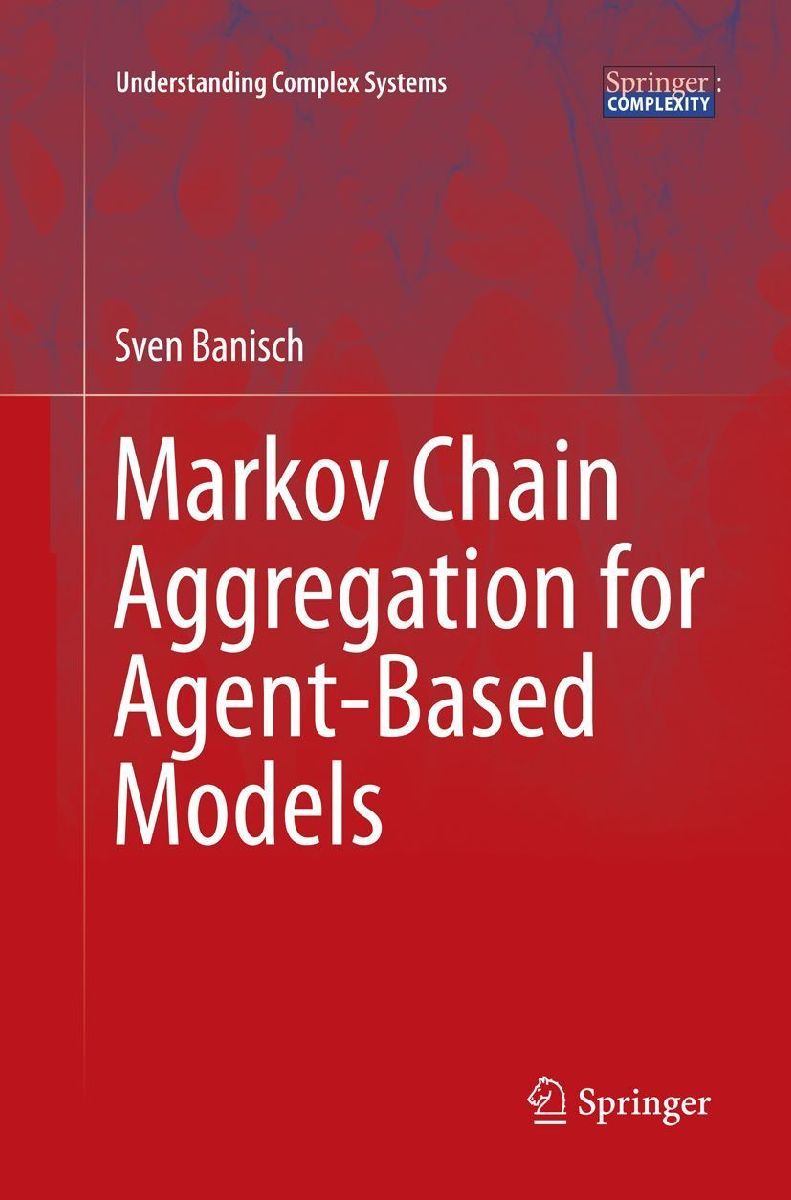
Markov Chain Aggregation for Agent-Based Models
von Sven Banisch
Aus der Reihe Understanding Complex Systems
- Einband
- Kartoniert
- Seiten
- 212
- Sprache
- Englisch
- Erschienen
- März 2018
- Verlag
- Springer
Buchbeschreibung
This self-contained text develops a Markov chain approach that makes the rigorous analysis of a class of microscopic models that specify the dynamics of complex systems at the individual level possible.
It presents a general framework of aggregation in agent-based and related computational models, one which makes use of lumpability and information theory in order to link the micro and macro levels of observation.
Ganze Beschreibung lesenWeniger anzeigen
The starting point is a microscopic Markov chain description of the dynamical process in complete correspondence with the dynamical behavior of the agent-based model (ABM), which is obtained by considering the set of all possible agent configurations as the state space of a huge Markov chain.
An explicit formal representation of a resulting "micro-chain" including microscopic transition rates is derived for a class of models by using the random mapping representation of a Markov process. The type of probability distribution used to implement the stochastic part of the model, which defines the updating rule and governs the dynamics at a Markovian level, plays a crucial part in the analysis of "voter-like" models used in population genetics, evolutionary game theory and social dynamics.
The book demonstrates that the problem of aggregation in ABMs - and the lumpability conditions in particular - can be embedded into a more general framework that employs information theory in order to identify different levels and relevant scales in complex dynamical systems
Inhaltsverzeichnis
- Introduction
- Background and Concepts
- Agent-based Models as Markov Chains
- The Voter Model with Homogeneous Mixing
- From Network Symmetries to Markov Projections
- Application to the Contrarian Voter Model
- Information-Theoretic Measures for the Non-Markovian Case
- Overlapping Versus Non-Overlapping Generations
- Aggretion and Emergence: A Synthesis
- Conclusion
Details
- Erscheinungstermin
- März 2018
- Kategorie
- Fremdsprachige Bücher
- Einband
- Kartoniert
- Seiten
- 212
- Sprache
- Englisch
- Verlag
- Springer
- Reihe
- Understanding Complex Systems
- Format
- 23,5 × 15,5 cm
- Dicke
- 1,2 cm
- Gewicht
- 330 g
- EAN / ISBN-13
- 9783319796918
Versand und Rückgabe
Standardversand: 1 bis 3 Werktage, 3,99 €, kostenlos ab 35 €
Liefergebiet: Deutschland
Rücksendung: 14 Tage Widerrufsrecht. Bei einem Widerruf tragen Sie die Kosten der Rücksendung. Bei einer Falschlieferung oder einem Fehler von uns erstatten wir Ihnen das Rückporto. Den Widerruf erklären Sie über den Knopf „Vertrag widerrufen“ im Fuß der Seite.
Hersteller und ProduktsicherheitSpringer Nature Customer Service Center GmbH
Springer Nature Customer Service Center GmbH
Europaplatz 3
69115 Heidelberg
Deutschland
ProductSafety@springernature.com
Mehr aus der Reihe Understanding Complex Systems


Artificial Intelligence and Complex Dynamical Systems
Giorgos Tsironis
Kartoniert, Englisch, 2 Ausgaben
ab 53,49 €

Ähnliche Titel

Fractal Functions, Dimensions and Signal Analysis
Santo Banerjee
Gebunden, Englisch, 2 Ausgaben
ab 139,09 €


Topics in Nonlinear Mechanics and Physics
Mohamed Belhaq (Hrsg.)
Gebunden, Englisch, 2 Ausgaben
ab 106,99 €

Bewertungen
Zu diesem Titel gibt es noch keine Bewertung. Bewerten kann, wer ihn bei uns gekauft hat.
So prüfen wir Bewertungen
Eine Bewertung kann bei uns nur abgeben, wer den Titel über sein Kundenkonto bei uns gekauft hat. Jede Bewertung ist fest mit der zugehörigen Bestellung verknüpft; anders kommt sie technisch gar nicht zustande. Deshalb trägt jede angezeigte Bewertung den Hinweis „Verifizierter Kauf". Wir zeigen positive wie negative Bewertungen und löschen nur bei Rechtsverstößen. Für Bewertungen gibt es keine Gegenleistung.
80,24 €Voraussichtlich 30. Nov. bis 2. Dez.