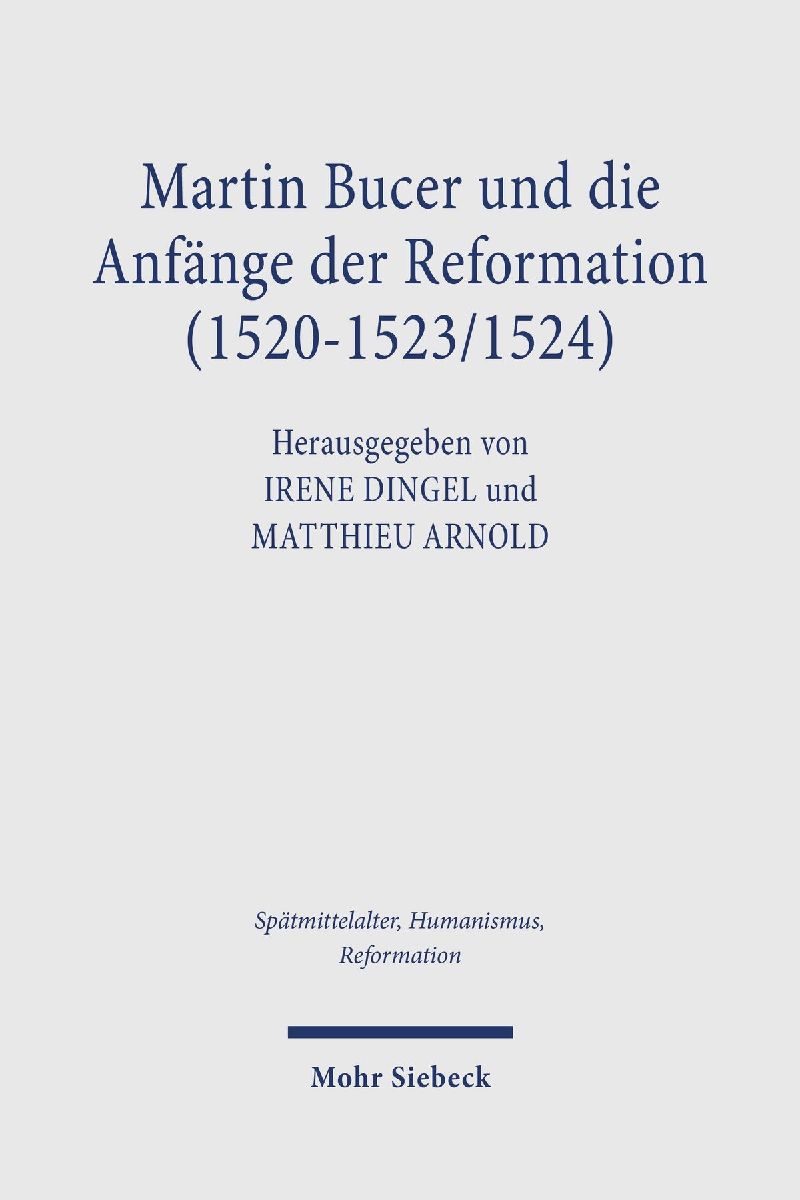
Martin Bucer und die Anfänge der Reformation (1520-1523/1524)
Herausgegeben von: Irene Dingel, Herausgegeben von: Matthieu Arnold
- Einband
- Gebunden
- Seiten
- 330
- Sprache
- Deutsch
- Erschienen
- November 2026
- Verlag
- Mohr Siebeck GmbH & Co. K
Buchbeschreibung
Martin Bucer (1491-1551) is regarded as the central figure of the Reformation in the southwest of the Holy Roman Empire.
The contributors to this volume examine the environments in which his early work unfolded and shed light on the regional diversity of the Reformation. The focus is on the early years, 1520-1523/1524.
Ganze Beschreibung lesenWeniger anzeigen
A description of the political and intellectual-historical contexts of the Reformation and a characterization of Bucer's theology based on his early writings lay the groundwork for the subsequent focus on Alsace and the surrounding regions.
Baden and the Electoral Palatinate, Huldrych Zwingli's Zurich, and the Erasmus-influenced Basel were influential zones of contact that shaped and influenced the Reformation championed by Bucer in various ways. At the same time, Bucer's work was accompanied by other factors that either fostered or hindered the Reformation: The impetus provided by Imperial Diets or city councils created favorable conditions, while the traditional clergy opposed the innovations.
Women's initiatives supported the changes brought about by the Reformation, and in popular reception, Anabaptist positions also gained ground, revealing a potential for dissent. Early on, centers of the Reformation began to emerge in Alsace; this section will focus on those that best illustrate the region's diverse manifestations of the Reformation: Strasbourg, Sélestat, and Mulhouse.
The channels and media through which Reformation ideas spread were - as elsewhere - book printing, correspondence, catechetical instruction, preaching, and singing. In the regional contexts of the southwest and within Bucer's sphere of influence, however, these too took on distinctive characteristics.
Inhaltsverzeichnis
- Hinführung
- Volker Leppin : Der politische und geistesgeschichtliche Kontext der Reformation - Christoph Strohm : Martin Bucers theologisches Profil nach seinen frühen Schriften
- Kontexte - Die Oberrhein-Region und die Schweiz
- Ulrich Andreas Wien : "das in kurtzer zeit mit der hilff des herrn gar viell eyn zirlicher Christenheit und loeblicher Evangelischer wandel bey uns würde erstaen".
- Anfänge der reformatorischen Bewegung in Regionen des heutigen Badens und der Pfalz - Peter Opitz : Ulrich Zwingli im Austausch mit den Straßburger Reformatoren Wolfgang Capito und Martin Bucer über den Aufbau einer "nach Gottes Wort reformierten" Kirche - Amy Nelson Burnett : The Erasmian Network
- Basel as a Central Node of the Early Reformation
- Akteure und historisch-theologisches Umfeld
- Eike Wolgast : Reichstag, reformatorische Bewegung, und Stadtrat als Akteure der frühen Reformation
Ganzes Inhaltsverzeichnis anzeigen (23 Einträge)Weniger anzeigen
- Olivier Ponçet : Le choix de Rome ? Les clercs restés fidèles à la foi traditionnelle à Strasbourg entre 1520 et 1524
- Andrea Hofmann : Akteurinnen der frühen Straßburger Reformation
- Weibliche Initiativen
- Irene Dingel : Das Echo der frühen Reformation auf volkstümlicher Ebene
- Karsthans und Clemens Ziegler
- Brennpunkte der Reformation im Elsass
- Marc Lienhard : Les débuts de la Réformation à Strasbourg 1520-1524 - Gabriel Braeuner : Sélestat entre Humanisme et Réforme - Odile Kammerer : Mulhouse et les débuts de la Réformation
- Medien und Wege der Verbreitung reformatorischen Gedankenguts
- Armin Kohnle : Buchdruck und Reformation in Straßburg und Schlettstadt 1518-1525
- Matthieu Arnold : Le rôle des correspondances épistolaires dans la diffusion des idées réformatrices: l'exemple de Martin Bucer (1520-1524)
- Florian Büttner : Frühe reformatorische Katechismen
- Zwischen Abgrenzung und Integration
- Wolf-Friedrich Schäufele : Martin Bucer als Theoretiker und Praktiker der evangelischen Predigt
- Daniel Trocmé-Latter : "Gott sei gelobet": L'aube du chant de la Réforme strasbourgeoise
- Beat Föllmi : Der Straßburger Psalmengesang und seine Wirkung
Details
- Erscheinungstermin
- November 2026
- Kategorie
- Sachbuch
- Einband
- Gebunden
- Seiten
- 330
- Sprache
- Deutsch
- Verlag
- Mohr Siebeck GmbH & Co. K
- Format
- 23,2 × 15,5 cm
- EAN / ISBN-13
- 9783162008701
Über Irene Dingel (Hrsg.)
Irene Dingel (Herausgegeben von)
Born 1956; studied Protestant Theology and Romance Studies; 1986 doctorate and 1993 habilitation at Heidelberg University; 2005-22 Director of the Leibniz Institute of European History, Mainz (Dept.
Mehr über Irene Dingel (Hrsg.)Weniger anzeigen
of Western Religious History); Senior Research Professor at Johannes Gutenberg University Mainz and the Heidelberg Academy of Sciences and Humanities | Mainz.
Matthieu Arnold (Herausgegeben von)
Born 1965; 1996 habilitation at the University of Strasbourg; Professor of the History of Christianity at the Protestant Faculty of Theology of the University of Strasbourg.
Versand und Rückgabe
Standardversand: 1 bis 3 Werktage, 3,99 €, kostenlos ab 35 €
Liefergebiet: Deutschland
Rücksendung: 14 Tage Widerrufsrecht. Bei einem Widerruf tragen Sie die Kosten der Rücksendung. Bei einer Falschlieferung oder einem Fehler von uns erstatten wir Ihnen das Rückporto. Den Widerruf erklären Sie über den Knopf „Vertrag widerrufen“ im Fuß der Seite.
Hersteller und ProduktsicherheitJana Trispel
Mehr von Irene Dingel




Handbuch Frieden im Europa der Frühen Neuzeit / Handbook of Peace in Early Modern Europe
Irene Dingel (Hrsg.)
Kartoniert, 2 Ausgaben
ab 44,95 €
Ähnliche Titel


Bewertungen
Zu diesem Titel gibt es noch keine Bewertung. Bewerten kann, wer ihn bei uns gekauft hat.
So prüfen wir Bewertungen
Eine Bewertung kann bei uns nur abgeben, wer den Titel über sein Kundenkonto bei uns gekauft hat. Jede Bewertung ist fest mit der zugehörigen Bestellung verknüpft; anders kommt sie technisch gar nicht zustande. Deshalb trägt jede angezeigte Bewertung den Hinweis „Verifizierter Kauf". Wir zeigen positive wie negative Bewertungen und löschen nur bei Rechtsverstößen. Für Bewertungen gibt es keine Gegenleistung.
120,00 €Erscheint 11/2026