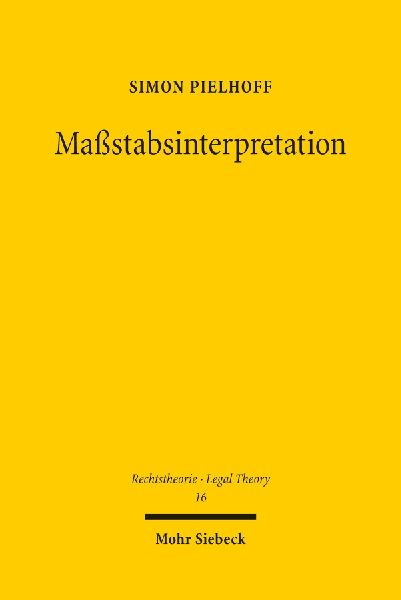
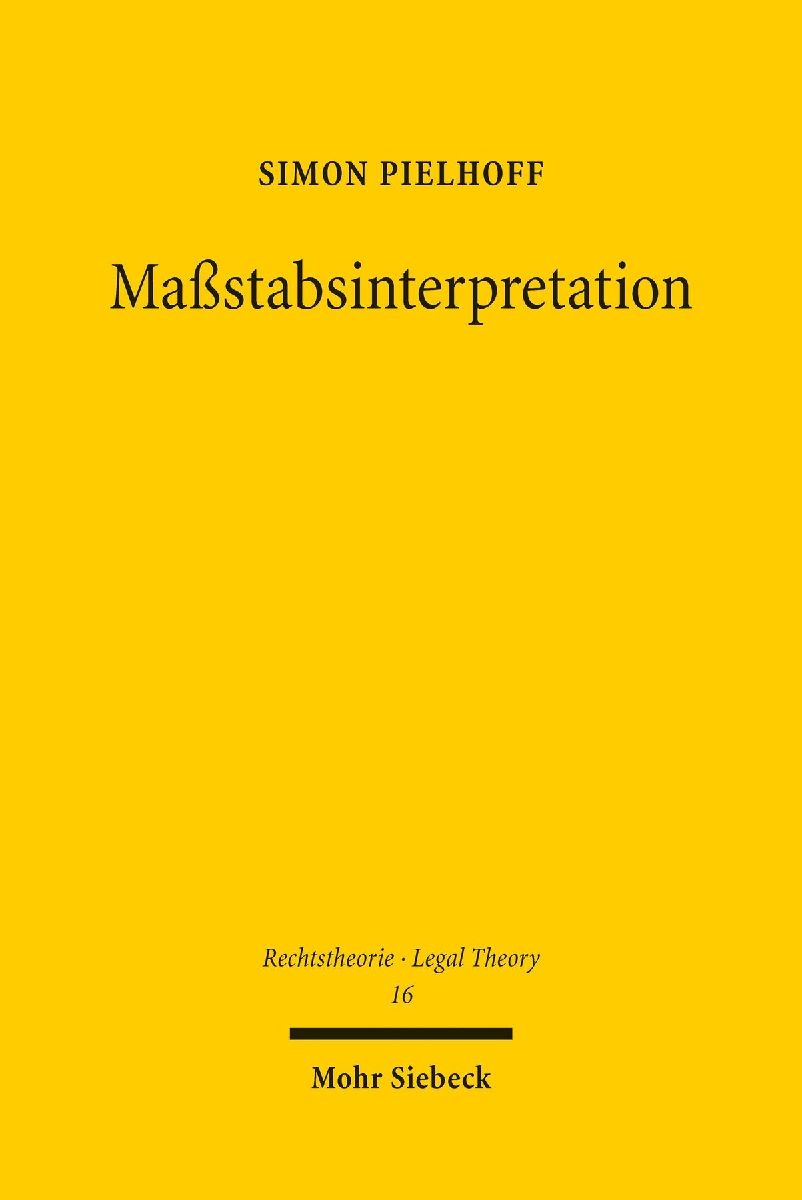
Maßstabsinterpretation
Die Auslegung verfassungsgerichtlicher Maßstäbe aus pragmatistischer Perspektive
von Simon Pielhoff
Aus der Reihe Rechtstheorie - Legal Theory
- Einband
- Kartoniert
- Seiten
- 358
- Sprache
- Deutsch
- Erschienen
- September 2026
- Verlag
- Mohr Siebeck GmbH & Co. K
Buchbeschreibung
Constitutional law is, to a large extent, judge-made law.
But how should constitutional court standards be interpreted? To what extent can they be generalized, and to what extent must they be contextualized, historicized, and relativized? Drawing on pragmatist theories of methodological choice, Simon Pielhoff develops an approach to interpreting standards that navigates between historicization and abstraction.
Ganze Beschreibung lesenWeniger anzeigen
Building on the work of, among others, Ronald Dworkin, Joseph Raz, and Scott Shapiro, he reconstructs a „teleological argument“ for methodological choice. According to this argument, norms should be interpreted using a method that brings to bear the functions for which we follow those norms. Methods must therefore pass a pragmatist test: they must prove themselves through their consequences.
If constitutional court standards serve to simplify and harmonize the application of the constitution and to allocate competences, interpretive methods should enable them to fulfil these functions. Pielhoff argues that this approach to methodological choice is particularly well suited to identifying a method for interpreting standards.
As an „incompletely theorized agreement,“ it provides common ground among the positions in the debate on standard interpretation. The teleological argument supports understanding constitutional court standards as norms with implicit escape clauses. Standards can be applied abstractly but always reserve the possibility of deviation.
Accordingly, their binding force is differentiated: it varies depending on the form of the standard, its degree of abstraction, and the identity of the interpreter. Moreover, deviation from standards that are unconvincing in a particular application context is always envisaged, without thereby disregarding the standard itself.
After developing this „exit method,“ Pielhoff uses pragmatist criteria to criticize both the methodological proposal of historicizing relativization of standards and the practice of their abstracting application.
Inhaltsverzeichnis
- Einführung
- 1. Teil - Streit ohne Gegenstand: Die Methodendebatte über die Interpretation verfassungsgerichtlicher Maßstäbe und Bedingungen von Methodenvorschlägen
- I. Die Methodendebatte über die Interpretation verfassungsgerichtlicher Maßstäbe - II. Bedingungen für das Gelingen eines Methodenvorschlags
- 2. Teil - Gegenstand ohne Streit: Das teleologische Argument zur Methodenwahl
- I. Einführung des Arguments: Methodenwahl als pragmatische Teleologie - II. Eignung des teleologischen Arguments zu den Gelingensbedingungen eines Methodenvorschlags: taugt es als Incompletely Theorized Agreement?
- 3. Teil - Pragmatistischer, historisierender und dogmatischer Umgang mit Maßstäben: Beurteilung verschiedener Interpretationsmethoden nach ihren Funktionen
- I. Gedanken und Zeit in Maßstäben gefasst
- Die Ausstiegsmethode
Ganzes Inhaltsverzeichnis anzeigen (13 Einträge)Weniger anzeigen
- II. Gedanken in Zeit gefasst
- Vergleich mit der Kontextualisierungsmethode
- III. Zeit in Gedanken gefasst
- Vergleich mit der Abstrahierungsmethode
- Schluss: Pragmatische Teleologie der Methodenwahl
Details
- Erscheinungstermin
- September 2026
- Kategorie
- Fachbuch
- Einband
- Kartoniert
- Seiten
- 358
- Sprache
- Deutsch
- Verlag
- Mohr Siebeck GmbH & Co. K
- Reihe
- Rechtstheorie - Legal Theory
- Format
- 23,0 × 15,4 cm
- Dicke
- 2,1 cm
- Gewicht
- 534 g
- EAN / ISBN-13
- 9783162005113
Über Simon Pielhoff
Geboren 1996; Studium der Rechtswissenschaften in Münster; 2020 Erste Juristische Prüfung; 2025 Promotion (Münster); Rechtsreferendariat am Kammergericht Berlin; 2026 Zweite Juristische Prüfung.
Versand und Rückgabe
Standardversand: 1 bis 3 Werktage, 3,99 €, kostenlos ab 35 €
Versandbeginn: in der Regel am selben oder am nächsten Werktag
Liefergebiet: Deutschland
Rücksendung: 14 Tage Widerrufsrecht. Bei einem Widerruf tragen Sie die Kosten der Rücksendung. Bei einer Falschlieferung oder einem Fehler von uns erstatten wir Ihnen das Rückporto. Den Widerruf erklären Sie über den Knopf „Vertrag widerrufen“ im Fuß der Seite.
Hersteller und ProduktsicherheitJana Trispel
Mehr aus der Reihe Rechtstheorie - Legal Theory
Ähnliche Titel



Bewertungen
Zu diesem Titel gibt es noch keine Bewertung. Bewerten kann, wer ihn bei uns gekauft hat.
So prüfen wir Bewertungen
Eine Bewertung kann bei uns nur abgeben, wer den Titel über sein Kundenkonto bei uns gekauft hat. Jede Bewertung ist fest mit der zugehörigen Bestellung verknüpft; anders kommt sie technisch gar nicht zustande. Deshalb trägt jede angezeigte Bewertung den Hinweis „Verifizierter Kauf". Wir zeigen positive wie negative Bewertungen und löschen nur bei Rechtsverstößen. Für Bewertungen gibt es keine Gegenleistung.
94,00 €Voraussichtlich 30. Nov. bis 2. Dez.