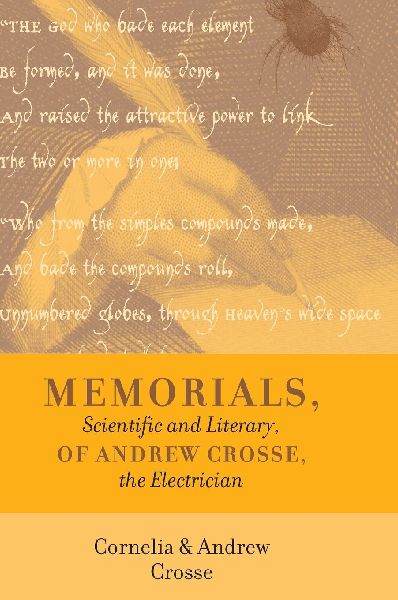
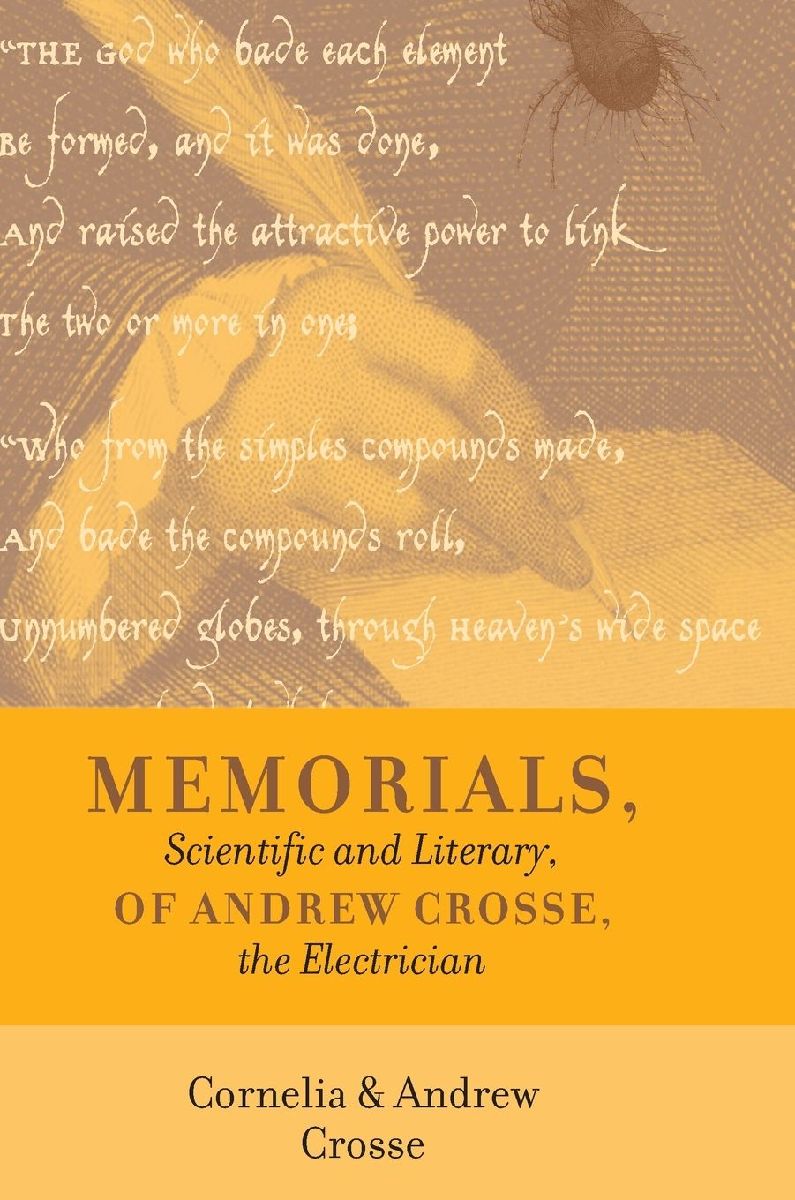
Memorials, Scientific and Literary, of Andrew Crosse, the Electrician
von Andrew Crosse und Cornelia Crosse
- Einband
- Gebunden
- Seiten
- 256
- Sprache
- Englisch
- Erschienen
- Dezember 2019
- Verlag
- Timaios Press
Buchbeschreibung
Today, the English scientist and poet Andrew Crosse (1784-1855) is almost exclusively remembered for his mysterious "Acarus electricus," a form of mites that seemed to have been created during one of his electrical experiments. But this is unfair.
Among his friends were the mathematician Lady Ada Lovelace and prominent scientists such as Sir Humphry Davy and Michael Faraday, but also romantic poets such as Robert Southey and Walter Savage Landor.
Ganze Beschreibung lesenWeniger anzeigen
These and many other celebrities from the first half of the 19th century occurs in this colorful and vivid memorial, written and published by his widow Cornelia Crosse in 1857. Here is depicted not only the life and work of the eccentric and likeable Andrew Crosse; it is also an anthology with examples of his literary output.
A typical amateur scientist of the upper classes, Andrew Crosse experimented for his own enjoyment and not for glory. The same applies to his writing; Crosse’s poems circulated among friends, but was only occasionally published during his lifetime. In the poems, prose and letters you see his obsession with the riddle of life and death.
All this should be seen in a romantic light. During this era, natural philosophers wanted to form a synthesis of science with aesthetics, imagination and breakneck speculations -- Romantic science was a concept. Researchers and laymen alike was fascinated by electricity, which was presumed to be the key to the mystery of matter and life.
Explaining all mysteries of the Universe was within the boundaries of opportunity, and a gifted philosopher could anticipate the answers with his imagination and intuition. Did Crosse really see the electric mites be born in his laboratory 1837, or was this also a phantasy?
Robert Southey leaked information about the mites to the press, and the sensation turned into moral panic. Crosse was accused of interfering with the Creator’s work and to run errands for atheism. Other scientists dismissed him as a charlatan. The sensible Andrew Crosse abandoned these experiments for peace and quiet.
And possibly he was not himself convinced that the mites arose spontaneously by the interaction of electricity and chemicals, but were due to the equipment having been contaminated by airborne eggs.
This book also shows that Crosse experimented with his electric mites during a period of strong psychological pressure because of death and a controversy with a research colleague. After her husband’s death, Cornelia Crosse (1827-1895) became an acclaimed author of popular science.
Details
- Erscheinungstermin
- Dezember 2019
- Kategorie
- Fremdsprachige Bücher
- Einband
- Gebunden
- Seiten
- 256
- Sprache
- Englisch
- Verlag
- Timaios Press
- Format
- 21,6 × 15,3 cm
- Dicke
- 1,9 cm
- Gewicht
- 449 g
- EAN / ISBN-13
- 9789187611216
Versand und Rückgabe
Standardversand: 1 bis 3 Werktage, 3,99 €, kostenlos ab 35 €
Liefergebiet: Deutschland
Rücksendung: 14 Tage Widerrufsrecht. Bei einem Widerruf tragen Sie die Kosten der Rücksendung. Bei einer Falschlieferung oder einem Fehler von uns erstatten wir Ihnen das Rückporto. Den Widerruf erklären Sie über den Knopf „Vertrag widerrufen“ im Fuß der Seite.
Hersteller und ProduktsicherheitTimaios Press
Timaios Press
Europaallee 1
36244 Bad Hersfeld
Deutschland
gpsr@libri.de
Verantwortliche Person in der EU
Libri GmbHEuropaallee 1
36244 Bad Hersfeld
Deutschland
gpsr@libri.de
Ähnliche Titel


Bewertungen
Zu diesem Titel gibt es noch keine Bewertung. Bewerten kann, wer ihn bei uns gekauft hat.
So prüfen wir Bewertungen
Eine Bewertung kann bei uns nur abgeben, wer den Titel über sein Kundenkonto bei uns gekauft hat. Jede Bewertung ist fest mit der zugehörigen Bestellung verknüpft; anders kommt sie technisch gar nicht zustande. Deshalb trägt jede angezeigte Bewertung den Hinweis „Verifizierter Kauf". Wir zeigen positive wie negative Bewertungen und löschen nur bei Rechtsverstößen. Für Bewertungen gibt es keine Gegenleistung.
20,90 €Voraussichtlich 7. bis 9. Dez.