Buch-OWLOnline-Buchhandel

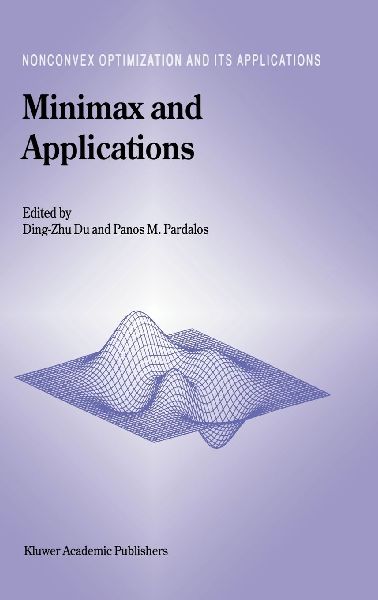
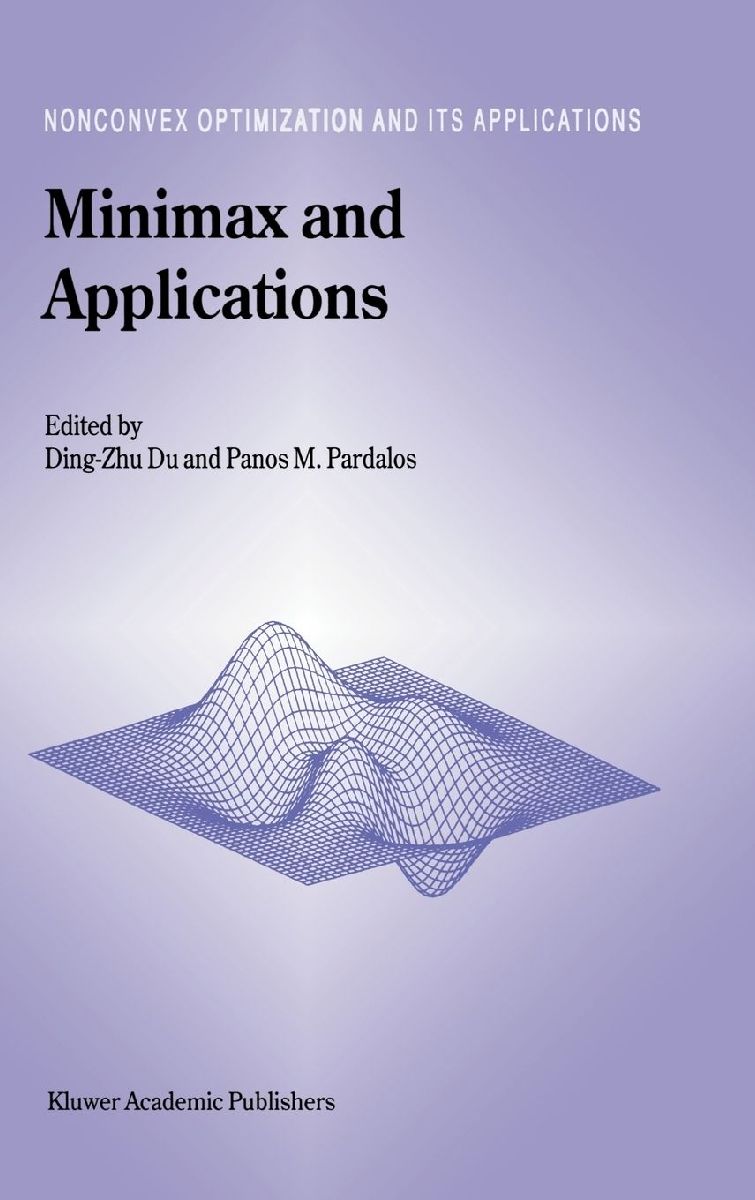
Minimax and Applications

von Ding-Zhu Du (Hrsg.)

Herausgegeben von: Ding-Zhu Du, Herausgegeben von: Panos M Pardalos

Einband
Gebunden
Seiten
296
Sprache
Englisch
Erschienen
Oktober 1995
Verlag
Springer Us

Buchbeschreibung

Techniques and principles of minimax theory play a key role in many areas of research, including game theory, optimization, and computational complexity.

In general, a minimax problem can be formulated as min max f(x, y) (1) ",EX !lEY where f(x, y) is a function defined on the product of X and Y spaces. There are two basic issues regarding minimax problems: The first issue concerns the establishment of sufficient and necessary conditions for equality minmaxf(x,y) = maxminf(x,y).

Ganze Beschreibung lesenWeniger anzeigen

(2) "'EX !lEY !lEY "'EX The classical minimax theorem of von Neumann is a result of this type. Duality theory in linear and convex quadratic programming interprets minimax theory in a different way. The second issue concerns the establishment of sufficient and necessary conditions for values of the variables x and y that achieve the global minimax function value f(x

, y

) = minmaxf(x, y). (3) "'EX !lEY There are two developments in minimax theory that we would like to mention.

Inhaltsverzeichnis

  • 5?
  • 3. 15/4? ? ? ? 5?
  • 4. 5/2? ? ? < 15/4?
  • 5. ? < 2.5?
  • References
  • A Study of On-Line Scheduling Two-Stage Shops
  • 1. Introduction
  • 2. Definitions and Preliminaries
Ganzes Inhaltsverzeichnis anzeigen (99 Einträge)Weniger anzeigen
  • 3. A Lower Bound for O2??max
  • 4. An Algorithm for O2??max
  • 5. A Best Algorithm for O2?pmtn??max
  • 6. On Flow and Job Shops
  • 7. Discussions
  • References
  • Maxmin Formulation of the Apportionments of Seats to a Parliament
  • 1. Introduction
  • 2. Concepts and models
  • 3. Illustrative examples
  • 4. Discussion
  • References
  • On Shortest k-Edge Connected Steiner Networks with Rectilinear
  • Distance
  • 1. Introduction
  • 2. Technical Preliminaries
  • 3. Main Results
  • References
  • Mutually Repellant Sampling
  • 1. Introduction
  • 2. Mutually Repellant Sampling
  • 3. Max-Min Distance Sampling
  • 4. Max-Min-Selection Distance Sampling
  • 5. Max-Average Distance Sampling
  • 6. Lower Bounds
  • 7. Applications and Open Questions
  • References
  • Geometry and Local Optimality Conditions for Bilevel Programs with Quadratic Strictly Convex Lower Levels
  • 1. Introduction
  • 2. Problem Statement and Geometry
  • 3. Computing the Convex Cones
  • 4. Number of Convex Cones
  • 5. Stationary Points and Local Minima
  • 6. Conclusions and Future Work
  • References
  • The Spherical One-Center Problem
  • 1. Introduction
  • 2. Main Result
  • 3. Conclusions
  • References
  • On Min-max Optimization of a Collection of Classical Discrete Optimization Problems
  • 1. Introduction
  • 2. The Min-max Spanning Tree Problem
  • 3. The Min-max Resource Allocation Problem
  • 4. The Min-max Production Control Problem
  • 5. Summary and Extensions
  • References
  • Heilbronn Problem for Six Points in a Planar Convex Body
  • 1. Introduction
  • 2. Prerequisites
  • 3. Proof of the Main Theorem
  • References
  • Heilbronn Problem for Seven Points in a Planar Convex Body
  • 1. Introduction
  • 2. Propositions and Proofs for Easier Cases
  • 3. Configurations with Stability
  • 4. Computing the Smallest Triangle
  • 5. Open Problems
  • References
  • On the Complexity of Min-Max Optimization Problems and Their Approximation
  • 1. Introduction
  • 2. Definition
  • 3. ?2P-Completeness Results
  • 4. Approximation Problems and Their Hardness
  • 5. Nonapproximability Results
  • 6. Conclusion and Open Questions
  • References
  • A Competitive Algorithm for the Counterfeit Coin Problem
  • 1. Introduction
  • 2. Some Lower Bounds of M(n : d)
  • 3. A Competitive
  • Algorithm
  • 4. Analysis of Competitiveness
  • 5. Conclusion
  • References
  • A Minimax ?ß Relaxation for Global Optimization
  • 1. Introduction
  • 2. Problem Model
  • 3. Relaxation Approach
  • 4. A General ?ß Relaxation Algorithm
  • 5. A Minimax ?ß Relaxation Algorithm for COP
  • 6. Experimental Results
  • References
  • Minimax Problems in Combinatorial Optimization
  • 1. Introduction
  • 2. Algorithmic Problems
  • 3. Geometric Problems
  • 4. Graph Problems
  • 5. Management Problems
  • 6. Miscellaneous
  • Author Index

Details

Erscheinungstermin
Oktober 1995
Kategorie
Fremdsprachige Bücher
Einband
Gebunden
Seiten
296
Sprache
Englisch
Verlag
Springer Us
Format
23,4 × 15,6 cm
Dicke
1,9 cm
Gewicht
612 g
EAN / ISBN-13
9780792336150
Maßstabsgetreu: Deckel und Buchrücken neben einer Hand (18 cm).
Versand und Rückgabe

Standardversand: 1 bis 3 Werktage, 3,99 €, kostenlos ab 35 €

Liefergebiet: Deutschland

Rücksendung: 14 Tage Widerrufsrecht. Bei einem Widerruf tragen Sie die Kosten der Rücksendung. Bei einer Falschlieferung oder einem Fehler von uns erstatten wir Ihnen das Rückporto. Den Widerruf erklären Sie über den Knopf „Vertrag widerrufen“ im Fuß der Seite.

Hersteller und ProduktsicherheitSpringer Nature Customer Service Center GmbH
Springer Nature Customer Service Center GmbH
Europaplatz 3
69115 Heidelberg
Deutschland
ProductSafety@springernature.com

Mehr von Ding-Zhu Du

Ähnliche Titel

Bewertungen

Zu diesem Titel gibt es noch keine Bewertung. Bewerten kann, wer ihn bei uns gekauft hat.
So prüfen wir Bewertungen
Eine Bewertung kann bei uns nur abgeben, wer den Titel über sein Kundenkonto bei uns gekauft hat. Jede Bewertung ist fest mit der zugehörigen Bestellung verknüpft; anders kommt sie technisch gar nicht zustande. Deshalb trägt jede angezeigte Bewertung den Hinweis „Verifizierter Kauf". Wir zeigen positive wie negative Bewertungen und löschen nur bei Rechtsverstößen. Für Bewertungen gibt es keine Gegenleistung.
170,50 €

Inhalte ab 18

Cover von Titeln für Erwachsene, etwa erotische Romane, Manga oder Comics, bleiben unscharf, bis Sie bestätigen. Die Bestätigung gilt für alle Seiten und Tabs, bis Sie den Browser schließen.

Zurück zum Katalog