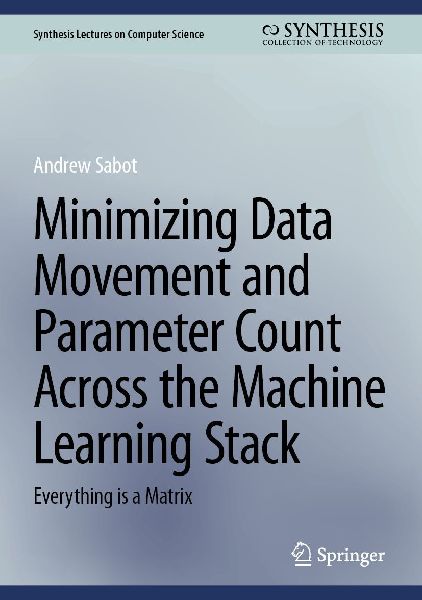
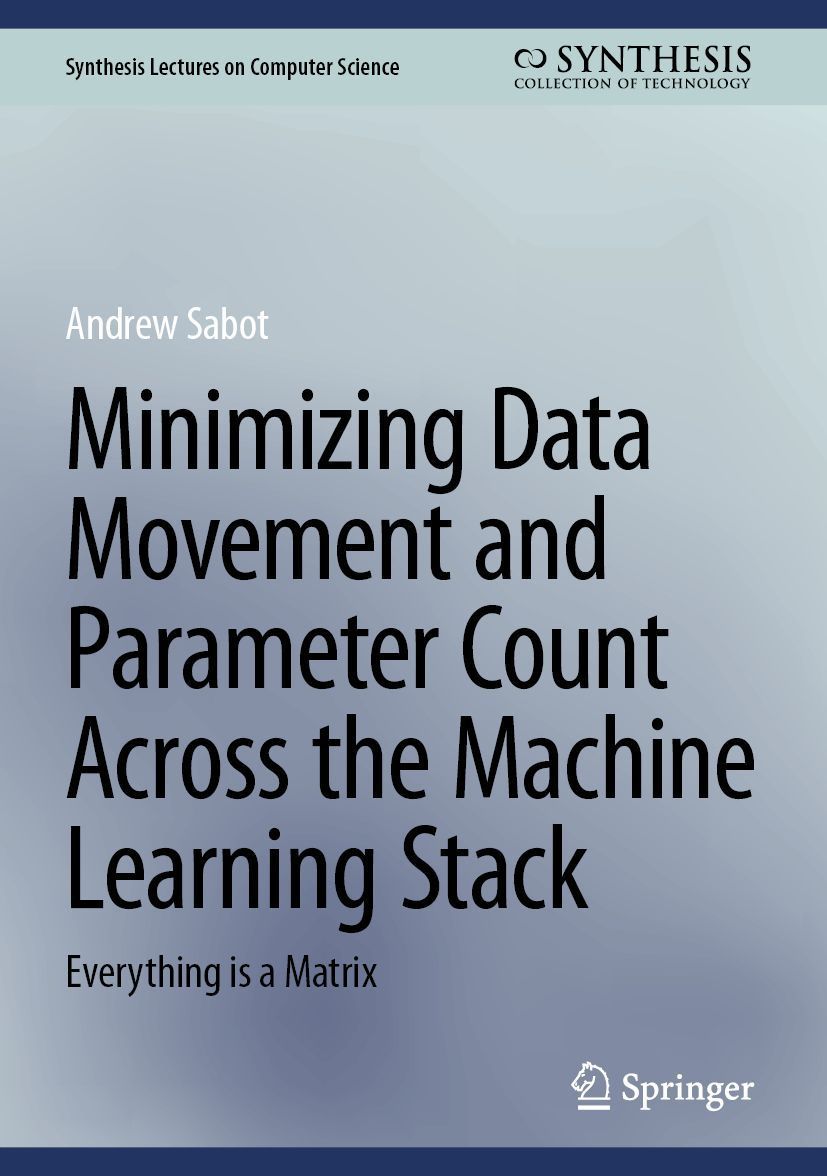
Minimizing Data Movement and Parameter Count Across the Machine Learning Stack
Everything is a Matrix
von Andrew Sabot
Aus der Reihe Synthesis Lectures on Computer Science
- Einband
- Gebunden
- Seiten
- 128
- Sprache
- Englisch
- Erschienen
- August 2026
- Verlag
- Springer
Buchbeschreibung
This book provides a focused, research-forward guide to making large AI models efficient in practice and also presents an array of novel techniques to reduce memory footprint, accelerate computation, and improve overall hardware utilization. The author demonstrates that substantial efficiency gains can be achieved by rethinking how data is computed, stored, and compressed, with a special focus on matrices, the core computational structure underpinning both scientific computing and neural networks.
Ganze Beschreibung lesenWeniger anzeigen
Modern AI models run on huge grids of numbers (matrices/tensors), and their speed and affordability depend on how those numbers are arranged and processed on real hardware (GPUs/TPUs/CPUs). This book explains practical methods to skip unnecessary work (structured sparsity), move data efficiently (gather/scatter), and shrink models without losing accuracy (block distillation) so that AI systems can use less memory, less time, and less energy without sacrificing quality.
In addition, the book shows how to turn algorithmic ideas into hardware-aware speedups on GPUs/TPUs. Readers will learn when sparsity pays off, how to schedule irregular workloads, and how to recover accuracy in compressed models. Case studies illustrate end-to-end design choices, evaluation, and pitfalls. The result is a coherent perspective that bridges theory, compilers/run times, and real-world deployment.
Inhaltsverzeichnis
- Introduction and Roadmap
- CAKE: Memory-Aware Block Shaping for GEMM
- mCAKE: From Matrices to Tensors
- Rosko: Structured Sparsity for ML Workloads
- Gather/Scatter for Rank-Sliced Activations
- Low-Rank Models via SVD
- Blockwise Knowledge Distillation
- Privacy-Preserving Split Inference (Edge/Cloud)
- Conclusion: Design Rules, Evaluation, and Outlook
Details
- Erscheinungstermin
- August 2026
- Kategorie
- Fremdsprachige Bücher
- Einband
- Gebunden
- Seiten
- 128
- Sprache
- Englisch
- Verlag
- Springer
- Reihe
- Synthesis Lectures on Computer Science
- Format
- 24,6 × 17,3 cm
- Dicke
- 1,3 cm
- Gewicht
- 347 g
- EAN / ISBN-13
- 9783032230997
Über Andrew Sabot
Andrew Sabot, Ph. D., is a Software Engineer working on Machine Learning at Google. He received his Ph. D. (2025) and M.S. (2021) in Computer Science from Harvard University. Dr.
Mehr über Andrew SabotWeniger anzeigen
Sabot’s work focuses on the intersection of hardware-aware kernels, model compression, and transformer inference acceleration to enable the sustainable deployment of state-of-the-art AI.
Versand und Rückgabe
Standardversand: 1 bis 3 Werktage, 3,99 €, kostenlos ab 35 €
Liefergebiet: Deutschland
Rücksendung: 14 Tage Widerrufsrecht. Bei einem Widerruf tragen Sie die Kosten der Rücksendung. Bei einer Falschlieferung oder einem Fehler von uns erstatten wir Ihnen das Rückporto. Den Widerruf erklären Sie über den Knopf „Vertrag widerrufen“ im Fuß der Seite.
Hersteller und ProduktsicherheitSpringer Nature Customer Service Center GmbH
Springer Nature Customer Service Center GmbH
Europaplatz 3
69115 Heidelberg
Deutschland
ProductSafety@springernature.com
Mehr aus der Reihe Synthesis Lectures on Computer Science
Ähnliche Titel
Bewertungen
Zu diesem Titel gibt es noch keine Bewertung. Bewerten kann, wer ihn bei uns gekauft hat.
So prüfen wir Bewertungen
Eine Bewertung kann bei uns nur abgeben, wer den Titel über sein Kundenkonto bei uns gekauft hat. Jede Bewertung ist fest mit der zugehörigen Bestellung verknüpft; anders kommt sie technisch gar nicht zustande. Deshalb trägt jede angezeigte Bewertung den Hinweis „Verifizierter Kauf". Wir zeigen positive wie negative Bewertungen und löschen nur bei Rechtsverstößen. Für Bewertungen gibt es keine Gegenleistung.
42,79 €Voraussichtlich 3. bis 7. Dez.