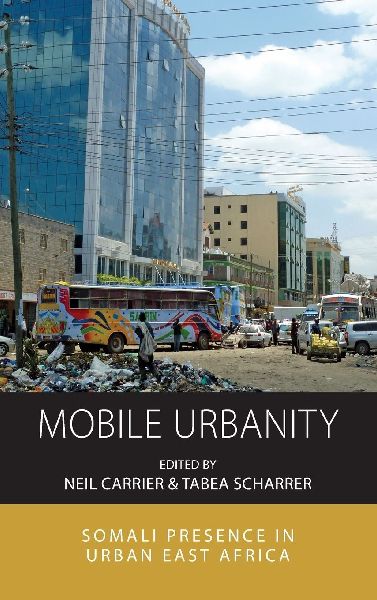
Mobile Urbanity
Somali Presence in Urban East Africa
Herausgegeben von: Neil Carrier, Herausgegeben von: Tabea Scharrer
Aus der Reihe Integration and Conflict Studies
- Einband
- Gebunden
- Seiten
- 266
- Sprache
- Englisch
- Erschienen
- Juli 2019
- Verlag
- Berghahn Books

Buchbeschreibung
The increased presence of Somalis has brought much change to East African towns and cities in recent decades, change that has met with ambivalence and suspicion, especially within Kenya.
This volume demystifies Somali residence and mobility in urban East Africa, showing its historical depth, and exploring the social, cultural and political underpinnings of Somali-led urban transformation.
Ganze Beschreibung lesenWeniger anzeigen
In so doing, it offers a vivid case study of the transformative power of (forced) migration on urban centres, and the intertwining of urbanity and mobility.
The volume will be of interest for readers working in the broader field of migration, as well as anthropology and urban studies.
Inhaltsverzeichnis
- List of Illustrations
- Acknowledgements
- List of Abbreviations PART I: INTRODUCTIONS Introduction: Mobile Urbanity: Somali Presence in Urban East Africa
- Tabea Scharrer and Neil Carrier Interlude: Being and Becoming Mobile
- Yusuf Hassan PART II: URBANITY Chapter 1. The Somali Factor in Urban Kenya: A History
- Hannah Whittaker Chapter 2. The Port and the Island: Cosmopolitan and Vernacular Identity Constructions among Somali Women in Nairobi and Johannesburg
- Nereida Ripero-Muñiz Chapter 3. Being Oromo in Nairobi's 'Little Mogadishu': Superdiversity, Moral Community and the Open Economy
- Neil Carrier and Hassan H. Kochore PART III: ECONOMIC NETWORKS Chapter 4. Demanding and Commanding Goods: The Eastleigh Transformation Told through the 'Lives' of Its Commodities
Ganzes Inhaltsverzeichnis anzeigen (17 Einträge)Weniger anzeigen
- Neil Carrier and Hannah Elliott Chapter 5. Capital Mobilization among the Somali Refugee Business Community in Eastleigh, Nairobi
- John Mwangi Githigaro and Kenneth Omeje Chapter 6. Challenging the Status Quo from the Bottom Up? Gender and Enterprise in Somali Migrant Communities in Nairobi, Kenya
- Holly A. Ritchie Chapter 7. Reinventing Retail: 'Somali' Shopping Centres in Kenya
- Tabea Scharrer PART IV: THE POLITICS OF SOMALI MOBILITY Chapter 8. Perpetually in Transit: Somalian Refugees in a Context of Increasing Hostility
- Lucy Lowe and Mark Yarnell Chapter 9. Framing the Swoop: A Comparative Analysis of Operation Usalama Watch in Muslim and Secular Print Media in Kenya
- Joseph Wandera and Halkano Abdi Wario Chapter 10. Beyond Eastleigh: A New Little Mogadishu in Uganda?
- Gianluca Iazzolino Afterword
- Günther Schlee Glossary
- Index
Details
- Erscheinungstermin
- Juli 2019
- Kategorie
- Fremdsprachige Bücher
- Einband
- Gebunden
- Seiten
- 266
- Sprache
- Englisch
- Verlag
- Berghahn Books
- Reihe
- Integration and Conflict Studies
- Format
- 23,5 × 15,7 cm
- Dicke
- 1,9 cm
- Gewicht
- 493 g
- EAN / ISBN-13
- 9781789202960
Über Neil Carrier (Hrsg.)
Tabea Scharrer is currently working at the Max Planck Institute for Social Anthropology in Halle (Germany), doing research with Somali migrants in Kenyan urban centres and in Europe.
Mehr über Neil Carrier (Hrsg.)Weniger anzeigen
She wrote her dissertation on Muslim Missionary Movements and Conversion to Islam at the Free University in Berlin.
Versand und Rückgabe
Standardversand: 1 bis 3 Werktage, 3,99 €, kostenlos ab 35 €
Liefergebiet: Deutschland
Rücksendung: 14 Tage Widerrufsrecht. Bei einem Widerruf tragen Sie die Kosten der Rücksendung. Bei einer Falschlieferung oder einem Fehler von uns erstatten wir Ihnen das Rückporto. Den Widerruf erklären Sie über den Knopf „Vertrag widerrufen“ im Fuß der Seite.
Hersteller und ProduktsicherheitBerghahn Books
Berghahn Books
Europaallee 1
36244 Bad Hersfeld
Deutschland
gpsr@libri.de
Verantwortliche Person in der EU
Libri GmbHEuropaallee 1
36244 Bad Hersfeld
Deutschland
gpsr@libri.de
Mehr von Neil Carrier


Mehr aus der Reihe Integration and Conflict Studies




Ähnliche Titel




Bewertungen
Zu diesem Titel gibt es noch keine Bewertung. Bewerten kann, wer ihn bei uns gekauft hat.
So prüfen wir Bewertungen
Eine Bewertung kann bei uns nur abgeben, wer den Titel über sein Kundenkonto bei uns gekauft hat. Jede Bewertung ist fest mit der zugehörigen Bestellung verknüpft; anders kommt sie technisch gar nicht zustande. Deshalb trägt jede angezeigte Bewertung den Hinweis „Verifizierter Kauf". Wir zeigen positive wie negative Bewertungen und löschen nur bei Rechtsverstößen. Für Bewertungen gibt es keine Gegenleistung.
150,00 €Voraussichtlich 4. bis 8. Dez.