
Buch-OWLOnline-Buchhandel

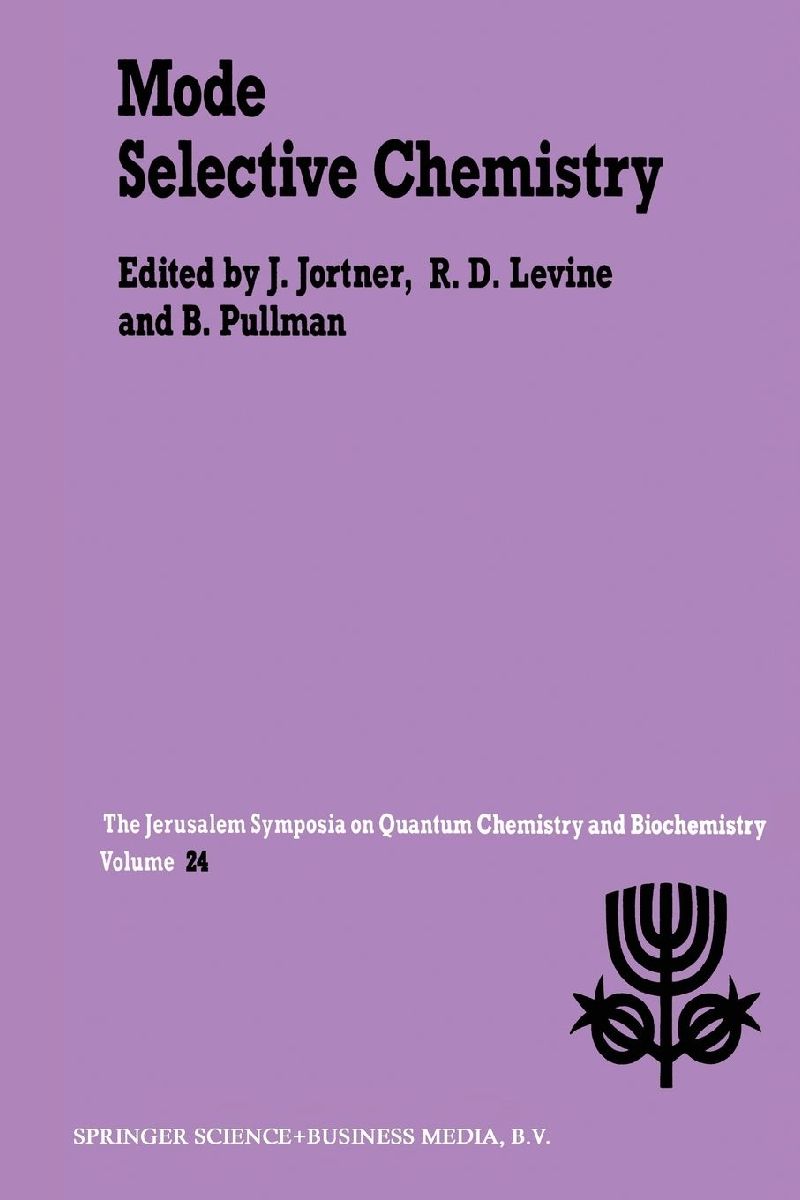
Mode Selective Chemistry

Proceedings of the Twenty-Fourth Jerusalem Symposium on Quantum Chemistry and Biochemistry Held in Jerusalem, Israel, May 20-23, 1991

von Joshua Jortner (Hrsg.)

Herausgegeben von: Joshua Jortner, Herausgegeben von: R. D. Levine, Herausgegeben von: A. Pullman

Aus der Reihe Jerusalem Symposia

Einband
Kartoniert
Seiten
596
Sprache
Englisch
Erschienen
Oktober 2012
Verlag
Springer

Buchbeschreibung

The Twenty Fourth Jerusalem Symposium reflected the high standards of these distinguished scientific meetings, which convene once a year at the Israel Academy of Sciences and Humanities in Jerusalem to discuss a specific topic in the broad area of quantum chemistry and biochemistry. The topic at this year's Jerusalem Symposium was mode selective chemistry, which constitutes a truly interdisciplinary subject of central interest in the areas of chemical physics, photochemistry and photobiology.

Ganze Beschreibung lesenWeniger anzeigen

The main theme of the Symposium was built around the exploration of the possibility and conditions for non-statistical reaction dynamics in molecules, van der Waals molecules, clusters and condensed phases.

The main issues addressed photoselective and coherent excitation modes, bottlenecks for intramolecular vibrational energy redistribution, the consequences of the internal structure of many-atom systems and of rotational­ vibrational level structure for intramolecular dynamics, bond selective photodissociation, ultrafast chemical clocks for energy disposal, coherent control of photochemical reactions and nonstatistical unimolecular reaction dynamics.

The interdisciplinary nature of this research area was deliberated by intensive and extensive interactions between theory and experiment. This volume provides a record of the invited lectures at the Symposium.

Inhaltsverzeichnis

  • How we and Molecules Explore Molecular Landscapes
  • Intramolecular Vibrational Redistribution on the Nanosecond Time Scale: v1 and 2v1Spectra of Substituted Acetylene Compounds
  • Multiple Laser Probes of Intramolecular Dynamics at Chemically Significant Energies
  • Mode Selective Vibrational Redistribution and Unimolecular Reactions during and after IR-Laser Excitation
  • Vibrational Level Structures and Reasonances in Triatomic Molecules: H2O
  • Mode Selective Van der Waals Chemistry
  • Theoretical Studies on Photofragmentation of Rare Gas-Interhalogen Van der Waals Complexes
  • Mode Specific Vibrational Predissociation Dynamics in Fragile Molecules
Ganzes Inhaltsverzeichnis anzeigen (36 Einträge)Weniger anzeigen
  • Observations of the Level Mixing Associated with the Methyl Rotor Acceleration of Intramolecular Vibrational Redistribution. p-Fluorotoluene
  • Dynamics and Spectroscopy of Heteroclusters
  • Mode Selectivity in Cluster-Molecule Interactions: Ni13+ D2
  • Cluster Photoexcitation and Evaporation: Two Regimes ?
  • Search for Mode Selective Cluster Isomerization
  • Dynamics of Photoinduced Reactions in Clusters
  • Mode-and Bond-Selected Bimolecular Reaction of Water
  • Mode-Selective Bond Fission in Fundamental Stretchings of HOD
  • Adiabatic and Non-Adiabatic Dynamics in Unimolecular Reactions
  • Mode Specificity in Intramolecular Conversions
  • Temperatures of Fragments in Unimolecular Dissociations
  • Theory of Excitation, Bond Breaking, and Raman Scattering with Short Laser Pulses
  • Coherent Excitation Effects in Photodissociation: Strong Orientation of Molecular Products
  • Quantum Interference and the Control of Molecular Processes
  • Design of Femtosecond Pulse Sequences to Control Photochemical Products
  • Impulsive Iterative Inversion
  • Triplet States Dynamics in Isolated Molecules
  • Bond-Selective Memory Effects for is-Level Excitationof Molecules: Zero Kinetic Energy (Zeke) Electron-Photoion Coincidence Measurements
  • Random Walk Model for Energy Transfer at High Temperatures
  • Molecular Electronic Energy Transfer in a Supersonic Jet Expansion
  • Mode Specifity in Collisions of Aniline with Surfaces covered with Organized Organic Monolayers
  • No (X2II) Product State Distributions in Molecule-Surface Dissociative Scattering: n, i - C3F7No From MgO(100)
  • Implications of Giant Optical Vibrations Created by Ultrashort Laser Pulses
  • Femto
  • Second Processes and Ultrafast Biological Electron Transfer
  • Active Control of Selectivity of Product Formation in a Chemical Reaction: What's New?
  • The Prospects for Impulsively Driven, Mode-Selective Chemistry in Condensed Phases
  • Mode Selective Chemistry

Details

Erscheinungstermin
Oktober 2012
Kategorie
Fremdsprachige Bücher
Einband
Kartoniert
Seiten
596
Sprache
Englisch
Verlag
Springer
Reihe
Jerusalem Symposia
Format
23,5 × 15,5 cm
Dicke
3,2 cm
Gewicht
890 g
EAN / ISBN-13
9789401051675
Maßstabsgetreu: Deckel und Buchrücken neben einer Hand (18 cm).
Versand und Rückgabe

Standardversand: 1 bis 3 Werktage, 3,99 €, kostenlos ab 35 €

Liefergebiet: Deutschland

Rücksendung: 14 Tage Widerrufsrecht. Bei einem Widerruf tragen Sie die Kosten der Rücksendung. Bei einer Falschlieferung oder einem Fehler von uns erstatten wir Ihnen das Rückporto. Den Widerruf erklären Sie über den Knopf „Vertrag widerrufen“ im Fuß der Seite.

Hersteller und ProduktsicherheitSpringer Nature Customer Service Center GmbH
Springer Nature Customer Service Center GmbH
Europaplatz 3
69115 Heidelberg
Deutschland
ProductSafety@springernature.com

Mehr von Joshua Jortner

Mehr aus der Reihe Jerusalem Symposia

Ähnliche Titel

Bewertungen

Zu diesem Titel gibt es noch keine Bewertung. Bewerten kann, wer ihn bei uns gekauft hat.

So prüfen wir Bewertungen
Eine Bewertung kann bei uns nur abgeben, wer den Titel über sein Kundenkonto bei uns gekauft hat. Jede Bewertung ist fest mit der zugehörigen Bestellung verknüpft; anders kommt sie technisch gar nicht zustande. Deshalb trägt jede angezeigte Bewertung den Hinweis „Verifizierter Kauf". Wir zeigen positive wie negative Bewertungen und löschen nur bei Rechtsverstößen. Für Bewertungen gibt es keine Gegenleistung.
213,99 €Voraussichtlich 30. Nov. bis 2. Dez.

Inhalte ab 18

Cover von Titeln für Erwachsene, etwa erotische Romane, Manga oder Comics, bleiben unscharf, bis Sie bestätigen. Die Bestätigung gilt für alle Seiten und Tabs, bis Sie den Browser schließen.

Zurück zum Katalog