
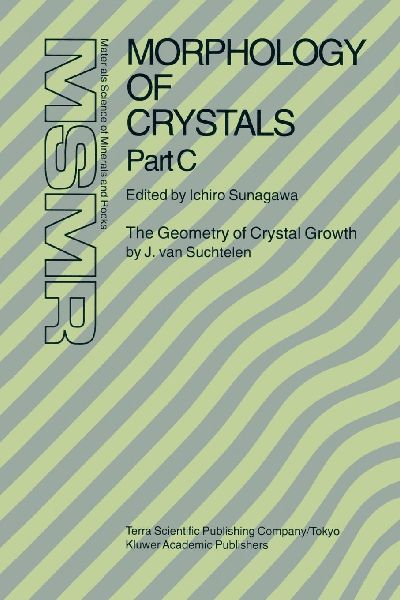
Morphology of Crystals
Part A: Fundamentals Part B: Fine Particles, Minerals and Snow Part C: The Geometry of Crystal Growth by Jaap Van Suchtelen
Herausgegeben von: Ichiro Sunagawa
- Seiten
- 1.227
- Sprache
- Englisch
- Erschienen
- Februar 1988
- Verlag
- Terrabooks
Buchbeschreibung
The molecular mechanisms underlying the fact that a crystal can take a variety of external forms is something we have come to understand only in the last few decades.
This is due to recent developments in theoretical and experimental investigations of crystal growth mechanisms.
Ganze Beschreibung lesenWeniger anzeigen
Morphology of Crystals is divided into three separately available volumes. Part A contains chapters on roughening transition; equilibrium form; step pattern theory; modern PBC; and surface microtopography. This part provides essentially theoretical treatments of the problem, particularly the solid-liquid interface.
Part B contains chapters on ultra-fine particles; minerals; transition from polyhedral to dendrite; theory of dendrite; and snow crystals. All chapters are written by world leaders in their respective areas, and some can be seen as representing the essence of a life's work. This is the first English-language work which covers all aspects of the morphology of crystals - a topic which has attracted top scientific minds for centuries.
As such, it is indispensable for anyone seeking an answer to a question relating to this fascinating problem: mineralogists, petrologists, crystallographers, materials scientists, workers in solid-state physics and chemistry, etc.
In Parts A: Fundamentals and B: Fine Particles, Minerals and Snow equilibrium and kinetic properties of crystals are generally approached from an `atomistic' point of view. In contrast, Part C: The Geometry of Crystal Growth follows the alternative and complementary `geometrical' description, where bulk phases are considered as continuous media and their interfaces as mathematical surfaces with orientation-dependent properties.
Equations of motion for a crystal surface are expressed in terms of vector and tensor operators working on surface free energy and growth rate, both expressed as functions of surface orientation and driving force, or `affinity' for growth. This approach emphasizes the interrelation between equilibrium and kinetic behavior. Part 1 establishes the theoretical framework.
Part 2 gives a construction toolbox for explicit (analytic) functions. An extra chapter is devoted to experimental techniques for measuring such functions: a new approach to sphere growth experiments. The emphasis throughout is on principles and new concepts.
Audience: Advanced readers familiar with traditional aspects of crystal growth theory. Can be used as the basis for an advanced course, provided supplementation is provided in the areas of atomistic models of the advancing surface, diffusion fields, etc.
Inhaltsverzeichnis
- Part A
- Crystal Graphs, Connected Nets, Roughening Transition and the Morphology of Crystals
- 2. The Equilibrium Form of a Crystal
- 3. Growth Shapes and their Stability at Anisotropic Interface Kinetics: Theorectical Aspects for Solution Growth
- 4. Modern PBC Theory
- 5. Surface Microtopography of Crystal Faces
- Part B
- 6. Crystallography of Metal Smoke Particles
Ganzes Inhaltsverzeichnis anzeigen (31 Einträge)Weniger anzeigen
- 7. Morphology of Minerals
- 8. Transition from Polyhedral to Dendritic Morphology
- 9. Theory of Dendritic Crystal Growth
- 10. Snow Crystals
- Part C
- 1. The continuum approach to crystal interfaces: basics
- I: Theoretical framework
- 2. Operators for orientation-dependent parameters
- 3. Mechanics and thermodynamics of interfaces
- 4. Equilibrium structures of junctions, edges and vertices
- 5. Growth: kinematic wave theory revisited
- 6. Kinetic behaviour of junctions, edges and vertices
- 7. Structural phase transitions of a crystal surface as a branch of soliton physics
- 8. Miscellaneous topics
- II: Growth rate functions
- 9. Analytic representations of R(n,A) functions
- 10. Nonlinear networks and the `assembled function' notation
- 11. Physical aspects of assembling operations
- 12. The systematic construction of R(n,A) functions by a sequence of assembling steps
- 13. Notes on sphere-growth experiments
- 14. Summary: Conclusions and outstanding questions
- References
- List of symbols, abbreviations and notations
Details
- Erscheinungstermin
- Februar 1988
- Kategorie
- Fremdsprachige Bücher
- Seiten
- 1.227
- Sprache
- Englisch
- Verlag
- Terrabooks
- Gewicht
- 1 g
- EAN / ISBN-13
- 9789027725103
Versand und Rückgabe
Standardversand: 1 bis 3 Werktage, 3,99 €, kostenlos ab 35 €
Liefergebiet: Deutschland
Rücksendung: 14 Tage Widerrufsrecht. Bei einem Widerruf tragen Sie die Kosten der Rücksendung. Bei einer Falschlieferung oder einem Fehler von uns erstatten wir Ihnen das Rückporto. Den Widerruf erklären Sie über den Knopf „Vertrag widerrufen“ im Fuß der Seite.
Hersteller und ProduktsicherheitSpringer Nature Customer Service Center GmbH
Springer Nature Customer Service Center GmbH
Europaplatz 3
69115 Heidelberg
Deutschland
ProductSafety@springernature.com
Mehr von Ichiro Sunagawa

Ähnliche Titel



Miniature Fluidic Devices for Rapid Biological Detection
Sang-Hyun Oh (Hrsg.)
Gebunden, Englisch, 2 Ausgaben
ab 123,04 €

Vibronic Interactions and the Jahn-Teller Effect
Mihail Atanasov (Hrsg.)
Gebunden, Englisch, 2 Ausgaben
ab 213,99 €
Bewertungen
Zu diesem Titel gibt es noch keine Bewertung. Bewerten kann, wer ihn bei uns gekauft hat.
So prüfen wir Bewertungen
Eine Bewertung kann bei uns nur abgeben, wer den Titel über sein Kundenkonto bei uns gekauft hat. Jede Bewertung ist fest mit der zugehörigen Bestellung verknüpft; anders kommt sie technisch gar nicht zustande. Deshalb trägt jede angezeigte Bewertung den Hinweis „Verifizierter Kauf". Wir zeigen positive wie negative Bewertungen und löschen nur bei Rechtsverstößen. Für Bewertungen gibt es keine Gegenleistung.
470,50 €