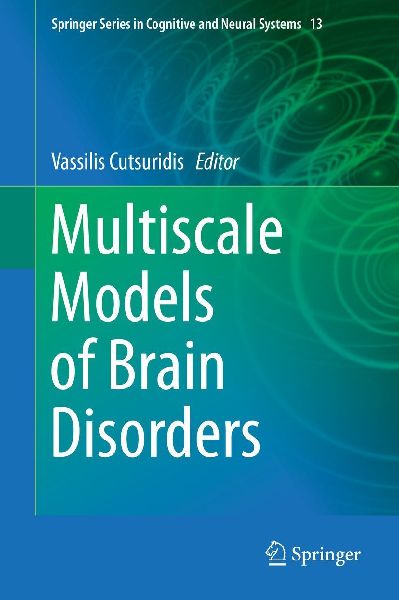
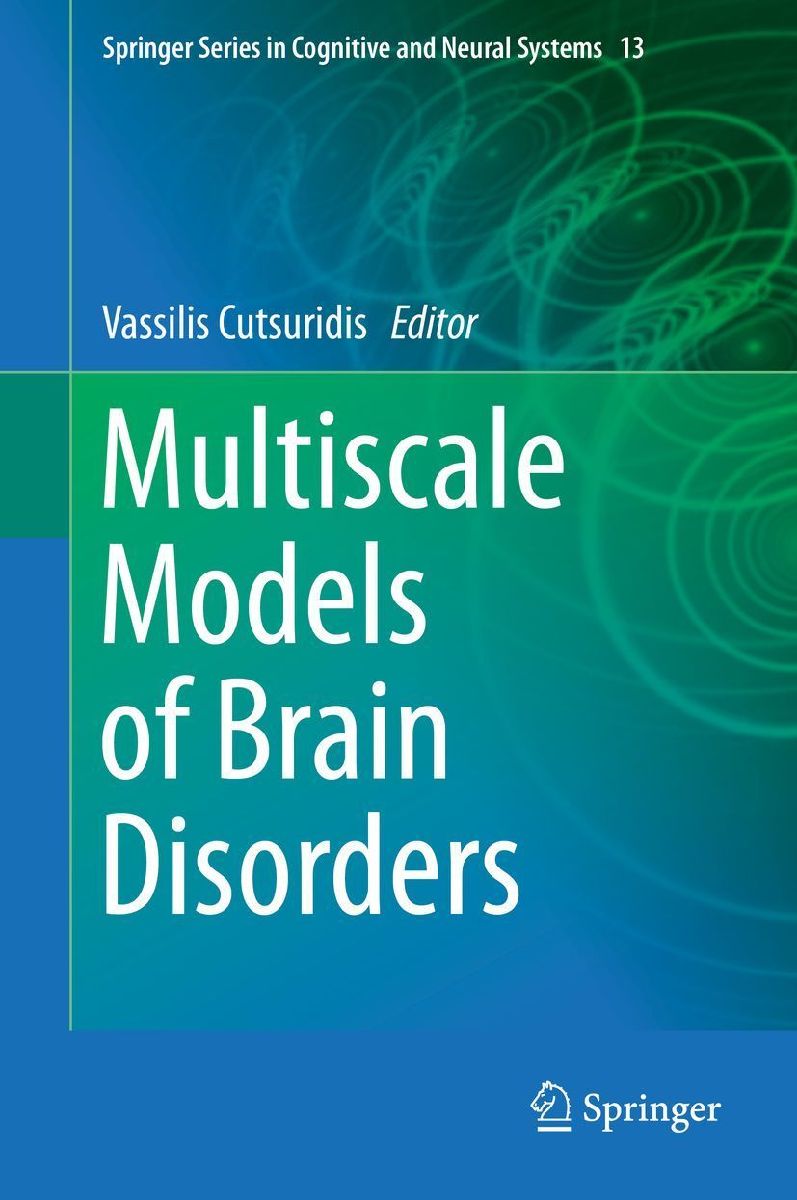
Multiscale Models of Brain Disorders
von Vassilis Cutsuridis (Hrsg.)
Herausgegeben von: Vassilis Cutsuridis
Aus der Reihe Springer Series in Cognitive and Neural Systems
- Einband
- Gebunden
- Seiten
- 236
- Sprache
- Englisch
- Erschienen
- Oktober 2019
- Verlag
- Springer
Buchbeschreibung
This book focuses on our current understanding of brain dynamics in various brain disorders (e.g. epilepsy, Alzheimer's and Parkinson's disease) and how the multi-scale, multi-level tools of computational neuroscience can enhance this understanding. In recent years, there have been significant advances in the study of the dynamics of the disordered brain at both the microscopic and the macroscopic levels.
Ganze Beschreibung lesenWeniger anzeigen
This understanding can be furthered by the application of multi-scale computational models as integrative principles that may link single neuron dynamics and the dynamics of local and distant brain regions observed using human EEG, ERPs, MEG, LFPs and fMRI.Focusing on the computational models that are used to study movement, memory and cognitive disorders as well as epilepsy and consciousness related diseases, the book brings together physiologists and anatomists investigating cortical circuits; cognitive neuroscientists studying brain dynamics and behaviorby means of EEG and functional magnetic resonance imaging (fMRI); and computational neuroscientists using neural modeling techniques to explore local and large-scale disordered brain dynamics.
Covering topics that have a significant impact on the field of medicine, neuroscience and computer science, the book appeals to a diverse group of investigators.
Inhaltsverzeichnis
- Part I Movement Disorders
- A neuro-computational model of Pallidal vs. Subthalamic Deep Brain Stimulation Effect on synchronization at Tremor frequency in Parkinson's disease, Alekhya Mandali, Srinivasa Chakravarthy V, Ahmed A. Moustafa
- Dynamics of Basal Ganglia and Thalamus in Parkinsonian Tremor, Jan Moren, Jun Igarashi, Osamu Shouno, Junichiro Yoshimoto, and Kenji Doya
- A neural mass model for abnormal beta-rebound in schizophrenia, Aine Byrne, Stephen Coombes, and Peter F Liddle
- Basal ganglio-thalamo-cortico-spino-muscular model of Parkinson's disease bradykinesia, Vassilis Cutsuridis
- Network Models of the Basal Ganglia in Parkinson's Disease: Advances in Deep Brain Stimulation through Model-Based Optimization, Karthik Kumaravelu1, Warren M. Grill
- Neural synchronization in Parkinson's disease on different time-scales, Sungwoo Ahn, Choongseok Park, Leonid L. Rubchinsky
- Obsessive compulsive tendencies and action sequence complexity: An Information Theory Analysis, Mustafa Zeki, Fuat Balc¿, Tutku Öztel, Ahmed A. Moustafa
Ganzes Inhaltsverzeichnis anzeigen (24 Einträge)Weniger anzeigen
- Part II Cognitive Disorders
- Cortical disinhibition, attractor dynamics and belief updating in schizophrenia, Rick A Adams
- Modelling cognitive processing of healthy controls and obsessive compulsive disorder subjects in the antisaccade task, Vassilis Cutsuridis
- Simulating cognitive deficits in Parkinson's disease, Sébastien Hélie and Zahra Sajedinia
- Attentional deficits in Alzheimer's disease: investigating the role of acetylcholine with computational modelling, Eirini Mavritsaki, Howard Bowman, Li Su
- A computational hypothesis on how serotonin regulates catecholamines in the pathogenesis of depressive apathy, Massimo Silvetti, Gianluca Baldassarre, Daniele Caligiore
- Autism Spectrum Disorder and deep attractors in neurodynamics, W¿odzis¿aw Duch
- Part III Memory Disorders
- Alzheimer's disease: rhythms, local circuits and model-experiment interaction, Frances K Skinner, Alexandra Chatzikalymniou
- Using A Neurocomputational Autobiographical Memory Model to Study Memory Loss, Di Wang, Ahmed A. Moustafa, Ah-Hwee Tan, Chunyan Miao
- Part IV Epilepsy and Consciousness Related Disorders
- How can computer modeling help understanding the dynamics of absence epilepsy?, Piotr Suffczynski, Stiliyan Kalitzin, Fernando H. Lopes da Silva
- a-driven modeling of normal and pathological oscillations in the hippocampus, Ivan Raikov, Ivan Soltesz
- Shaping brain rhythms: dynamic and control-theoretic perspectives on periodic brain stimulation for treatment of neurological disorders, John D. Griffiths, Jérémie Lefebvre
- Brain connectivity reduction reflects disturbed self-organisation of the brain: Neural disorders and General Anesthesia
- Axel Hutt. Index
Details
- Erscheinungstermin
- Oktober 2019
- Kategorie
- Fremdsprachige Bücher
- Einband
- Gebunden
- Seiten
- 236
- Sprache
- Englisch
- Verlag
- Springer
- Reihe
- Springer Series in Cognitive and Neural Systems
- Format
- 24,1 × 16,0 cm
- Dicke
- 1,8 cm
- Gewicht
- 515 g
- EAN / ISBN-13
- 9783030188290
Versand und Rückgabe
Standardversand: 1 bis 3 Werktage, 3,99 €, kostenlos ab 35 €
Liefergebiet: Deutschland
Rücksendung: 14 Tage Widerrufsrecht. Bei einem Widerruf tragen Sie die Kosten der Rücksendung. Bei einer Falschlieferung oder einem Fehler von uns erstatten wir Ihnen das Rückporto. Den Widerruf erklären Sie über den Knopf „Vertrag widerrufen“ im Fuß der Seite.
Hersteller und ProduktsicherheitSpringer Nature Customer Service Center GmbH
Springer Nature Customer Service Center GmbH
Europaplatz 3
69115 Heidelberg
Deutschland
ProductSafety@springernature.com
Mehr von Vassilis Cutsuridis


Mehr aus der Reihe Springer Series in Cognitive and Neural Systems
The Physics of the Mind and Brain Disorders
Ioan Opris (Hrsg.)
Gebunden, Englisch, 2 Ausgaben
ab 353,09 €
Solving the Mind-Body Problem by the CODAM Neural Model of Consciousness?
John G. Taylor
Gebunden, Englisch, 2 Ausgaben
ab 106,99 €
A New Foundation for Representation in Cognitive and Brain Science
Jaime Gómez-Ramirez
Gebunden, Englisch, 2 Ausgaben
ab 160,49 €
Ähnliche Titel

Awake Behaving Mesoscopic Brain Imaging
James E. Niemeyer (Hrsg.)
Kartoniert, Englisch, 2 Ausgaben
ab 181,89 €


Bewertungen
Zu diesem Titel gibt es noch keine Bewertung. Bewerten kann, wer ihn bei uns gekauft hat.
So prüfen wir Bewertungen
Eine Bewertung kann bei uns nur abgeben, wer den Titel über sein Kundenkonto bei uns gekauft hat. Jede Bewertung ist fest mit der zugehörigen Bestellung verknüpft; anders kommt sie technisch gar nicht zustande. Deshalb trägt jede angezeigte Bewertung den Hinweis „Verifizierter Kauf". Wir zeigen positive wie negative Bewertungen und löschen nur bei Rechtsverstößen. Für Bewertungen gibt es keine Gegenleistung.
106,99 €Voraussichtlich 4. bis 8. Dez.