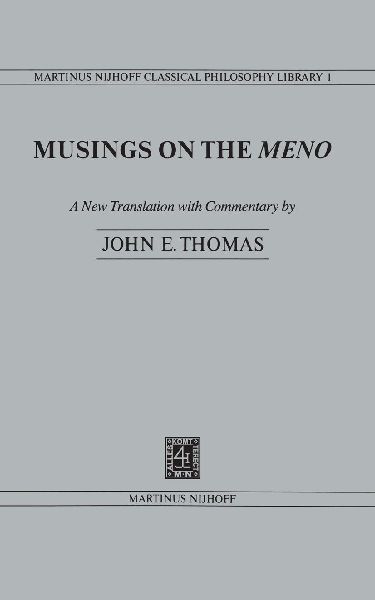
Musings on the Meno
von J. E. Thomas
Aus der Reihe Nijhoff Classical Philosophy Library
- Einband
- Kartoniert
- Seiten
- 240
- Sprache
- Englisch
- Erschienen
- März 1980
- Verlag
- Springer
Buchbeschreibung
The objectives of this book are to provide a new translation of Plato's M eno together with a series of studies on its philcisophical argument in the light of recent secondary literature.
My translation is based mainly on the Oxford Classical Text, 1. Burnet's Platonis Opera (Oxford Clarendon Press 1900) Vol. III. In conjunction with this I have made extensive use of R.S. Bluck's Plato's Meno (Cam bridge University Press, 1964).
Ganze Beschreibung lesenWeniger anzeigen
At critical places in the dialogue I have also consulted A. Croiset's Gorgias, Menon (Bude text). My debt ~o two other sources will be clearly in evidence.
They are E.S. Thompson's Plato's Meno (London, MacMillan 1901), and St. George Stock's The Meno of Plato (Oxford Clarendon Press, 1894). One of the greatest difficulties facing a translator is to achieve a balance between accuracy and elegance. Literal translations are more likely to be accurate, but, alas, they also tend to be duller.
Free translations run into the opposite danger of paying for elegance and liveliness with the coin of inaccuracy. Another hurdle, for a translator of a Platonic dialogue, is posed by the challenge to maintain the conversational pattern and fast moving character of the discussion. This is easier where the exchang~s are short, but much more difficult where Socrates gets somewhat long-winded.
Inhaltsverzeichnis
- to the Meno
- A. Plato, the Man
- B. Plato's Use of Dialogue Form
- C. The Meno as a Transitional Dialogue
- D. Plato on Socrates and Sophistry
- E. The Date of the Meno
- F. The Characters of the Meno
- Translation of the Meno
Ganzes Inhaltsverzeichnis anzeigen (26 Einträge)Weniger anzeigen
- Commentary
- I. Socrates' Elenchos at Work (70a1-81a7)
- 1. The Opening Conversation: The Relevance of the Ti-Poion Distinction (70a1-71b7)
- 2. Lesson One: Definition Is Not Enumeration (71e-73c5)
- 3. Lesson Two: Correct Form Isn't Everything (73c8-75a9)
- 4. Models for Muddles (75b1-77a5)
- 5. Digression on the Logic of the What-is-X Question
- 6. Lesson Three: You Can't Teach an Old Dog New Tricks (77a5-79e4)
- 7. Perplexity and Paradox (79e5-81a7)
- II. Anamn?sis (81a10-86c6)
- 1. Knowledge as Recollection: (i) Narration (81a10-82a6)
- 2. Knowledge as Recollection: (ii) Demonstration (82a8-86c6)
- III. The Method of Hypothesis (86c7-100c2)
- 1. Introduction of the Method: The Geometrical Example (86c7-87b2
- 2. Application of the Method: 'Virtue is Knowledge' Established (87b2-89c4)
- 3. Ramification of the Method: 'Virtue is Knowledge' Challenged (89c5-96c10)
- 4. True Opinion versus Knowledge (96d1-100c2)
- Name Index
Details
- Erscheinungstermin
- März 1980
- Kategorie
- Fremdsprachige Bücher
- Einband
- Kartoniert
- Seiten
- 240
- Sprache
- Englisch
- Verlag
- Springer
- Reihe
- Nijhoff Classical Philosophy Library
- Format
- 24,0 × 16,0 cm
- Dicke
- 1,4 cm
- Gewicht
- 391 g
- EAN / ISBN-13
- 9789024721214
Versand und Rückgabe
Standardversand: 1 bis 3 Werktage, 3,99 €, kostenlos ab 35 €
Liefergebiet: Deutschland
Rücksendung: 14 Tage Widerrufsrecht. Bei einem Widerruf tragen Sie die Kosten der Rücksendung. Bei einer Falschlieferung oder einem Fehler von uns erstatten wir Ihnen das Rückporto. Den Widerruf erklären Sie über den Knopf „Vertrag widerrufen“ im Fuß der Seite.
Hersteller und ProduktsicherheitSpringer Nature Customer Service Center GmbH
Springer Nature Customer Service Center GmbH
Europaplatz 3
69115 Heidelberg
Deutschland
ProductSafety@springernature.com
Mehr von J. E. Thomas



Ähnliche Titel
Bewertungen
Zu diesem Titel gibt es noch keine Bewertung. Bewerten kann, wer ihn bei uns gekauft hat.
So prüfen wir Bewertungen
Eine Bewertung kann bei uns nur abgeben, wer den Titel über sein Kundenkonto bei uns gekauft hat. Jede Bewertung ist fest mit der zugehörigen Bestellung verknüpft; anders kommt sie technisch gar nicht zustande. Deshalb trägt jede angezeigte Bewertung den Hinweis „Verifizierter Kauf". Wir zeigen positive wie negative Bewertungen und löschen nur bei Rechtsverstößen. Für Bewertungen gibt es keine Gegenleistung.
106,99 €Voraussichtlich 1. bis 3. Dez.