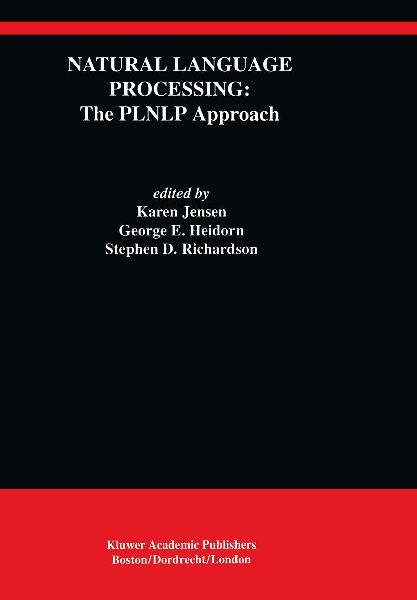
Natural Language Processing: The PLNLP Approach
Herausgegeben von: Karen Jensen, Herausgegeben von: George E. Heidorn, Herausgegeben von: Stephen D. Richardson
- Einband
- Kartoniert
- Seiten
- 348
- Sprache
- Englisch
- Erschienen
- Februar 2013
- Verlag
- Humana
Buchbeschreibung
Natural language is easy for people and hard for machines.
For two generations, the tantalizing goal has been to get computers to handle human languages in ways that will be compelling and useful to people. Obstacles are many and legendary. Natural Language Processing: The PLNLP Approach describes one group's decade of research in pursuit of that goal.
Ganze Beschreibung lesenWeniger anzeigen
A very broad coverage NLP system, including a programming language (PLNLP) development tools, and analysis and synthesis components, was developed and incorporated into a variety of well-known practical applications, ranging from text critiquing (CRITIQUE) to machine translation (e.g. SHALT).
This books represents the first published collection of papers describing the system and how it has been used. Twenty-six authors from nine countries contributed to this volume. Natural language analysis, in the PLNLP approach, is done is six stages that move smoothly from syntax through semantics into discourse.
The initial syntactic sketch is provided by an Augmented Phrase Structure Grammar (APSG) that uses exclusively binary rules and aims to produce some reasonable analysis for any input string. Its `approximate' analysis passes to the reassignment component, which takes the default syntactic attachments and adjusts them, using semantic information obtained by parsing definitions and example sentences from machine-readable dictionaries.
This technique is an example of one facet of the PLNLP approach: the use of natural language itself as a knowledge representation language -- an innovation that permits a wide variety of online text materials to be exploited as sources of semantic information. The next stage computes the intrasential argument structure and resolves all references, both NP- and VP-anaphora, that can be treated at this point in the processing.
Subsequently, additional components, currently not so well developed as the earlier ones, handle the further disambiguation of word senses, the normalization of paraphrases, and the construction of a paragraph (discourse) model by joining sentential semantic graphs. Natural Language Processing: The PLNLP Approach acquaints the reader with the theory and application of a working, real-world, domain-free NLP system, and attempts to bridge the gap between computational and theoretical models of linguistic structure.
It provides a valuable resource for students, teachers, and researchers in the areas of computational linguistics, natural processing, artificial intelligence, and information science.
Details
- Erscheinungstermin
- Februar 2013
- Kategorie
- Fremdsprachige Bücher
- Einband
- Kartoniert
- Seiten
- 348
- Sprache
- Englisch
- Verlag
- Humana
- Format
- 24,4 × 17,0 cm
- Dicke
- 1,9 cm
- Gewicht
- 601 g
- EAN / ISBN-13
- 9781461363897
Versand und Rückgabe
Standardversand: 1 bis 3 Werktage, 3,99 €, kostenlos ab 35 €
Liefergebiet: Deutschland
Rücksendung: 14 Tage Widerrufsrecht. Bei einem Widerruf tragen Sie die Kosten der Rücksendung. Bei einer Falschlieferung oder einem Fehler von uns erstatten wir Ihnen das Rückporto. Den Widerruf erklären Sie über den Knopf „Vertrag widerrufen“ im Fuß der Seite.
Hersteller und ProduktsicherheitSpringer Nature Customer Service Center GmbH
Springer Nature Customer Service Center GmbH
Europaplatz 3
69115 Heidelberg
Deutschland
ProductSafety@springernature.com
Ähnliche Titel
Natural Language Processing for Social Media, Third Edition
Anna Atefeh Farzindar
Kartoniert, Englisch
64,19 €
Bewertungen
Zu diesem Titel gibt es noch keine Bewertung. Bewerten kann, wer ihn bei uns gekauft hat.
So prüfen wir Bewertungen
Eine Bewertung kann bei uns nur abgeben, wer den Titel über sein Kundenkonto bei uns gekauft hat. Jede Bewertung ist fest mit der zugehörigen Bestellung verknüpft; anders kommt sie technisch gar nicht zustande. Deshalb trägt jede angezeigte Bewertung den Hinweis „Verifizierter Kauf". Wir zeigen positive wie negative Bewertungen und löschen nur bei Rechtsverstößen. Für Bewertungen gibt es keine Gegenleistung.
53,49 €Voraussichtlich 1. bis 3. Dez.