Quantitative Methods and Data Analysis in Applied Demography - Volume 1
Christos H. Skiadas (Hrsg.)
Gebunden, Englisch, 2 Ausgaben
ab 149,79 €
von Anna Naszodi
Aus der Reihe The Springer Series on Demographic Methods and Population Analysis
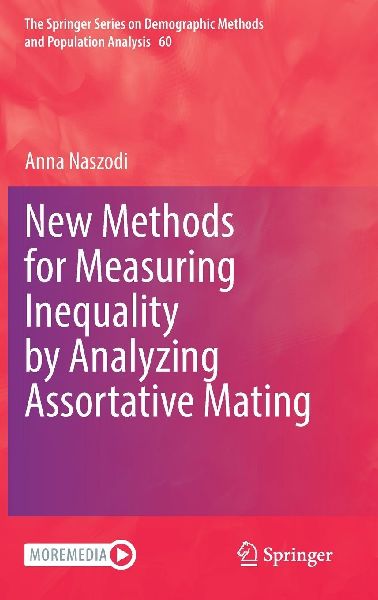
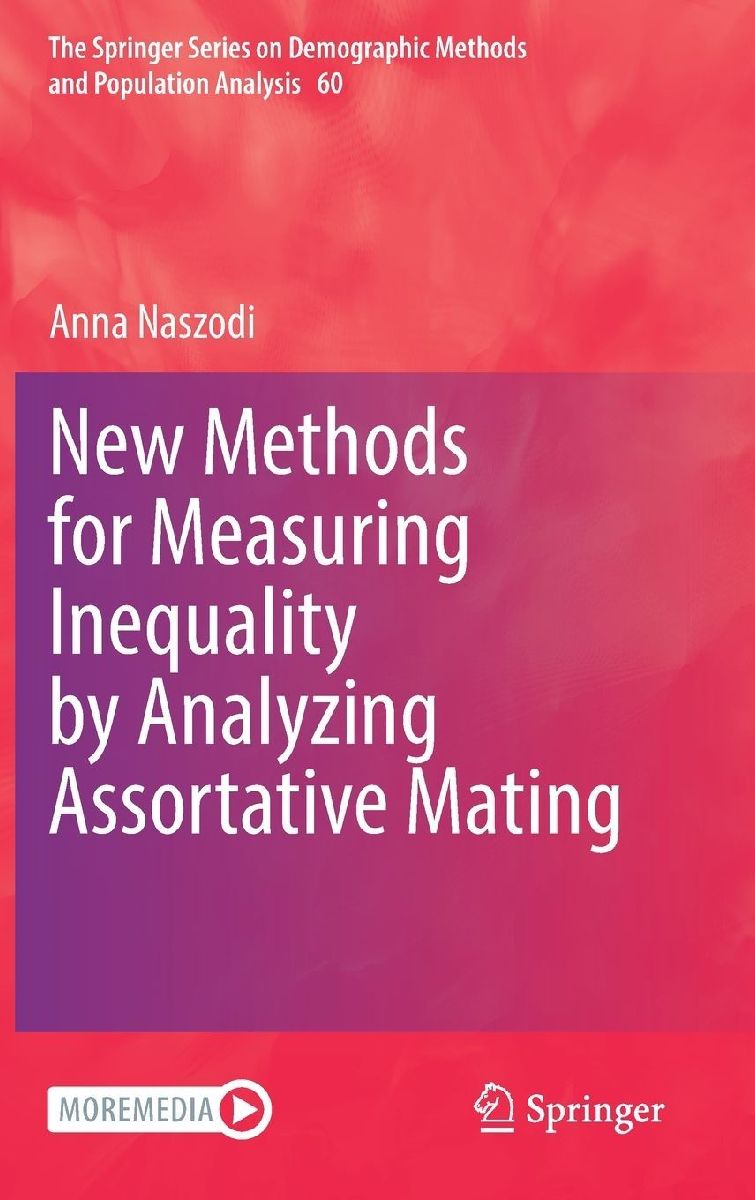
The monograph titled New Methods for Measuring Inequality by Analyzing Assortative Mating offers a comprehensive account of the methods and models proposed in the literature for measuring the degree of sorting into couples with the aim of identifying patterns in inequality.
It starts with the premise that it is a sign of increasing overall inequality between different social groups if a generation is less permissive of their members to choose a partner outside their own educational group or racial group relative to an earlier-born generation. In the same vain, the comparison across countries works just as well as it works inter-temporally.
At its core, the book not only guides readers through a diverse array of models and methods but also introduces innovative approaches for selecting tools that are fit for the purpose of quantifying the inherently unobservable degree of sorting.
The need for thoughtful model and method selection is underscored by demonstrating that competing tools often yield qualitatively different patterns—even when applied to the same data on real or fictitious populations of couples.
Using two of the methods from the well-performing set of tools and census data from nearly 80 countries—sourced from the Integrated Public Use Microdata Series (IPUMS)—the book illustrates the potential of studying inequality through patterns of sorting along education, as well as along race in the case of the United States.
The book offers an intellectually stimulating journey for both academic and policy researchers. Along the way, it meets ambitious goals, i.e., to dispel common misconceptions in the literature about the direction of causal relationship between assortative mating and inequality, to challenge established conventions on their measurements, and—true to its constructive spirit—to introduce approaches that perform well in practice.
Anna Naszodi is the Founding Director of the International Demographic Inequality Lab (IDIL), a Visiting Research Fellow at the University of Turku, and an Honorary Member of the Centre for Economic and Regional Studies (KRTK-KTI).
She previously worked as a Lead Researcher at the Central Bank of Hungary and as a Scientific Project Officer at the Joint Research Centre (JRC) of the European Commission. While affiliated with the JRC, she began her research project on inequality and assortative mating. Her papers on this topic—and on some others—have been published in the Journal of Demographic Economics, the International Journal of Central Banking, and the Journal of International Money and Finance. Her work has also been featured in Defacto (in Hungarian), in a VoxEU column, and in The New York Times.
Standardversand: 1 bis 3 Werktage, 3,99 €, kostenlos ab 35 €
Liefergebiet: Deutschland
Rücksendung: 14 Tage Widerrufsrecht. Bei einem Widerruf tragen Sie die Kosten der Rücksendung. Bei einer Falschlieferung oder einem Fehler von uns erstatten wir Ihnen das Rückporto. Den Widerruf erklären Sie über den Knopf „Vertrag widerrufen“ im Fuß der Seite.
Christos H. Skiadas (Hrsg.)
Gebunden, Englisch, 2 Ausgaben
ab 149,79 €
Christos H. Skiadas (Hrsg.)
Gebunden, Englisch, 2 Ausgaben
ab 149,79 €
Amber R. Crowell
Gebunden, Englisch, 2 Ausgaben
ab 53,49 €
Zu diesem Titel gibt es noch keine Bewertung. Bewerten kann, wer ihn bei uns gekauft hat.