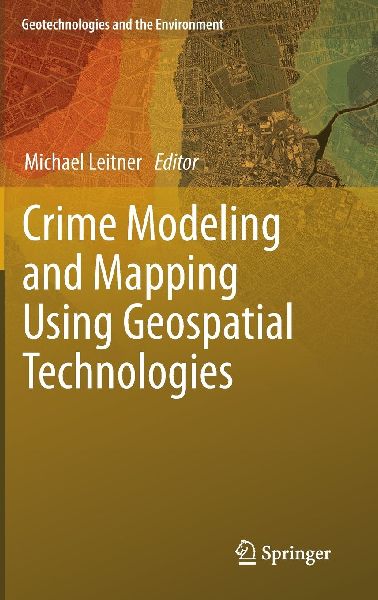
Crime Modeling and Mapping Using Geospatial Technologies
Michael Leitner (Hrsg.)
Gebunden, Englisch, 2 Ausgaben
ab 160,49 €
Herausgegeben von: Michael Leitner
Aus der Reihe Geotechnologies and the Environment
This edited volume offers innovative research and applications in the analysis, modelling, and mapping of crime using geospatial and GeoAI technologies.
This is a follow-up publication of an edited volume by the same editor with a similar title, Crime Modeling and Mapping Using Geospatial Technologies, published by Springer in its popular Geotechnologies and the Environment series in 2013.The book comprises sixteen chapters authored by some of the most esteemed researchers in the field.
These chapters are organized into four sections: big data and microspaces (Part I), mobility (Part II), drugs (Part III), and additional geospatial applications (Part IV).Part I includes five chapters focusing on interactive crime mapping by using large data sets obtained from social media and analyzing these data using AI applications; a fundamental spatial problem that considers spatial properties of a crime dataset to determine an adequate areal unit size; different aspects of the influence or prediction of crime in microspaces; and the use of sampled surface pollen to model the search space for documented forensic cases.
Part II has four chapters that introduce two route generation heuristics that automate the creation of hot spots policing patrol routes; discuss how to optimize police response with two different maximal covering location problems; and examine how human mobility patterns impact crime trends and modelling.
Part III consists of three chapters addressing opioid overdose patterns using a spatial mixed methods approach; spatial-temporal changes in hot spots of drug-related offences; and how geospatial technology can be used to empower stakeholders to make informed policy decisions about alcohol-related motor vehicle collisions. Part IV comprises four diverse chapters that do not fit under a single theme.
The topics discussed include: the impact of video surveillance on the spatial distribution of crime; the identification of the location of missing persons outreach events with spatial clustering analysis methods; an examination of the distribution patterns of all types of juvenile delinquency to investigate underlying factors; and a review and comparison of GeoAI methods for detecting and mapping illegal logging.
This book would be useful to faculty, students and research scholars from geography, sociology, criminal justice, criminology, forensic sciences, and other related disciplines as well as to crime analysts working for law enforcement agencies at the local, state, or federal levels from around the world.
Michael Leitner is the Carl O. Sauer Professor of Geography in the Department of Geography and Anthropology at Louisiana State University (LSU) in Baton Rouge, US.
He is an Adjunct Professor in the Department of Experimental Statistics at LSU, an Adjunct Faculty in the Department of Geoinformatics - Z_GIS at the University of Salzburg, Austria, and an affiliated scholar with the Independent Research Group: Space, Contexts, and Crime at the Max Planck Institute for the Study of Crime, Security and Law in Freiburg, Germany. His primary research interests include geographies of crime and health, geospatial privacy concerns, and fine-scale spatial data collection and analysis combining spatial video geonarratives and physiological measurements of people. He has co-authored two books, co-edited four books, published 68 peer-reviewed articles, and served as the editor of Cartography and Geographic Information Science (CaGIS) from 2008 to 2014.
Standardversand: 1 bis 3 Werktage, 3,99 €, kostenlos ab 35 €
Liefergebiet: Deutschland
Rücksendung: 14 Tage Widerrufsrecht. Bei einem Widerruf tragen Sie die Kosten der Rücksendung. Bei einer Falschlieferung oder einem Fehler von uns erstatten wir Ihnen das Rückporto. Den Widerruf erklären Sie über den Knopf „Vertrag widerrufen“ im Fuß der Seite.
Michael Leitner (Hrsg.)
Gebunden, Englisch, 2 Ausgaben
ab 160,49 €
Michael Leitner
Gebunden, Englisch, 2 Ausgaben
ab 53,49 €
Swagata Ghosh (Hrsg.)
Gebunden, Englisch, 2 Ausgaben
ab 235,39 €
Wenwu Tang (Hrsg.)
Gebunden, Englisch, 2 Ausgaben
ab 160,49 €
Jeffrey O. Durrant (Hrsg.)
Gebunden, Englisch, 2 Ausgaben
ab 106,99 €
Song Gao (Hrsg.)
Kartoniert, Englisch, 2 Ausgaben
ab 134,00 €
John Jensen
Kartoniert, Englisch
105,99 €
Zu diesem Titel gibt es noch keine Bewertung. Bewerten kann, wer ihn bei uns gekauft hat.