Buch-OWLOnline-Buchhandel

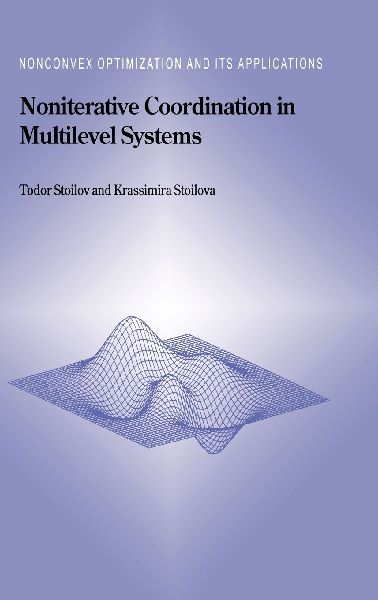
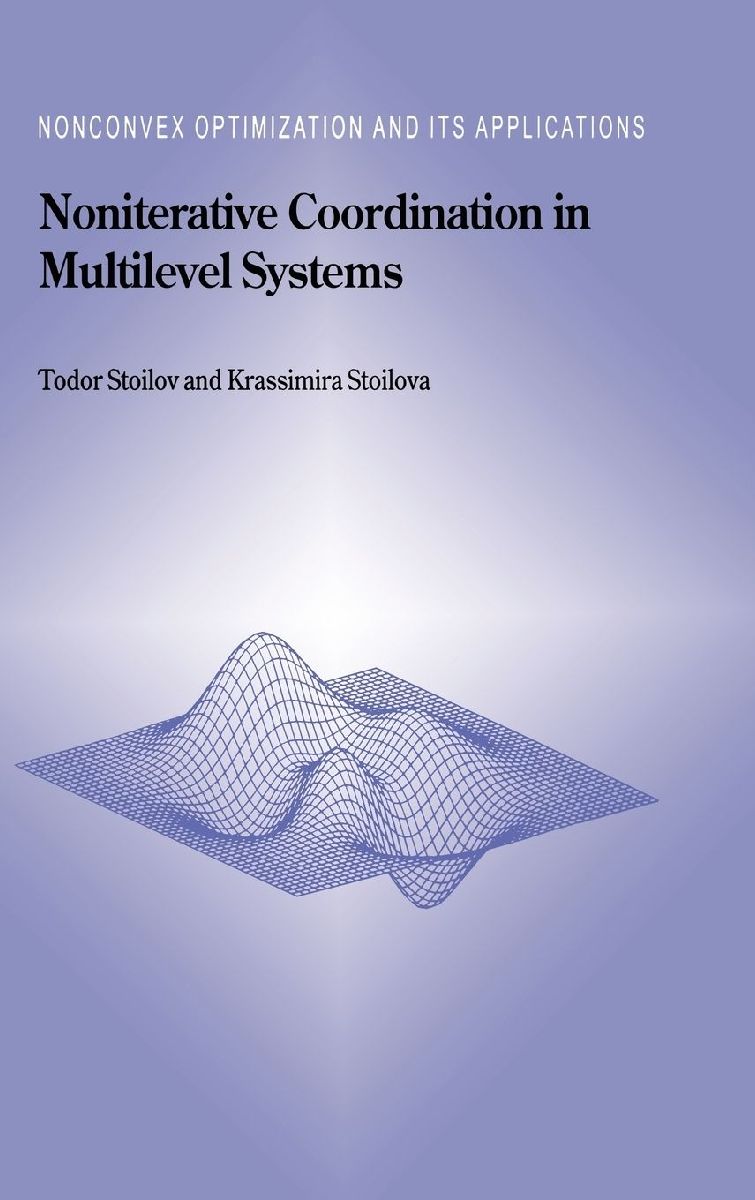
Noniterative Coordination in Multilevel Systems

von Todor Stoilov

Aus der Reihe Nonconvex Optimization and Its Applications

Einband
Gebunden
Seiten
288
Sprache
Englisch
Erschienen
August 1999
Verlag
Springer

Buchbeschreibung

Multilevel decision theory arises to resolve the contradiction between increasing requirements towards the process of design, synthesis, control and management of complex systems and the limitation of the power of technical, control, computer and other executive devices, which have to perform actions and to satisfy requirements in real time.

Ganze Beschreibung lesenWeniger anzeigen

This theory rises suggestions how to replace the centralised management of the system by hierarchical co-ordination of sub-processes. All sub-processes have lower dimensions, which support easier management and decision making. But the sub-processes are interconnected and they influence each other. Multilevel systems theory supports two main methodological tools: decomposition and co-ordination.

Both have been developed, and implemented in practical applications concerning design, control and management of complex systems. In general, it is always beneficial to find the best or optimal solution in processes of system design, control and management. The real tendency towards the best (optimal) decision requires to present all activities in the form of a definition and then the solution of an appropriate optimization problem.

Every optimization process needs the mathematical definition and solution of a well stated optimization problem. These problems belong to two classes: static optimization and dynamic optimization. Static optimization problems are solved applying methods of mathematical programming: conditional and unconditional optimization.

Dynamic optimization problems are solved by methods of variation calculus: Euler­ Lagrange method; maximum principle; dynamical programming.

Inhaltsverzeichnis

  • I Hierarchical Systems and Their Management
  • 1.1 Hierarchical optimization of a catalytic cracking plant
  • 1.2. Hierarchical optimization of a hydro and thermal power plant system
  • 1.3. Hierarchical optimization and management of an interconnected dynamical system
  • 1.4. Mathematical models in hierarchical multilevel system theory
  • 1.5. Two level mathematical programming models
  • 1.6. Hierarchical model applications
  • 1.7. Mathematical modeling in hierarchical system theory - summary
Ganzes Inhaltsverzeichnis anzeigen (39 Einträge)Weniger anzeigen
  • II One step Coordination as a Tool for Real Time System Management
  • 2.1. Relations between multilevel and multilayer hierarchies
  • 2.2. One step coordination "suggestion-correction" protocols - a new noniterative multilevel strategy
  • 2.3. General mathematical modeling for noniterative coordination
  • III Noniterative Coordination with Linear Quadratic Approximations
  • 3.1. Analytical solution of the primal Lagrange problem
  • 3.2. Evaluation of the matrix dx/dX
  • 3.3. Evaluation of the optimal coordination Xopt
  • 3.4. Assessment of the approximations of x(X), H(X)
  • 3.5. Approximation of the global optimization problem
  • 3.6. Analytical solution of the general problem of quadratic programming
  • 3.7. Noniterative coordination for block diagonal optimization problems
  • 3.8. Analytical solution of the quadratic programming problem in the block diagonal case
  • 3.9. Examples of block-diagonal problems
  • 3.10. Global optimization problem with inequality constraints
  • 3.11. Application of noniterative coordination to the general problem of quadratic programming
  • 3.12. Application of noniterative coordination for the optimal management of traffic lights of neighbor junctions
  • 3.13. Application of noniterative coordination for optimal wireless data communication
  • 3.14. Conclusions
  • IVNoniterative Coordination applying Rational Pade Functions
  • 4.1. Pade approximation of x(X)
  • 4.2. Modified optimization problem
  • 4.3. Dual Lagrange problem
  • 4.4. Dual Lagrange problem with approximation
  • 4.5. Application of noniterative coordination for optimal hierarchical control of interconnected systems
  • 4.6. Application of noniterative coordination for fast solution of nonlinear optimization problems
  • 4.7. Comparison between the SQP, QQ and LQ algorithms on optimization problem for vector X
  • 4.7. Conclusions
  • Epilogue
  • Appendices
  • References

Details

Erscheinungstermin
August 1999
Kategorie
Fremdsprachige Bücher
Einband
Gebunden
Seiten
288
Sprache
Englisch
Verlag
Springer
Reihe
Nonconvex Optimization and Its Applications
Format
24,1 × 16,0 cm
Dicke
2,1 cm
Gewicht
548 g
EAN / ISBN-13
9780792358794
Maßstabsgetreu: Deckel und Buchrücken neben einer Hand (18 cm).
Versand und Rückgabe

Standardversand: 1 bis 3 Werktage, 3,99 €, kostenlos ab 35 €

Liefergebiet: Deutschland

Rücksendung: 14 Tage Widerrufsrecht. Bei einem Widerruf tragen Sie die Kosten der Rücksendung. Bei einer Falschlieferung oder einem Fehler von uns erstatten wir Ihnen das Rückporto. Den Widerruf erklären Sie über den Knopf „Vertrag widerrufen“ im Fuß der Seite.

Hersteller und ProduktsicherheitSpringer Nature Customer Service Center GmbH
Springer Nature Customer Service Center GmbH
Europaplatz 3
69115 Heidelberg
Deutschland
ProductSafety@springernature.com

Mehr aus der Reihe Nonconvex Optimization and Its Applications

Ähnliche Titel

Bewertungen

Zu diesem Titel gibt es noch keine Bewertung. Bewerten kann, wer ihn bei uns gekauft hat.

So prüfen wir Bewertungen
Eine Bewertung kann bei uns nur abgeben, wer den Titel über sein Kundenkonto bei uns gekauft hat. Jede Bewertung ist fest mit der zugehörigen Bestellung verknüpft; anders kommt sie technisch gar nicht zustande. Deshalb trägt jede angezeigte Bewertung den Hinweis „Verifizierter Kauf". Wir zeigen positive wie negative Bewertungen und löschen nur bei Rechtsverstößen. Für Bewertungen gibt es keine Gegenleistung.
106,99 €Voraussichtlich 3. bis 7. Dez.

Inhalte ab 18

Cover von Titeln für Erwachsene, etwa erotische Romane, Manga oder Comics, bleiben unscharf, bis Sie bestätigen. Die Bestätigung gilt für alle Seiten und Tabs, bis Sie den Browser schließen.

Zurück zum Katalog