Northern Ireland after the Good Friday Agreement: On the Way to Peace or Conflict Perpetuated?
von Patrick Wagner
- Einband
- Kartoniert
- Seiten
- 36
- Sprache
- Englisch
- Erschienen
- Juli 2007
- Verlag
- GRIN Verlag
Buchbeschreibung
Essay from the year 2004 in the subject Politics - Region: Western Europe, grade: 2+ (B), University of Kent (Brussels School of International Studies), language: English, abstract: Six years after the Good Friday Agreement was signed and after a promising, although troubled start of the institutional framework it has put in place, Northern Ireland is, following the suspension of devolution on 14 October 2002, yet again under direct rule from Westminster.
Ganze Beschreibung lesenWeniger anzeigen
Centuries of conflict, decades of violent troubles and diametrically opposed demands of the groups involved make the Northern Ireland question to one of the most difficult conflicts of our time. Nevertheless, there was genuine optimism both among the parties involved and the international community that the Agreement would succeed and resolve the conflict.
However, in the political reality of Northern Ireland, the Agreement soon reached its limits, and people realised that it takes more than an assembly and a power-sharing executive to overcome Ulster's deep-rooted sectarian divisions.
Internal disagreement in the unionist and nationalist camps over the direction the Agreement is likely to take them and the still unresolved question of IRA weapons decommissioning leave the future of the Agreement in serious doubt.
The Agreement has been widely acknowledged as being consociational and consistent with the four principles of power-sharing identified by Lijphart. This paper will thus also discuss the theoretical foundation of the Agreement. Here, it will particularly focus on the role of the voting system (Single Transferable Vote) employed for the Assembly elections, which is unusual for consociational models.
This paper will conclude that the Agreement is undeniably a major breakthrough. Even if the Agreement itself does not solve the conflict, by creating a prolonged period of peace in which political dialogue can take place, it could be a vital step towards a future settlement.
But is the current situation in Northern Ireland really a transitional period likely to lead to a solution of the conflict in the future or is it what Trimble calls the 'continuation of war by other means'?The Agreement was certainly not an overall failure as it has managed to bring parties together in political institutions which have refused to sit together in the same room for decades.
But its limitations must also be clear: the war might be over but the conflict is far from ended. Since the Agreement has failed to address the underlying issues of the conflict and merely regulates violence, it cannot be regarded as a permanent and sustainable solution.
Details
- Erscheinungstermin
- Juli 2007
- Kategorie
- Fremdsprachige Bücher
- Einband
- Kartoniert
- Seiten
- 36
- Sprache
- Englisch
- Verlag
- GRIN Verlag
- Format
- 21,0 × 14,8 cm
- Dicke
- 0,4 cm
- Gewicht
- 68 g
- EAN / ISBN-13
- 9783638648912
Versand und Rückgabe
Standardversand: 1 bis 3 Werktage, 3,99 €, kostenlos ab 35 €
Liefergebiet: Deutschland
Rücksendung: 14 Tage Widerrufsrecht. Bei einem Widerruf tragen Sie die Kosten der Rücksendung. Bei einer Falschlieferung oder einem Fehler von uns erstatten wir Ihnen das Rückporto. Den Widerruf erklären Sie über den Knopf „Vertrag widerrufen“ im Fuß der Seite.
Hersteller und ProduktsicherheitGRIN Publishing GmbH
Mehr von Patrick Wagner

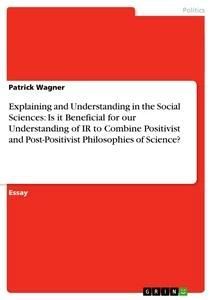
Explaining and Understanding in the Social Sciences: Is it Beneficial for our Understanding of IR to Combine Positivist and Post-Positivist Philosophies of Science?
Patrick Wagner
Kartoniert, Englisch
15,95 €
Ähnliche Titel

Bewertungen
Zu diesem Titel gibt es noch keine Bewertung. Bewerten kann, wer ihn bei uns gekauft hat.
So prüfen wir Bewertungen
Eine Bewertung kann bei uns nur abgeben, wer den Titel über sein Kundenkonto bei uns gekauft hat. Jede Bewertung ist fest mit der zugehörigen Bestellung verknüpft; anders kommt sie technisch gar nicht zustande. Deshalb trägt jede angezeigte Bewertung den Hinweis „Verifizierter Kauf". Wir zeigen positive wie negative Bewertungen und löschen nur bei Rechtsverstößen. Für Bewertungen gibt es keine Gegenleistung.
17,95 €Voraussichtlich 2. bis 4. Dez.