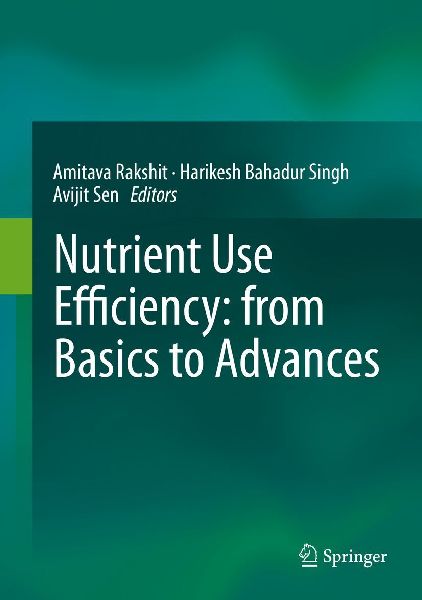
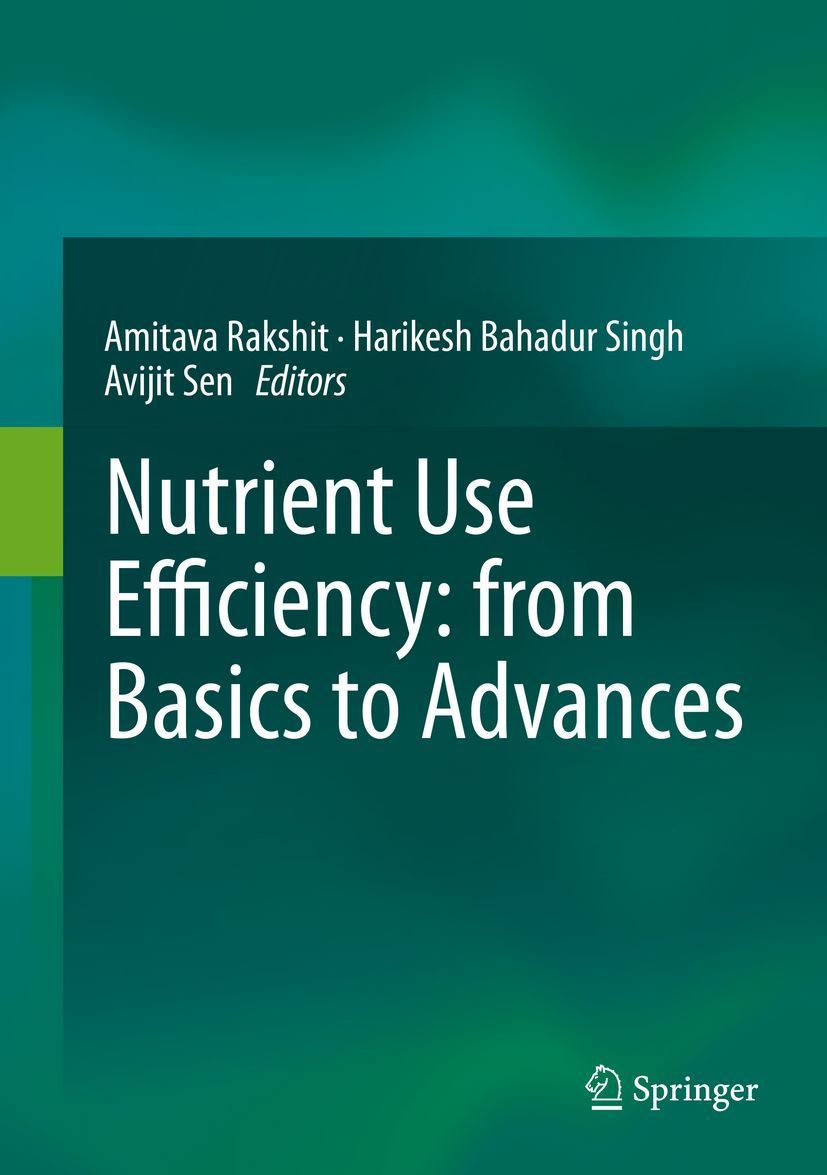
Nutrient Use Efficiency: from Basics to Advances
Herausgegeben von: Amitava Rakshit, Herausgegeben von: Harikesh Bahadur Singh, Herausgegeben von: Avijit Sen
- Einband
- Gebunden
- Seiten
- 444
- Sprache
- Englisch
- Erschienen
- Januar 2015
- Verlag
- Springer
Buchbeschreibung
This book addresses in detail multifaceted approaches to boosting nutrient use efficiency (NUE) that are modified by plant interactions with environmental variables and combine physiological, microbial, biotechnological and agronomic aspects. Conveying an in-depth understanding of the topic will spark the development of new cultivars and strains to induce NUE, coupled with best management practices that will immensely benefit agricultural systems, safeguarding their soil, water, and air quality.
Ganze Beschreibung lesenWeniger anzeigen
Written by recognized experts in the field, the book is intended to provide students, scientists and policymakers with essential insights into holistic approaches to NUE, as well as an overview of some successful case studies. In the present understanding of agriculture, NUE represents a question of process optimization in response to the increasing fragility of our natural resources base and threats to food grain security across the globe.
Further improving nutrient use efficiency is a prerequisite to reducing production costs, expanding crop acreage into non-competitive marginal lands with low nutrient resources, and preventing environmental contamination. The nutrients most commonly limiting plant growth are N, P, K, S and micronutrients like Fe, Zn, B and Mo.
NUE depends on the ability to efficiently take up the nutrient from the soil, but also on transport, storage, mobilization, usage within the plant and the environment. A number of approaches can help us to understand NUE as a whole. One involves adopting best crop management practices that take into account root-induced rhizosphere processes, which play a pivotal role in controlling nutrient dynamics in the soil-plant-atmosphere continuum.
New technologies, from basic tools like leaf color charts to sophisticated sensor-based systems and laser land leveling, can reduce the dependency on laboratory assistance and manual labor. Another approach concerns the development of crop plants through genetic manipulations thatallow them to take up and assimilate nutrients more efficiently, as well as identifying processes of plant responses to nutrient deficiency stress and exploring natural genetic variation.
Though only recently introduced, the ability of microbial inoculants to induce NUE is gaining in importance, as the loss, immobilization, release and availability of nutrients are mediated by soil microbial processes.
Inhaltsverzeichnis
- Chapter 1: Nutrient use efficiency in plants: an overview
- Part I: Nutrients as a Key Driver of Nutrient Use Efficiency
- Chapter 2: Soils and Inputs Management Options for Increasing Nutrient Use Efficiency
- Chapter 3: Nutrient and water use efficiency in soil: The influence of geological mineral amendments
- Chapter 4: Resource conserving techniques for improving nitrogen use-efficiency
- Chapter 5: Strategies for enhancing phosphorus efficiency in crop production systems
- Chapter 6: Efficiency of soil and fertilizer phosphorus use in time: a comparison between recovered struvite, FePO4-sludge, digestate, animal manure and synthetic fertilizer
- Chapter 7: Strategies for Enhancing Zinc Efficiency in Crop Plants
Ganzes Inhaltsverzeichnis anzeigen (30 Einträge)Weniger anzeigen
- Chapter 8: Nitrification inhibitors: classes and its use in nitrification management
- Part-II: Microbiological aspects of Nutrient Use Efficiency
- Chapter 9: Role of Microorganisms in Plant Nutrition and Health
- Chapter 10: Role of Cyanobacteria inNutrient Cycle and Use Efficiency in the Soil
- Chapter 11: Trichoderma improves nutrient use efficiency in crop plants
- Chapter 12: Bio-priming mediated nutrient use efficiency of crop species
- Chapter 13: Unrealized potential of seed biopriming for versatile agriculture
- Part-III: Molecular and physiological aspects of Nutrient Use Efficiency
- Chapter 14: Improving nutrient use efficiency by exploiting genetic diversity of crops
- Chapter 15: Micro RNA based approach to improve nitrogen use efficiency in plants
- Chapter 16: Biofortification for selecting and developing crop cultivars denser in iron and zinc
- Chapter 17: Understanding genetic and molecular bases of Fe and Zn accumulation towards development of micronutrient enriched maize
- Part-IV: Nutrient Use Efficiency of Crop Species
- Chapter 18: Nitrogen uptake and use efficiency in rice
- Chapter 19: Nutrient-use efficiency in Sorghum
- Chapter 20: Improving nutrient use efficiency in oilseeds Brassica
- Chapter21: Strategies for higher nutrient use efficiency and productivity in forage crops
- Chapter 22: Integrated nutrient management in potato for increasing nutrient use efficiency and sustainable productivity
- Part-V: Specialised Case Studies
- Chapter 23: Enhancing Nutrient Use Efficiencies in Rainfed Systems
- Chapter 24: Dynamics Of Plant Nutrients, Utilization And Uptake, And Soil Microbial Community In Crops Under Ambient And Elevated Carbon Dioxide
- Chapter 25: Phytometallophore Mediated Nutrient Acquisition by Plants
Details
- Erscheinungstermin
- Januar 2015
- Kategorie
- Fremdsprachige Bücher
- Einband
- Gebunden
- Seiten
- 444
- Sprache
- Englisch
- Verlag
- Springer
- Format
- 26,0 × 18,3 cm
- Dicke
- 3,0 cm
- Gewicht
- 963 g
- EAN / ISBN-13
- 9788132221685
Über Amitava Rakshit (Hrsg.)
Amitava Rakshit, an IIT, Kharagpur alumnus is presently the faculty member in the Department of Soil Science and Agricultural Chemistry at Institute of Agricultural Sciences, Banaras Hindu University(IAS, BHU).
Mehr über Amitava Rakshit (Hrsg.)Weniger anzeigen
Dr. Rakshit worked in the Department of Agriculture, Government of West Bengal in administration and extension roles. He has visited Norway, Finland, Denmark, France, Austria, Russia, Thailand, Egypt, Turkey pertaining to his research work and presentation. He was awarded with TWAS Nxt Fellow (Italy), Biovision Nxt Fellow (France), Darwin Now Bursary (British Council), Young Achiever Award and Best Teacher's Award at UG and PG level (BHU & ICAR, New Delhi). He is serving as review college member of British Ecological Society, London since 2011. He has published 70 research papers, 15 book chapters, 28 popular articles, one manual and co authored five books.
Avijit Sen is presently Professor and Head in the Department of Agronomy, IAS, BHU. He has presented more than 40 research papers and delivered lectures in conferences/seminars/refresher courses within and outside the country besides handling 5 ad-hoc projects. Currently he is the Deputy Coordinator of the prestigious Special Assistance Programme awarded to the Department by UGC. He is recipient of CWSS Gold Medal 2013. With 33 years of experience, he has published more than 60 research papers and articles, and written 3 chapters of books till date.
Harikesh B. Singh is presently Professor of Mycology and Plant Pathology at IAS, BHU. He served State Agriculture University, Central University and CSIR Institute in teaching, research, and extension roles. In recognition of Prof. Singh's scientific contributions and leadership in the field of plant pathology, he was honored with several prestigious awards, notable being, CSIR Prize for Biological Sciences, Vigyan Bharti Award, Prof. V.P. Bhide Memorial Award, BRSI Industrial Medal Award, Bioved Fellowship Award, Prof. Panchanan Maheshwari, IPS Plant Pathology Leader Award, CSIR-CAIRD Team award, Environment Conservation Award, CST Vigyan Ratna Award and many more. Dr. Singh has been the Fellow of National Academy of Agricultural Sciences. Prof. Singh has written two books, several training modules and manuals and more than 150 research publications and has more than 18 US patents and 3 PCTs to his credit.
Versand und Rückgabe
Standardversand: 1 bis 3 Werktage, 3,99 €, kostenlos ab 35 €
Liefergebiet: Deutschland
Rücksendung: 14 Tage Widerrufsrecht. Bei einem Widerruf tragen Sie die Kosten der Rücksendung. Bei einer Falschlieferung oder einem Fehler von uns erstatten wir Ihnen das Rückporto. Den Widerruf erklären Sie über den Knopf „Vertrag widerrufen“ im Fuß der Seite.
Hersteller und ProduktsicherheitSpringer Nature Customer Service Center GmbH
Springer Nature Customer Service Center GmbH
Europaplatz 3
69115 Heidelberg
Deutschland
ProductSafety@springernature.com
Mehr von Amitava Rakshit
Soil Science: Fundamentals to Recent Advances
Amitava Rakshit (Hrsg.)
Gebunden, Englisch, 2 Ausgaben
ab 246,09 €
Adaptive Soil Management : From Theory to Practices
Amitava Rakshit (Hrsg.)
Kartoniert, Englisch, 2 Ausgaben
ab 176,54 €
Ähnliche Titel
Advances in Research on Potato Production
Shashank Shekhar Solankey (Hrsg.)
Gebunden, Englisch, 2 Ausgaben
ab 171,19 €
Insecticides Design Using Advanced Technologies
Isaac Ishaaya (Hrsg.)
Gebunden, Englisch, 2 Ausgaben
ab 160,49 €
Bewertungen
Zu diesem Titel gibt es noch keine Bewertung. Bewerten kann, wer ihn bei uns gekauft hat.
So prüfen wir Bewertungen
Eine Bewertung kann bei uns nur abgeben, wer den Titel über sein Kundenkonto bei uns gekauft hat. Jede Bewertung ist fest mit der zugehörigen Bestellung verknüpft; anders kommt sie technisch gar nicht zustande. Deshalb trägt jede angezeigte Bewertung den Hinweis „Verifizierter Kauf". Wir zeigen positive wie negative Bewertungen und löschen nur bei Rechtsverstößen. Für Bewertungen gibt es keine Gegenleistung.
160,49 €Voraussichtlich 4. bis 8. Dez.