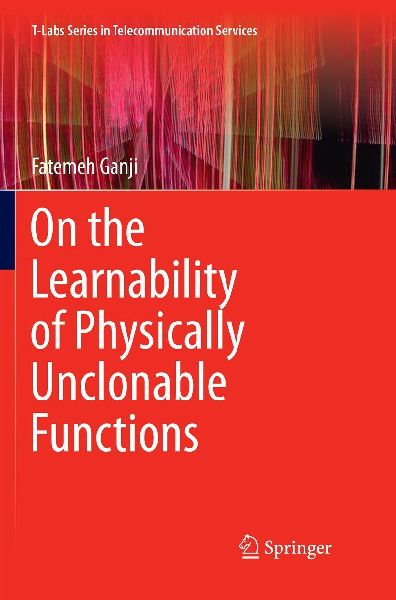
On the Learnability of Physically Unclonable Functions
von Fatemeh Ganji
Aus der Reihe T-Labs Series in Telecommunication Services
- Einband
- Kartoniert
- Seiten
- 112
- Sprache
- Englisch
- Erschienen
- Dezember 2018
- Verlag
- Springer
Buchbeschreibung
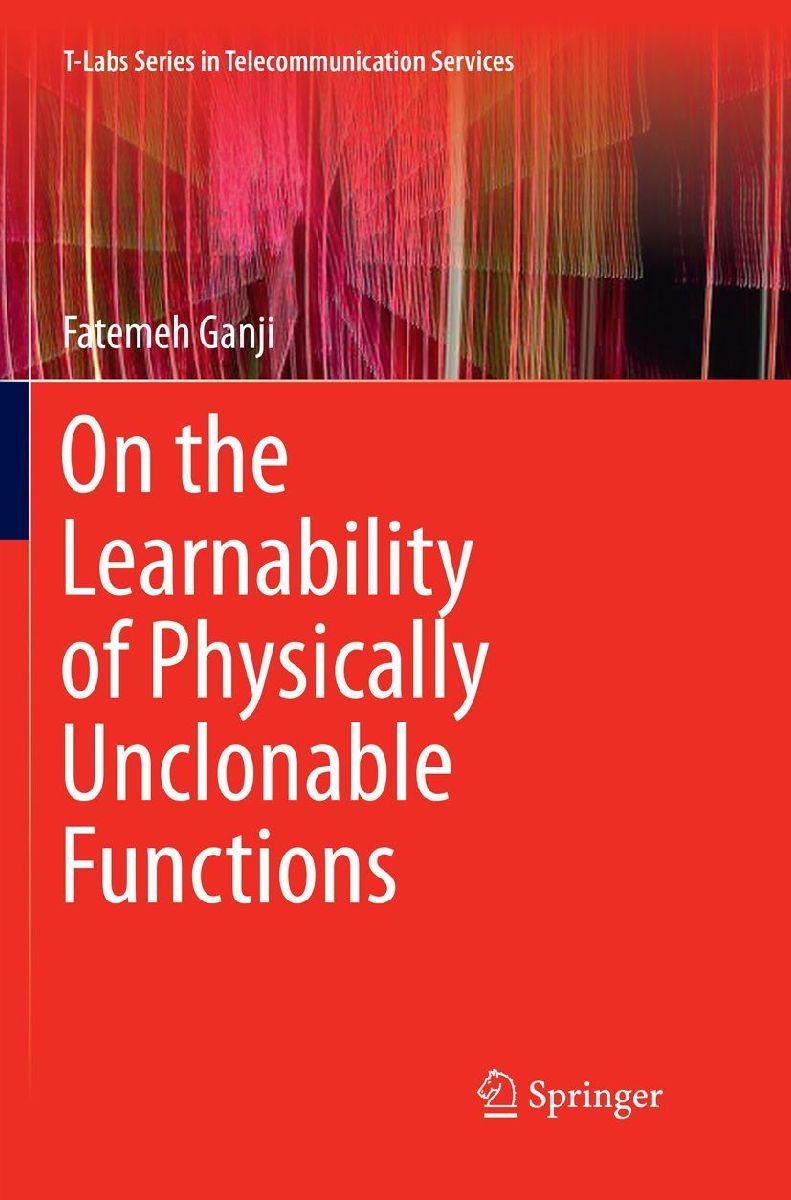
This book addresses the issue of Machine Learning (ML) attacks on Integrated Circuits through Physical Unclonable Functions (PUFs).
It provides the mathematical proofs of the vulnerability of various PUF families, including Arbiter, XOR Arbiter, ring-oscillator, and bistable ring PUFs, to ML attacks. To achieve this goal, it develops a generic framework for the assessment of these PUFs based on two main approaches.
Ganze Beschreibung lesenWeniger anzeigen
First, with regard to the inherent physical characteristics, it establishes fit-for-purpose mathematical representations of the PUFs mentioned above, which adequately reflect the physical behavior of these primitives.
To this end, notions and formalizations that are already familiar to the ML theory world are reintroduced in order to give a better understanding of why, how, and to what extent ML attacks against PUFs can be feasible in practice. Second, the book explores polynomial time ML algorithms, which can learn the PUFs under the appropriate representation.
More importantly, in contrast to previous ML approaches, the framework presented here ensures not only the accuracy of the model mimicking the behavior of the PUF, but also the delivery of such a model. Besides off-the-shelf ML algorithms, the book applies a set of algorithms hailing from the field of property testing, which can help to evaluate the security of PUFs.
They serve as a "toolbox", from which PUF designers and manufacturers can choose the indicators most relevant for their requirements. Last but not least, on the basis of learning theory concepts, the book explicitly states that the PUF families cannot be considered as an ultimate solution to the problem of insecure ICs. As such, it provides essential insights into both academic research on and the design and manufacturing of PUFs.
Inhaltsverzeichnis
- Introduction
- Definitions and Preliminaries
- PAC Learning of Arbiter PUFs
- PAC Learning of XOR Arbiter PUFs
- PAC Learning of Ring Oscillator PUFs
- PAC Learning of Bistable Ring PUFs
- Follow-up
- Conclusion
Details
- Erscheinungstermin
- Dezember 2018
- Kategorie
- Fremdsprachige Bücher
- Einband
- Kartoniert
- Seiten
- 112
- Sprache
- Englisch
- Verlag
- Springer
- Reihe
- T-Labs Series in Telecommunication Services
- Format
- 23,5 × 15,5 cm
- Dicke
- 0,7 cm
- Gewicht
- 184 g
- EAN / ISBN-13
- 9783030095635
Versand und Rückgabe
Standardversand: 1 bis 3 Werktage, 3,99 €, kostenlos ab 35 €
Liefergebiet: Deutschland
Rücksendung: 14 Tage Widerrufsrecht. Bei einem Widerruf tragen Sie die Kosten der Rücksendung. Bei einer Falschlieferung oder einem Fehler von uns erstatten wir Ihnen das Rückporto. Den Widerruf erklären Sie über den Knopf „Vertrag widerrufen“ im Fuß der Seite.
Hersteller und ProduktsicherheitSpringer Nature Customer Service Center GmbH
Springer Nature Customer Service Center GmbH
Europaplatz 3
69115 Heidelberg
Deutschland
ProductSafety@springernature.com
Mehr aus der Reihe T-Labs Series in Telecommunication Services



Human Information Processing in Speech Quality Assessment
Stefan Uhrig
Gebunden, Englisch, 2 Ausgaben
ab 139,09 €

User Experience for Serious Games in Virtual Reality
Tanja Koji¿
Gebunden, Englisch, 2 Ausgaben
ab 106,99 €
Ähnliche Titel




A Nature-Inspired Approach to Cryptology
Shishir Kumar Shandilya
Gebunden, Englisch, 2 Ausgaben
ab 171,19 €
Bewertungen
Zu diesem Titel gibt es noch keine Bewertung. Bewerten kann, wer ihn bei uns gekauft hat.
So prüfen wir Bewertungen
Eine Bewertung kann bei uns nur abgeben, wer den Titel über sein Kundenkonto bei uns gekauft hat. Jede Bewertung ist fest mit der zugehörigen Bestellung verknüpft; anders kommt sie technisch gar nicht zustande. Deshalb trägt jede angezeigte Bewertung den Hinweis „Verifizierter Kauf". Wir zeigen positive wie negative Bewertungen und löschen nur bei Rechtsverstößen. Für Bewertungen gibt es keine Gegenleistung.
106,99 €Voraussichtlich 1. bis 3. Dez.