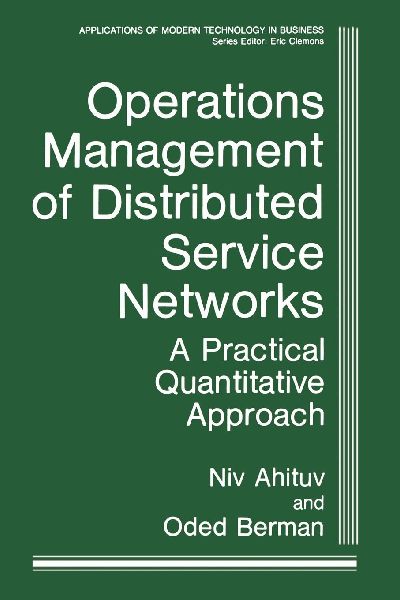
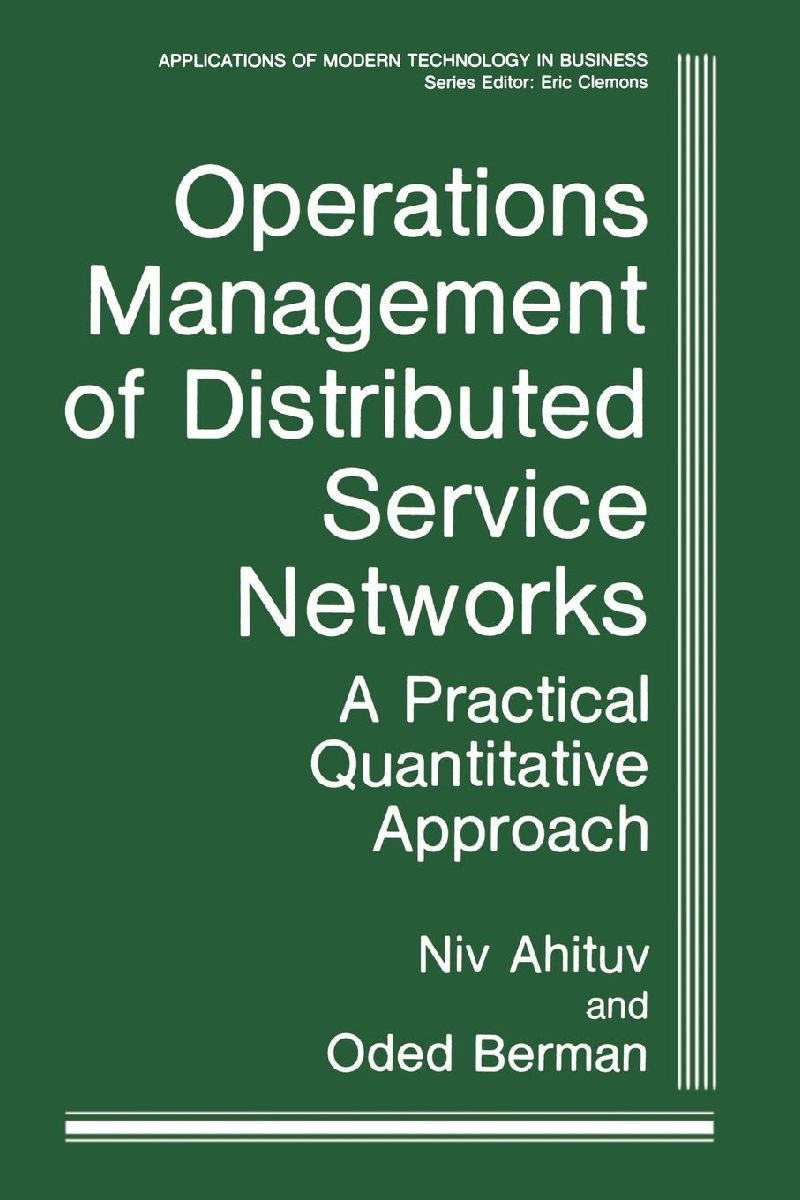
Operations Management of Distributed Service Networks
A Practical Quantitative Approach
von Niv Ahituv und Oded Berman
Aus der Reihe Applications of Modern Technology in Business
- Einband
- Kartoniert
- Seiten
- 312
- Sprache
- Englisch
- Erschienen
- Dezember 2011
- Verlag
- Springer
Buchbeschreibung
Distributed service networks encompass various facilities with which we have daily contact.
In the public sector they include, for instance, ambulance, fire, and police services; in the business sector they include maintenance and repair services, road services, courier services, and the like. Policy making problems in distributed service networks can be clearly classified into a number of hierarchical levels.
Ganze Beschreibung lesenWeniger anzeigen
The levels are distinguished by the time horizon of the problem, by the amount of cost involved in the implementation of a solution, and by the political implications of the solution. This top-down classification is typical of what is known as the "systems approach," advocating that the direction of the analysis of complex systems should be from the whole to the details.
The top-down classification consists of the following categories of policies: 1. Zoning: How should a network be partitioned into subzones? 2. Station location: Where should service stations or service units be located? 3. Resource allocation: What amount of resources should be allocated to the stations? vii viii Preface 4. Dispatching, routing, and repositioning: What is the optimal dis patching policy, what are the optimal routes for nonbusy units, and under what circumstances is it worthwhile to reposition a certain idle unit?
A top-down approach implies that each of the problems is solved separately; however, the solution of a higher-level problem sets constraints on problems at lower levels.
Inhaltsverzeichnis
- 1 Distributed Service Network Characteristics
- 1.1. What Is a Distributed Service Network?
- 1.2. Hierarchy of Policy Making in a Distributed Service Network
- 1.3. Technical Characteristics of a Distributed Service Network
- 1.4. The Hypercube Model: A System in a Steady State
- 1.5. Mathematical Presentation
- Key Concepts
- References
Ganzes Inhaltsverzeichnis anzeigen (87 Einträge)Weniger anzeigen
- 2 Zoning
- 2.1. What is Zoning?
- 2.2. Zoning Criteria
- 2.3. A Zoning Selection Process
- 2.4. Mathematical Section
- Key Concepts
- References
- 3 Location of Stationary Facilities
- 3.1. Classification of Location Problems
- 3.2. The One-Median Problem
- 3.3. The p-Median Problem
- 3.4. The One-Center Problem
- 3.5. The p-Center Problem
- 3.6. The Requirements Problem
- 3.7. The Stochastic One-Median Problem
- 3.8. Mathematical Presentation
- Key Concepts
- References
- 4 Allocation of Service Resources
- 4.1. Introduction
- 4.2. Answering Telephone Calls
- 4.3. Allocating Servers to a Station
- 4.4. Employing Reserve Units
- 4.5. Allocation of Units among a Number of Service Stations
- 4.6. Staffing a Service Unit
- 4.7. Mathematical Section
- Key Concepts
- References
- 5 Dispatching
- 5.1. Definition and Classification of Dispatching-Related Concepts
- 5.2. Cooperation in a Congested Network
- 5.3. No Cooperation in a Congested Network
- 5.4. Dispatching Criteria in a Noncongested Network
- 5.5. Dispatching Moving Servers in a Noncongested Network
- 5.6. Mathematical Presentation
- Key Concepts
- References
- 6 Repositioning
- 6.1. Reasons, Costs, and Benefits of Repositioning
- 6.2. Location on a Stochastic Network
- 6.3. Repositioning on a Stochastic Network
- 6.4. Repositioning in Congested Networks
- 6.5. Mathematical Presentation
- Key Concepts
- References
- 7 Patrol Routing
- 7.1. The Difference between Routing and Patrol Routing
- 7.2. A Patrol Routing Problem
- 7.3. A Model with Constraints on the Number of Nodes to be Visited
- 7.4. A Model with a Constraint on Travel Time
- 7.5. Mathematical Presentation
- Key Concepts
- References
- 8 Selecting an Information System for Dispatching Decisions
- 8.1. Alternative Information Systems
- 8.2. Stationary Information System (SIS)
- 8.3. Check-in Information System (CIS)
- 8.4. Real-Time Information System (RIS)
- 8.5. The Value of the Information System
- 8.6. Mathematical Presentation
- Key Concepts
- References
- 9 Negotiating Cooperation between Adjacent Service Networks
- 9.1. The Benefits and Limitations of Cooperation
- 9.2. Cooperation in the Case of a Zero Capacity Queue
- 9.3. Charging for Rendered Service
- 9.4. Mathematical Presentation
- Key Concepts
- References
- 10 A Comprehensive Approach to Cooperation
- 10.1. Introduction
- 10.2. Analysis of Sample Networks
- 10.3. Allowing for Nonpure Decisions
- 10.4. Applying the Model-Sample Numerical Results
- 10.5. Sensitivity of the Cooperation Policy to Penalty Values and Travel Times
- 10.6. Some Concluding Remarks
- 10.7. Mathematical Presentation
- Key Concepts
- References
Details
- Erscheinungstermin
- Dezember 2011
- Kategorie
- Fremdsprachige Bücher
- Einband
- Kartoniert
- Seiten
- 312
- Sprache
- Englisch
- Verlag
- Springer
- Reihe
- Applications of Modern Technology in Business
- Format
- 22,9 × 15,2 cm
- Dicke
- 1,7 cm
- Gewicht
- 455 g
- EAN / ISBN-13
- 9781461282815
Versand und Rückgabe
Standardversand: 1 bis 3 Werktage, 3,99 €, kostenlos ab 35 €
Liefergebiet: Deutschland
Rücksendung: 14 Tage Widerrufsrecht. Bei einem Widerruf tragen Sie die Kosten der Rücksendung. Bei einer Falschlieferung oder einem Fehler von uns erstatten wir Ihnen das Rückporto. Den Widerruf erklären Sie über den Knopf „Vertrag widerrufen“ im Fuß der Seite.
Hersteller und ProduktsicherheitSpringer Nature Customer Service Center GmbH
Springer Nature Customer Service Center GmbH
Europaplatz 3
69115 Heidelberg
Deutschland
ProductSafety@springernature.com
Mehr aus der Reihe Applications of Modern Technology in Business




Ähnliche Titel




Bewertungen
Zu diesem Titel gibt es noch keine Bewertung. Bewerten kann, wer ihn bei uns gekauft hat.
So prüfen wir Bewertungen
Eine Bewertung kann bei uns nur abgeben, wer den Titel über sein Kundenkonto bei uns gekauft hat. Jede Bewertung ist fest mit der zugehörigen Bestellung verknüpft; anders kommt sie technisch gar nicht zustande. Deshalb trägt jede angezeigte Bewertung den Hinweis „Verifizierter Kauf". Wir zeigen positive wie negative Bewertungen und löschen nur bei Rechtsverstößen. Für Bewertungen gibt es keine Gegenleistung.
53,49 €Voraussichtlich 1. bis 3. Dez.