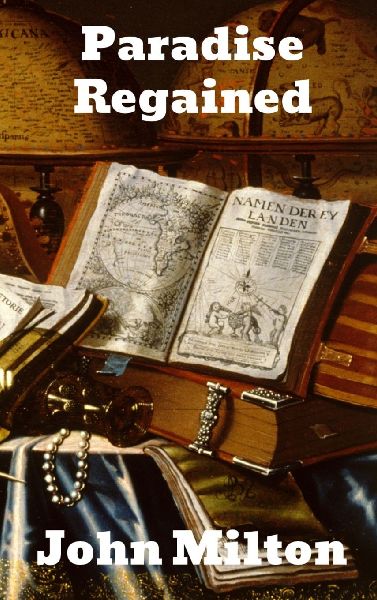
Paradise Regained
von John Milton
- Einband
- Gebunden
- Seiten
- 126
- Sprache
- Englisch
- Erschienen
- Februar 1771
- Verlag
- Binker North
Buchbeschreibung
Milton composed Paradise Regained at his cottage in Chalfont St Giles in Buckinghamshire.
Paradise Regained is four books long and comprises 2,065 lines; in contrast, Paradise Lost is twelve books long and comprises 10,565 lines. As such, Barbara K. Lewalski has labelled the work a "brief epic".
Ganze Beschreibung lesenWeniger anzeigen
Whereas Paradise Lost is ornate in style and decorative in its verse, Paradise Regained is carried out in a fairly plain style. Specifically, Milton reduces his use of simile and deploys a simpler syntax in Paradise Regained than he does in Paradise Lost, and this is consistent with Jesus's sublime plainness in his life and teachings (in the epic, he prefers Hebrew psalms to Greek poetry).
Modern editors believe the stylistics of Paradise Regained evince Milton's poetic maturity. No longer is the poet out to dazzle his readers with bombastic verse and lengthy epic similes. This is not to say that the poem bears no affinities with Milton's earlier work, but scholars continue to agree with Northrop Frye's suggestion that Paradise Regained is "practically sui generis" in its poetic execution.
One major concept emphasized throughout Paradise Regained is the idea of reversals. As implied by its title, Milton sets out to reverse the "loss" of Paradise. Thus, antonyms are often found next to each other, reinforcing the idea that everything that was lost in the first epic will be regained by the end of this "brief epic".
Additionally, the work focuses on the idea of "hunger", both in a literal and in a spiritual sense. After wandering in the wilderness for forty days, Jesus is starving for food. Satan, too blind to see any non-literal meanings of the term, offers Christ food and various other temptations, but Jesus continually denies him.
Although Milton's Jesus is remarkably human, an exclusive focus on this dimension of his character obscures the divine stakes of Jesus's confrontation with Satan; Jesus emerges victorious, and Satan falls, amazed.
An interesting anecdote recounted by a Quaker named Thomas Ellwood provides some insight into Paradise Regained's development. After studying Latin with Milton and reading the poet's epic Paradise Lost, Ellwood remarked, "Thou hast said much here of Paradise lost, but what hast thou to say of Paradise found?"
Hearing this, Milton at first "sat some time in a muse" before changing the subject; however, sometime thereafter he showed to Ellwood a new manuscript entitled Paradise Regained. Some maintain that although he seemed to express gratitude to Ellwood in a letter, Milton in truth "passed on a friendly if impish fabrication" that made Ellwood feel like the inspiration for the poem.
Details
- Erscheinungstermin
- Februar 1771
- Kategorie
- Fremdsprachige Bücher
- Einband
- Gebunden
- Seiten
- 126
- Sprache
- Englisch
- Verlag
- Binker North
- Format
- 23,5 × 15,7 cm
- Dicke
- 1,2 cm
- Gewicht
- 297 g
- EAN / ISBN-13
- 9781774413647
Über John Milton
John Milton (9 December 1608 - 8 November 1674) was an English poet, polemicist, man of letters, and civil servant for the Commonwealth of England under its Council of State and later under Oliver Cromwell.
Mehr über John MiltonWeniger anzeigen
He wrote at a time of religious flux and political upheaval, and is best known for his epic poem Paradise Lost (1667), written in blank verse.
Writing in English, Latin, Greek, and Italian, he achieved international renown within his lifetime, and his celebrated Areopagitica (1644), written in condemnation of pre-publication censorship, is among history's most influential and impassioned defences of freedom of speech and freedom of the press. His desire for freedom extended into his style: he introduced new words (coined from Latin) to the English language, and was the first modern writer to employ non-rhymed verse outside of the theatre or translations.
William Hayley's 1796 biography called him the "greatest English author",[1] and he remains generally regarded "as one of the preeminent writers in the English language",[2] though critical reception has oscillated in the centuries since his death (often on account of his republicanism). Samuel Johnson praised Paradise Lost as "a poem which...with respect to design may claim the first place, and with respect to performance, the second, among the productions of the human mind", though he (a Tory and recipient of royal patronage) described Milton's politics as those of an "acrimonious and surly republican".[3] Poets such as William Blake, William Wordsworth and Thomas Hardy revered him.
The phases of Milton's life parallel the major historical and political divisions in Stuart Britain. Milton studied, travelled, wrote poetry mostly for private circulation, and launched a career as pamphleteer and publicist under the increasingly personal rule of Charles I and its breakdown into constitutional confusion and war. The shift in accepted attitudes in government placed him in public office under the Commonwealth of England, from being thought dangerously radical and even heretical, and he even acted as an official spokesman in certain of his publications. The Restoration of 1660 deprived Milton, now completely blind, of his public platform, but this period saw him complete most of his major works of poetry.
Versand und Rückgabe
Standardversand: 1 bis 3 Werktage, 3,99 €, kostenlos ab 35 €
Liefergebiet: Deutschland
Rücksendung: 14 Tage Widerrufsrecht. Bei einem Widerruf tragen Sie die Kosten der Rücksendung. Bei einer Falschlieferung oder einem Fehler von uns erstatten wir Ihnen das Rückporto. Den Widerruf erklären Sie über den Knopf „Vertrag widerrufen“ im Fuß der Seite.
Hersteller und ProduktsicherheitBinker North
Binker North
Europaallee 1
36244 Bad Hersfeld
Deutschland
gpsr@libri.de
Verantwortliche Person in der EU
Libri GmbHEuropaallee 1
36244 Bad Hersfeld
Deutschland
gpsr@libri.de
Mehr von John Milton
Das verlorene Paradies (Paradise Lost) mit Illustrationen von William Blake
John Milton
Kartoniert, Englisch
16,80 €
Ähnliche Titel
Bewertungen
Zu diesem Titel gibt es noch keine Bewertung. Bewerten kann, wer ihn bei uns gekauft hat.
So prüfen wir Bewertungen
Eine Bewertung kann bei uns nur abgeben, wer den Titel über sein Kundenkonto bei uns gekauft hat. Jede Bewertung ist fest mit der zugehörigen Bestellung verknüpft; anders kommt sie technisch gar nicht zustande. Deshalb trägt jede angezeigte Bewertung den Hinweis „Verifizierter Kauf". Wir zeigen positive wie negative Bewertungen und löschen nur bei Rechtsverstößen. Für Bewertungen gibt es keine Gegenleistung.
23,10 €Voraussichtlich 3. bis 7. Dez.