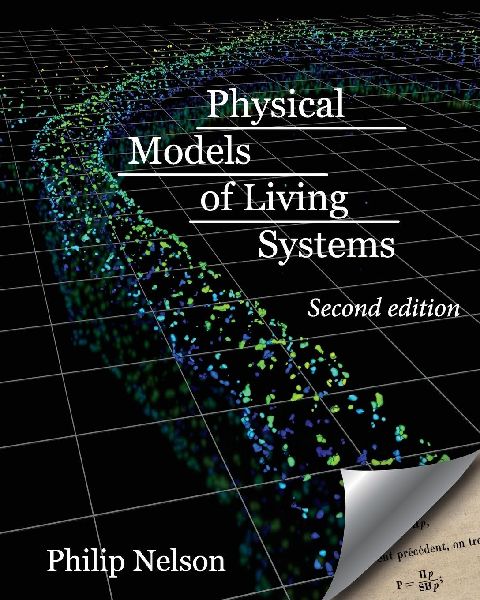
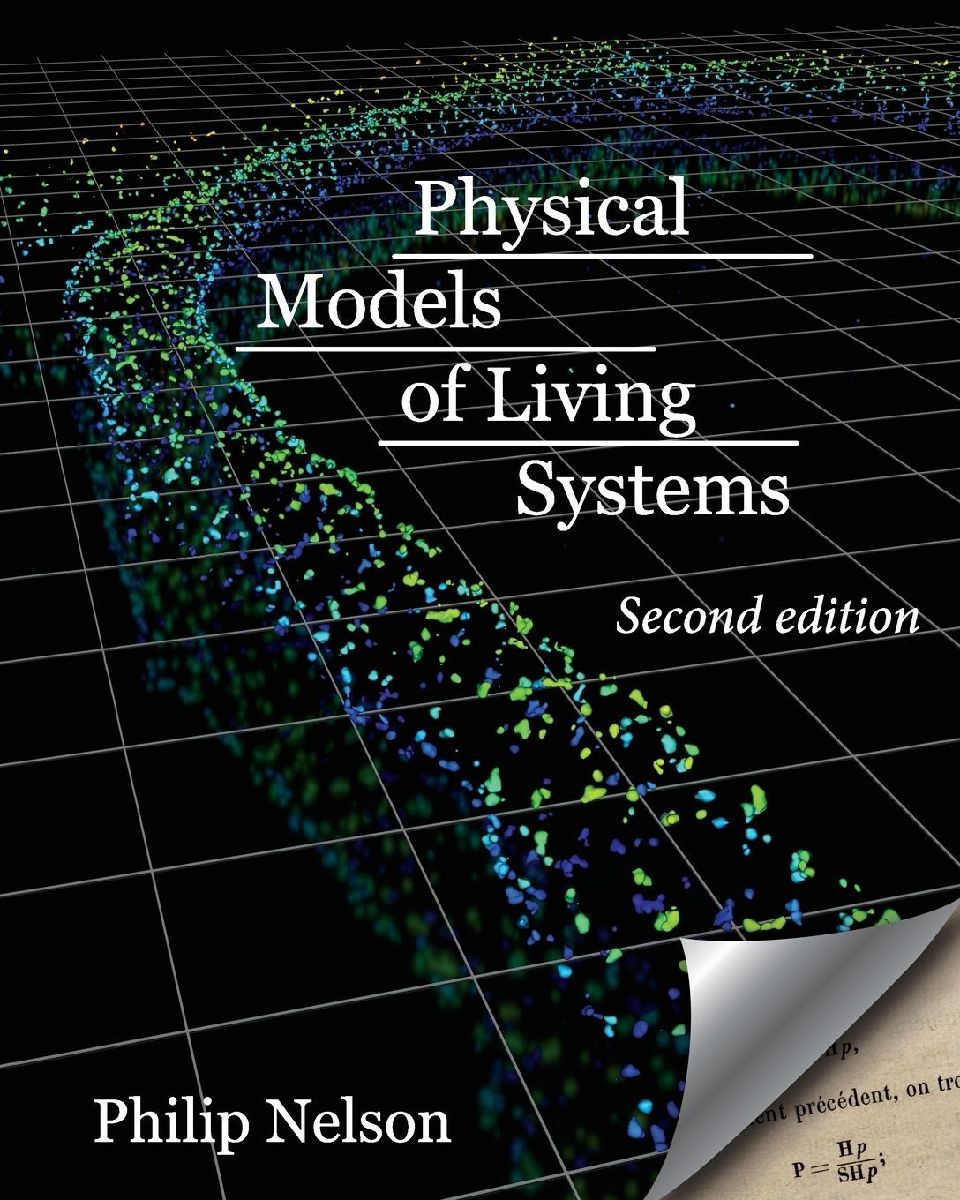
Physical Models of Living Systems
Probability, Simulation, Dynamics
von Philip Nelson
- Einband
- Kartoniert
- Seiten
- 492
- Sprache
- Englisch
- Erschienen
- November 2021
- Verlag
- Chiliagon Science
Buchbeschreibung
Award-winning prof brings you from first-year classes to the frontiers of systems and synthetic biology, epidemic modeling, and imaging.
Physical Models of Living Systems is a university textbook that integrates those cutting-edge topics with classic results in statistical inference, control theory, biophysical chemistry and mechanobiology, immunology, and neuroscience, as well as guiding you to create your own stochastic simulations.
Ganze Beschreibung lesenWeniger anzeigen
Instead of offering a huge pile of facts, the discovery-style exposition frequently asks you to reflect on "How could anything like that happen at all?" and then shows how scientists have incrementally peeled back the layers of mystery surrounding these beautiful mechanisms. Working through this book will give you an appreciation for how science has advanced in the past, and the skills and frameworks needed to push forward in the future.
Intended for intermediate-level undergraduates in any science or engineering major, the only prerequisite for this course is first-year physics. Supplementary sections make the book also suitable as the basis of a graduate-level course. This low-cost second edition expands the first one with four new chapters as well as adding add many clarifications and updates.
Dozens of exercises are included at all levels of complexity, many involving computer work. Throughout, the goal is for you to gain the fluency needed to derive every result for yourself.
Along the way, you will acquire several research skills that are often not addressed in traditional courses: Basic modeling skills, including dimensional analysis, identification of variables, and ODE formulation; Probabilistic modeling skills, including stochastic simulation; Data analysis methods, including maximum likelihood and Bayesian methods; Computer programming using a general-purpose platform like MATLAB or Python, with short codes written from scratch; Dynamical systems, particularly feedback control, with phase portrait methods.
All of these basic skills, which are relevant to nearly any field of science or engineering, are presented in the context of case studies from living systems, including: Virus dynamics; Bacterial genetics and evolution of drug resistance; Statistical inference; Super resolution microscopy and cryo-electron microscopy; Stochastic simulation, for example of gene expression; Synthetic biology; Epidemic modeling; Naturally evolved cellular control circuits, including homeostasis, genetic switches, and the mitotic clock; Excitable media.
Details
- Erscheinungstermin
- November 2021
- Kategorie
- Fremdsprachige Bücher
- Einband
- Kartoniert
- Seiten
- 492
- Sprache
- Englisch
- Verlag
- Chiliagon Science
- Format
- 25,4 × 20,3 cm
- Dicke
- 2,7 cm
- Gewicht
- 1.045 g
- EAN / ISBN-13
- 9781737540243
Über Philip Nelson
Philip Nelson is Professor of Physics and director of the Biophysics major at the University of Pennsylvania. He has received multiple teaching awards from the University of Pennsylvania and from the Biophysical Society.
Versand und Rückgabe
Standardversand: 1 bis 3 Werktage, 3,99 €, kostenlos ab 35 €
Liefergebiet: Deutschland
Rücksendung: 14 Tage Widerrufsrecht. Bei einem Widerruf tragen Sie die Kosten der Rücksendung. Bei einer Falschlieferung oder einem Fehler von uns erstatten wir Ihnen das Rückporto. Den Widerruf erklären Sie über den Knopf „Vertrag widerrufen“ im Fuß der Seite.
Hersteller und ProduktsicherheitChiliagon Science
Chiliagon Science
Europaallee 1
36244 Bad Hersfeld
Deutschland
gpsr@libri.de
Verantwortliche Person in der EU
Libri GmbHEuropaallee 1
36244 Bad Hersfeld
Deutschland
gpsr@libri.de
Mehr von Philip Nelson


The Coinage Of Ireland In Copper, Tin, And Pewter, 1460-1826 (1905)
Philip Nelson
Kartoniert, Englisch
22,20 €
Ähnliche Titel




Bewertungen
Zu diesem Titel gibt es noch keine Bewertung. Bewerten kann, wer ihn bei uns gekauft hat.
So prüfen wir Bewertungen
Eine Bewertung kann bei uns nur abgeben, wer den Titel über sein Kundenkonto bei uns gekauft hat. Jede Bewertung ist fest mit der zugehörigen Bestellung verknüpft; anders kommt sie technisch gar nicht zustande. Deshalb trägt jede angezeigte Bewertung den Hinweis „Verifizierter Kauf". Wir zeigen positive wie negative Bewertungen und löschen nur bei Rechtsverstößen. Für Bewertungen gibt es keine Gegenleistung.
76,80 €Voraussichtlich 2. bis 4. Dez.