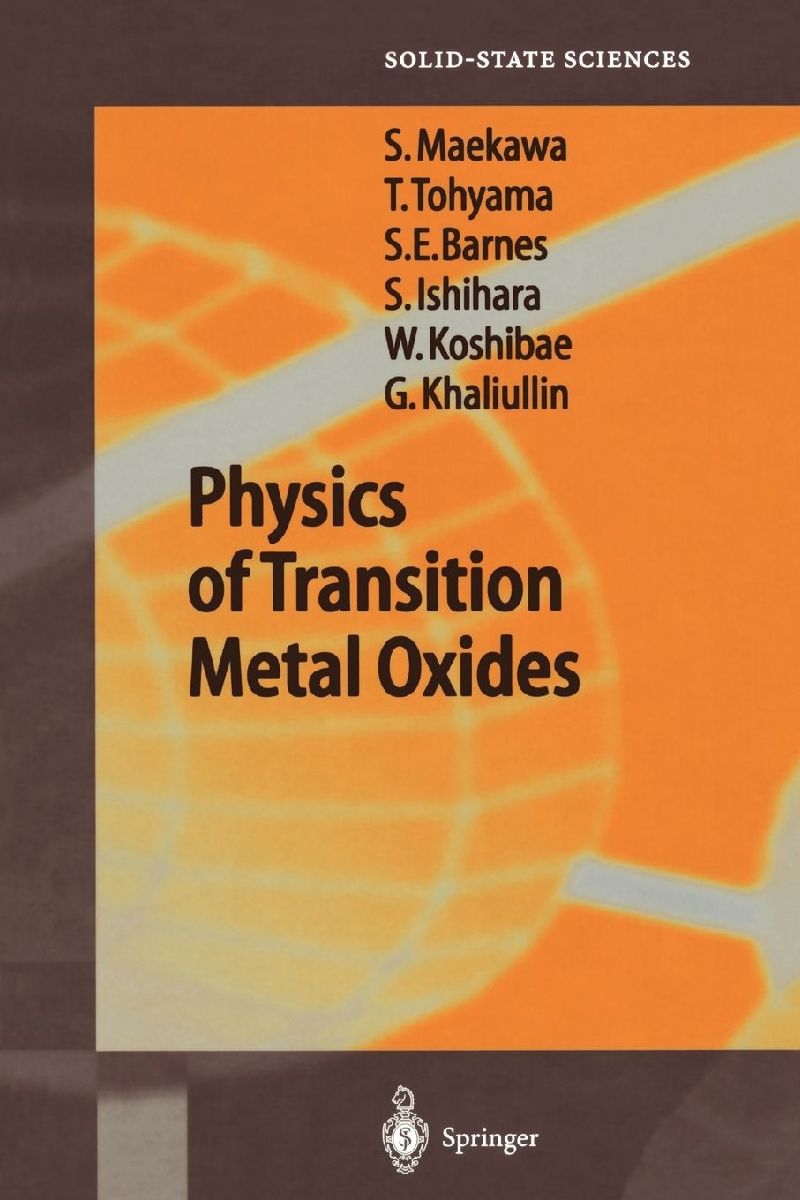
Physics of Transition Metal Oxides
von Sadamichi Maekawa, Takami Tohyama, Stewart Edward Barnes und 3 weitere
Aus der Reihe Springer Series in Solid-State Sciences
- Einband
- Kartoniert
- Seiten
- 356
- Sprache
- Englisch
- Erschienen
- Dezember 2010
- Verlag
- Springer
Buchbeschreibung
The fact that magnetite (Fe304) was already known in the Greek era as a peculiar mineral is indicative of the long history of transition metal oxides as useful materials.
The discovery of high-temperature superconductivity in 1986 has renewed interest in transition metal oxides. High-temperature su perconductors are all cuprates. Why is it? To answer to this question, we must understand the electronic states in the cuprates.
Ganze Beschreibung lesenWeniger anzeigen
Transition metal oxides are also familiar as magnets. They might be found stuck on the door of your kitchen refrigerator.
Magnetic materials are valuable not only as magnets but as electronics materials. Manganites have received special attention recently because of their extremely large magnetoresistance, an effect so large that it is called colossal magnetoresistance (CMR). What is the difference between high-temperature superconducting cuprates and CMR manganites?
Elements with incomplete d shells in the periodic table are called tran sition elements. Among them, the following eight elements with the atomic numbers from 22 to 29, i. e. , Ti, V, Cr, Mn, Fe, Co, Ni and Cu are the most im portant. These elements make compounds with oxygen and present a variety of properties. High-temperature superconductivity and CMR are examples.
Most of the textbooks on magnetism discuss the magnetic properties of transition metal oxides. However, when one studies magnetism using tradi tional textbooks, one finds that the transport properties are not introduced in the initial stages.
Inhaltsverzeichnis
- 1. Introduction
- 2. Cuprates
- 3. Theory of Superconductivity
- 4. Manganites
- 5. Titanates and Vanadates
- 6. Cobaltates
- 7. Quantum Effects in Orbitally Degenerate Systems
- Appendices
Ganzes Inhaltsverzeichnis anzeigen (14 Einträge)Weniger anzeigen
- D.1 Seebeck Effect
- D.2 Peltier Effect
- D.3 Thomson Effect
- D.4 The First and Second Laws of Thermodynamics and Thermoelectric Response in Solids: Thomson’s Considerations
- D.5 The Third Law of Thermodynamics and Thermoelectric Response in Solids
- References for Appendices
Details
- Erscheinungstermin
- Dezember 2010
- Kategorie
- Fremdsprachige Bücher
- Einband
- Kartoniert
- Seiten
- 356
- Sprache
- Englisch
- Verlag
- Springer
- Reihe
- Springer Series in Solid-State Sciences
- Format
- 23,5 × 15,5 cm
- Dicke
- 2,0 cm
- Gewicht
- 540 g
- EAN / ISBN-13
- 9783642059636
Versand und Rückgabe
Standardversand: 1 bis 3 Werktage, 3,99 €, kostenlos ab 35 €
Liefergebiet: Deutschland
Rücksendung: 14 Tage Widerrufsrecht. Bei einem Widerruf tragen Sie die Kosten der Rücksendung. Bei einer Falschlieferung oder einem Fehler von uns erstatten wir Ihnen das Rückporto. Den Widerruf erklären Sie über den Knopf „Vertrag widerrufen“ im Fuß der Seite.
Hersteller und ProduktsicherheitSpringer Nature Customer Service Center GmbH
Springer Nature Customer Service Center GmbH
Europaplatz 3
69115 Heidelberg
Deutschland
ProductSafety@springernature.com
Mehr von Sadamichi Maekawa



Mehr aus der Reihe Springer Series in Solid-State Sciences


Elastic and Inelastic Scattering in Electron Diffraction and Imaging
Zhong Lin Wang
Gebunden, Englisch
192,59 €

Ähnliche Titel


Optical and Electronic Process of Nano-Matters
Motoichi Ohtsu (Hrsg.)
Kartoniert, Englisch, 2 Ausgaben
ab 160,49 €

Progress in Nanoscale and Low-Dimensional Materials and Devices
Hilmi Ünlü (Hrsg.)
Gebunden, Englisch, 2 Ausgaben
ab 160,49 €

Semiconductor Spintronics and Quantum Computation
D. D. Awschalom (Hrsg.)
Gebunden, Englisch, 2 Ausgaben
ab 160,49 €
Bewertungen
Zu diesem Titel gibt es noch keine Bewertung. Bewerten kann, wer ihn bei uns gekauft hat.
So prüfen wir Bewertungen
Eine Bewertung kann bei uns nur abgeben, wer den Titel über sein Kundenkonto bei uns gekauft hat. Jede Bewertung ist fest mit der zugehörigen Bestellung verknüpft; anders kommt sie technisch gar nicht zustande. Deshalb trägt jede angezeigte Bewertung den Hinweis „Verifizierter Kauf". Wir zeigen positive wie negative Bewertungen und löschen nur bei Rechtsverstößen. Für Bewertungen gibt es keine Gegenleistung.
213,99 €Voraussichtlich 1. bis 3. Dez.