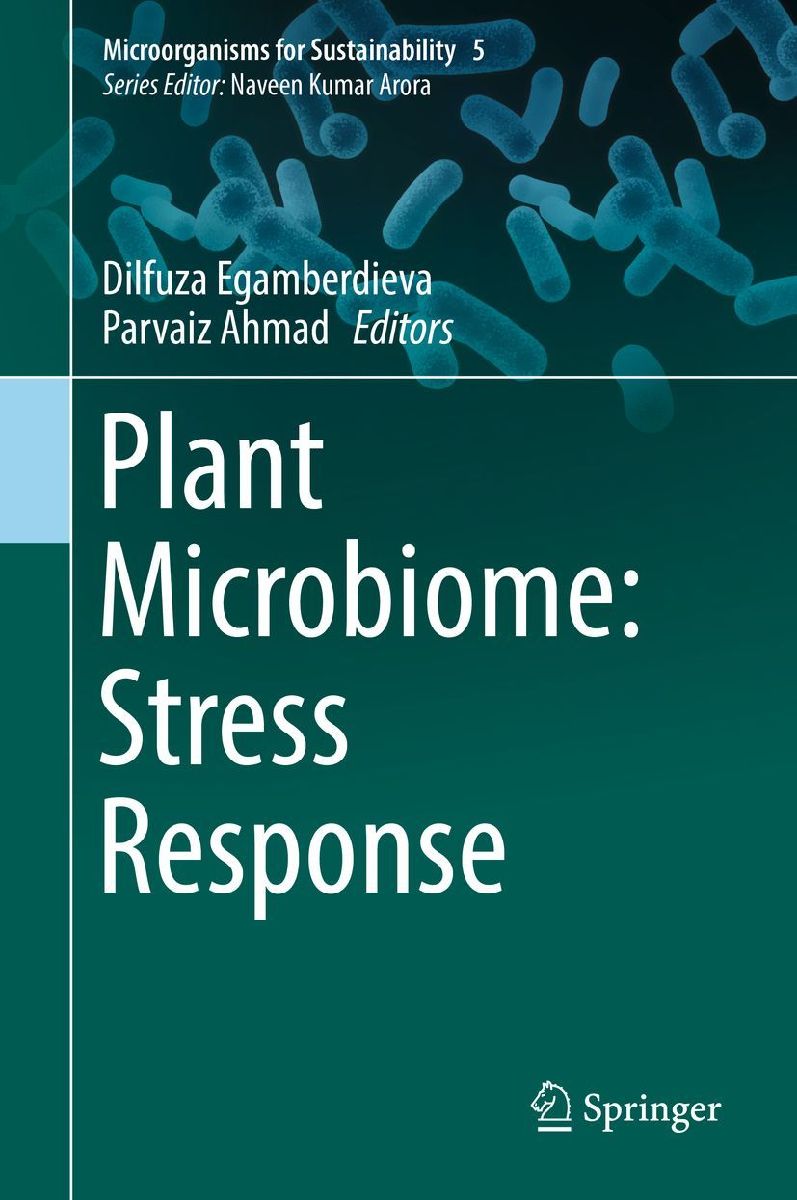
Extremophiles in Eurasian Ecosystems: Ecology, Diversity, and Applications
Dilfuza Egamberdieva (Hrsg.)
Gebunden, Englisch, 2 Ausgaben
ab 160,49 €
von Dilfuza Egamberdieva (Hrsg.)
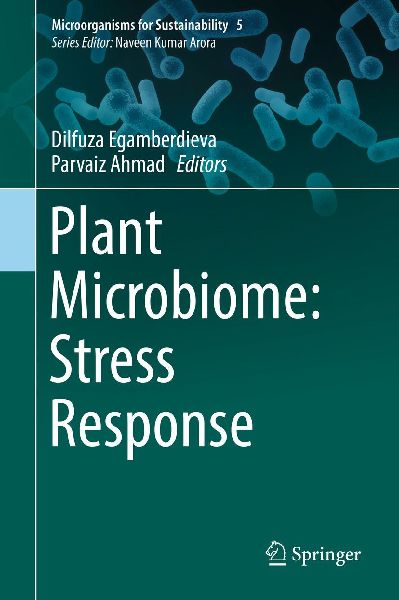
Herausgegeben von: Dilfuza Egamberdieva, Herausgegeben von: Parvaiz Ahmad
Aus der Reihe Microorganisms for Sustainability
This book presents state-of-the-art research on the many facets of the plant microbiome, including diversity, ecology, physiology and genomics, as well as molecular mechanisms of plant-microbe interactions.
Topics considered include the importance of microbial secondary metabolites in stimulating plant growth, induced systemic resistance, tolerance to abiotic stress, and biological control of plant pathogens.
The respective contributions show how microbes help plants to cope with abiotic stresses, and represent significant progress toward understanding the complex regulatory networks critical to host-microbe interaction and plant adaptation in extreme environments.
New insights into the mechanisms of microbial actions in inducing plant stress tolerance open new doors for improving the efficacy of microbial strategies, and could produce new ways of economically increasing crop yields without harming the environment.
As such, this book offers an essential resource for students and researchers with an interest in plant-microbe interaction, as well as several possibilities for employing the plant microbiome in the enhancement of crop productivity under future climate change scenarios.
Dilfuza Egamberdieva graduated in biology from the National University of Uzbekistan in 1993. She received her PhD in Agricultural Sciences from the Humboldt University of Berlin, Germany in 2000 and …
She received her PhD in Agricultural Sciences from the Humboldt University of Berlin, Germany in 2000 and did her first postdoctoral studies at the Helsinki University of Finland in 2001. In 2003 she conducted her second postdoctoral research in the Department of Soil Science and Plant Nutrition, University of Florence, Italy. In 2006 she continued her research activities in Department of Biological Sciences of Manchester Metropolitan University and 2007 in Institute of Biology, Leiden University of Netherlands. She returned to Uzbekistan in 2009 and established research laboratory in National University of Uzbekistan, where the main focus of the research is directed towards an understanding of the structural and functional organization of plant associated microbial communities. For her best academic achievements she received numerous fellowship and awards including UNESCO-L'OREAL Fellowship for Women in Science (2006), IUBMB Young scientist Award (2006), ASM Morrison Rogosa Award (2006), UNESCO-MAB Award (2005), TWAS-TWOWS-SCOPUS Young Women Research Award (2009) and in 2012 she has been awarded with TWAS Prize in Agricultural Sciences for her innovative contributions to the study of plant-microbe interactions in environmental stressed conditions and their potential to improve crop production. In 2014 she has been elected as a member of Global Young Academy and in same year she has been awarded with Alexander Von Humboldt Fellowship and begins her research as senior scientist at Leibniz Centre for Agricultural Landscape Research (ZALF) Germany. She has over 80 peer-reviewed publications in international journals and 40 chapters.
Dr. Parvaiz is Senior Assistant Professor in Department of Botany at Sri Pratap College, Srinagar, Jammu and Kashmir, India. He has completed his postgraduation in Botany in 2000 from Jamia Hamdard, New Delhi, India. After receiving a Doctorate degree from the Indian Institute of Technology (IIT), Delhi, India, he joined the International Centre for Genetic Engineering and Biotechnology, New Delhi, in 2007. His main research area is Stress Physiology, Molecular Biology and Microbiology. He has published more than 60 research papers in peer-reviewed journals and 40 book chapters. He is also an Editor of 19 volumes (1 with Studium Press Pvt. India Ltd., New Delhi, India, 9 with Springer NY USA, 5 with Elsevier USA and 4 with John Wiley). He is a recipient of the Junior Research Fellowship and Senior Research Fellowship by CSIR, New Delhi, India. Dr. Parvaiz has been awarded the Young Scientist Award under Fast Track scheme in 2007 by the Department of Science and Technology (DST), Govt. of India. Dr. Parvaiz is actively engaged in studying the molecular and physio-biochemical responses of different agricultural and horticultural plants under environmental stress.
Standardversand: 1 bis 3 Werktage, 3,99 €, kostenlos ab 35 €
Liefergebiet: Deutschland
Rücksendung: 14 Tage Widerrufsrecht. Bei einem Widerruf tragen Sie die Kosten der Rücksendung. Bei einer Falschlieferung oder einem Fehler von uns erstatten wir Ihnen das Rückporto. Den Widerruf erklären Sie über den Knopf „Vertrag widerrufen“ im Fuß der Seite.
Dilfuza Egamberdieva (Hrsg.)
Gebunden, Englisch, 2 Ausgaben
ab 160,49 €
Dilfuza Egamberdieva (Hrsg.)
Gebunden, Englisch, 2 Ausgaben
ab 160,49 €
Dilfuza Egamberdieva (Hrsg.)
Gebunden, Englisch, 2 Ausgaben
ab 192,59 €
Dilfuza Egamberdieva (Hrsg.)
Gebunden, Englisch, 2 Ausgaben
ab 160,49 €
Meenu Saraf (Hrsg.)
Kartoniert, Englisch, 2 Ausgaben
ab 235,39 €
Venugopal Gopikrishnan (Hrsg.)
Gebunden, Englisch
213,99 €
Naveen Kumar Arora (Hrsg.)
Gebunden, Englisch
213,99 €
Ashok Kumar (Hrsg.)
Gebunden, Englisch, 2 Ausgaben
ab 171,19 €
Bhavtosh Kikani
Kartoniert, Englisch
17,95 €
Dhananjaya Pratap Singh (Hrsg.)
Gebunden, Englisch, 2 Ausgaben
ab 213,99 €
Zu diesem Titel gibt es noch keine Bewertung. Bewerten kann, wer ihn bei uns gekauft hat.