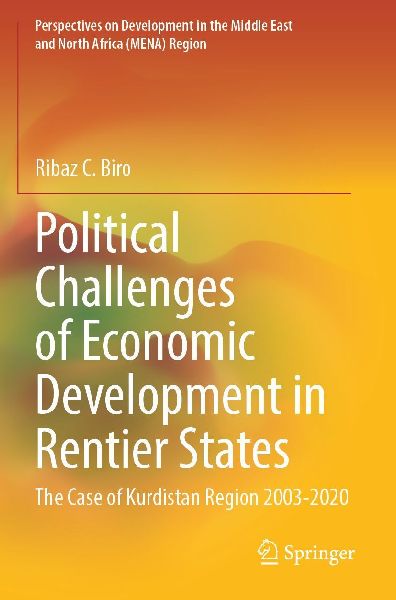
Political Challenges of Economic Development in Rentier States
The Case of Kurdistan Region 2003-2020
von Ribaz C. Biro
Aus der Reihe Perspectives on Development in the Middle East and North Africa (MENA) Region
- Einband
- Kartoniert
- Seiten
- 180
- Sprache
- Englisch
- Erschienen
- Dezember 2025
- Verlag
- Springer
Buchbeschreibung
This book investigates the relationship between politics and economics in rentier states, with a particular focus on the Kurdistan Region of Iraq from 2003 to 2020. Resource-rich states face low levels of economic growth due to the various factors of corruption, weak performance of institutions, poor levels of accountability and transparency in governance, and absence of rule of law.
Ganze Beschreibung lesenWeniger anzeigen
While most previous studies of the topic focus on either the political or economic concerns, this book focuses on their interaction. The book explores the political hurdles in resource-rich states, examining to what extent this impedes economic growth through panel data from 51 rentier states from 2003 to 2020 with different political systems and different types of natural resource dependency.
The insights presented in this book have wider implications for understanding and solving similar hurdles in the Kurdistan Region of Iraq and would be a valuable resource for policymakers, strategists, academics, lawmakers, and government officials in implementing sustainable development plans and reducing the negative impacts of natural resource over-reliance in rentier states.
Inhaltsverzeichnis
- 1. Introduction
- 2. Literature Review
- 3. Political and Economic Landscape of the KRI
- 4. Institutional Quality in Rentier States
- 5. Economic Freedom and Economic Development
- 6. Political Challenges Impacting Institutional Quality and Economic Freedom in the KRI
- 7. Political Challenges and Economic Development in the KRI
- 8. Conclusion
Details
- Erscheinungstermin
- Dezember 2025
- Kategorie
- Fremdsprachige Bücher
- Einband
- Kartoniert
- Seiten
- 180
- Sprache
- Englisch
- Verlag
- Springer
- Reihe
- Perspectives on Development in the Middle East and North Africa (MENA) Region
- Format
- 23,5 × 15,5 cm
- Dicke
- 1,1 cm
- Gewicht
- 283 g
- EAN / ISBN-13
- 9789819605651
Über Ribaz C. Biro
Ribaz C. Biro is a leading researcher at the Economic Research Center, Soran University, Kurdistan Region, Iraq.
Mehr über Ribaz C. BiroWeniger anzeigen
He received his MA (2019) in International Relations at University of Warsaw-Poland, and his PhD (2023) in International Relations at Soran University, Kurdistan Region, Iraq. Dr. Biro has a professional background in academia, consultancy, and management across various industries. His recognized research covers diverse political and economic subjects, with a focus on political stability, security, corruption, governance, foreign direct investment, natural resource economics, agriculture economics, and economic growth in developing and post-conflict areas. He is currently a research fellow in political economy at the Economic Research Center at Soran University, Kurdistan Region of Iraq.
Versand und Rückgabe
Standardversand: 1 bis 3 Werktage, 3,99 €, kostenlos ab 35 €
Liefergebiet: Deutschland
Rücksendung: 14 Tage Widerrufsrecht. Bei einem Widerruf tragen Sie die Kosten der Rücksendung. Bei einer Falschlieferung oder einem Fehler von uns erstatten wir Ihnen das Rückporto. Den Widerruf erklären Sie über den Knopf „Vertrag widerrufen“ im Fuß der Seite.
Hersteller und ProduktsicherheitSpringer Nature Customer Service Center GmbH
Springer Nature Customer Service Center GmbH
Europaplatz 3
69115 Heidelberg
Deutschland
ProductSafety@springernature.com
Mehr aus der Reihe Perspectives on Development in the Middle East and North Africa (MENA) Region
Resource Management Performance: A Sectoral Analysis in the Post-Conflict Kurdistan Region of Iraq
Goran M. Muhamad (Hrsg.)
Gebunden, Englisch, 2 Ausgaben
ab 139,09 €
Conflicts and Challenges in the Middle East
Ho-Don Yan (Hrsg.)
Gebunden, Englisch, 2 Ausgaben
ab 160,49 €
Ähnliche Titel




Bewertungen
Zu diesem Titel gibt es noch keine Bewertung. Bewerten kann, wer ihn bei uns gekauft hat.
So prüfen wir Bewertungen
Eine Bewertung kann bei uns nur abgeben, wer den Titel über sein Kundenkonto bei uns gekauft hat. Jede Bewertung ist fest mit der zugehörigen Bestellung verknüpft; anders kommt sie technisch gar nicht zustande. Deshalb trägt jede angezeigte Bewertung den Hinweis „Verifizierter Kauf". Wir zeigen positive wie negative Bewertungen und löschen nur bei Rechtsverstößen. Für Bewertungen gibt es keine Gegenleistung.
139,09 €Voraussichtlich 2. bis 4. Dez.