Buch-OWLOnline-Buchhandel

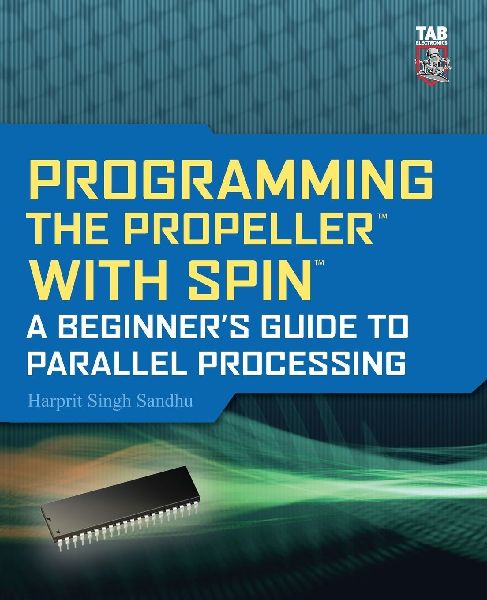
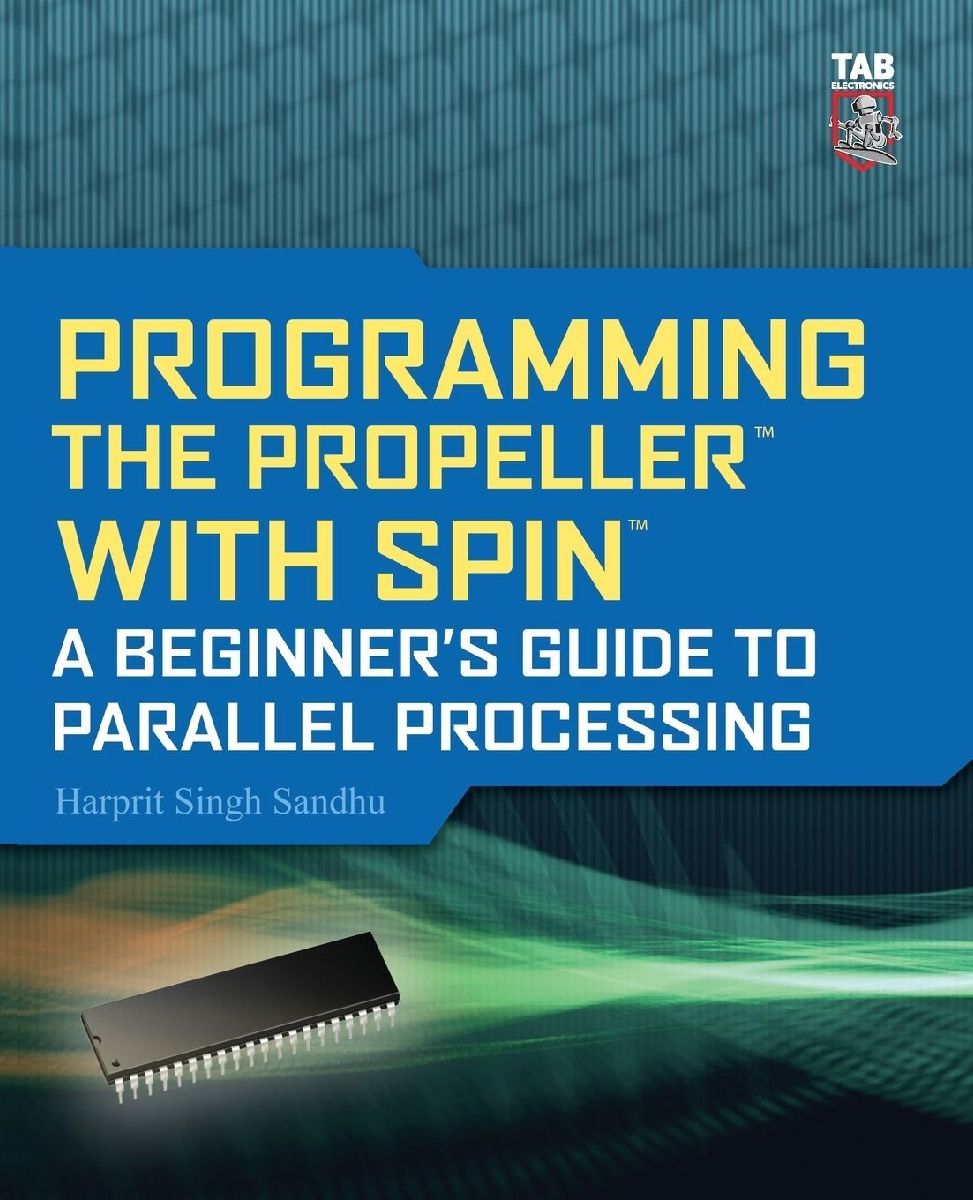
Programming the Propeller with Spin

A Beginner's Guide to Parallel Processing

von Harprit Singh Sandhu

Einband
Kartoniert
Seiten
370
Sprache
Englisch
Erschienen
Januar 2010
Verlag
McGraw-Hill Education

Buchbeschreibung

Publisher's Note: Products purchased from Third Party sellers are not guaranteed by the publisher for quality, authenticity, or access to any online entitlements included with the product.

Parallel Processing With the Propeller--Made Easy! "This book should find a place on any Propellerhead's bookshelf, between Parallax's Propeller Manual and its Programming and Customizing the Multicore Propeller volumes."

Ganze Beschreibung lesenWeniger anzeigen

Make: 24 Programming the Propeller with Spin: A Beginner's Guide to Parallel Processing walks you through the essential skills you need to build and control devices using the Propeller chip and its parallel processing environment.

Find out how to use each of the identical 32-bit processors, known as cogs, and make the eight cogs effectively interact with each other. The book covers Propeller hardware and software setup, memory, and the Spin language. Step-by-step projects give you hands-on experience as you learn how to:

  • Use Propeller I/O techniques with extensive Spin code examples
  • Display numbers with seven segment displays
  • Create accurate, controlled pulse sequences
  • Add a 16 character by two line LCO display
  • Control R/C hobby servos
  • Use motor amplifiers to control small motors
  • Run a bipolar stepper motor
  • Build a gravity sensor-based auto-leveling table
  • Run DC motors with incremental encoders
  • Run small AC motors You'll also find hundreds of lines of ready-to-run documented Spin code as well as PDFs of all the schematics on McGraw-Hill's website: Downloads available at www.mhprofessional.com/computingdownload "This book should find a place on any Propellerhead's bookshelf, between Parallax's Propeller Manual and its Programming and Customizing the Multicore Propeller volumes." Make: 24

Inhaltsverzeichnis

  • Preface
  • Part I: The Propeller/SPIN System. Introduction for the Beginner
  • Chapter 1. A General Introduction to the Propeller Chip
  • Chapter 2. The Propeller Chip. An Overall Description
  • Chapter 3. The Hardware Setup
  • Chapter 4. Software Setup: The Propeller "Tool" Environment
  • Chapter 5. The Various Propeller Memories
  • Chapter 6. The How and Why of Shared Memory
Ganzes Inhaltsverzeichnis anzeigen (42 Einträge)Weniger anzeigen
  • Chapter 7. Understanding One Cog
  • Chapter 8. The Eight Cogs
  • Chapter 9. Special Terms and Ideas
  • Chapter 10. The Spin Language
  • Chapter 11. Tasks Suited to Parallel Processing
  • Part II: Input and Output: The Basic Techniques to Be Mastered--Learning by Doing
  • Chapter 12. General Discussion of Input/Output
  • Chapter 13. Binary Pulsing
  • Chapter 14. Setting Up a 16-Character-by-2-Line Liquid Crystal Display
  • Chapter 15. Binary Input and Output: Reading a Switch and Turning on an LED if Switch is Closed
  • Chapter 16. Reading a Potentiometer: Creating an Input We Can Vary in Real Time
  • Chapter 17. Creating and Reading Frequencies
  • Chapter 18. Reading and Creating Pulses
  • Part III: The Projects: Using What Was Learned to Build The Projects
  • Chapter 19. Seven Segment Displays: Displaying Numbers with Seven-Segment LED Displays
  • Chapter 20. The Metronomes
  • Chapter 21. Understanding a 16-Character-by-2-Line LCD Display
  • Chapter 22. Running Motors: A Preliminary Discussion
  • Chapter 23. Motor Amplifiers for Small Motors
  • Chapter 24. Motor Amplifiers for Small Motors
  • Chapter 25. Controlling a Small DC Motor
  • Chapter 26. Running a Stepper Motor: Bipolar, Four-Wire Motors
  • Chapter 27. Gravity Sensor Based Auto-Leveling Table
  • Chapter 28. Running DC Motors with Attached Incremental Encoders
  • Chapter 29. Running Small AC Motors: Controlling Inductive Loads
  • Part IV: Appendixes
  • Appendix A. LCD
  • Routines4 and Utilities Object Listings
  • Appendix B. Materials
  • Appendix C. Turning Cogs On and Off
  • Appendix D. Experiments Board
  • Appendix E. Debugging
  • Epilogue
  • Index

Details

Erscheinungstermin
Januar 2010
Kategorie
Fremdsprachige Bücher
Einband
Kartoniert
Seiten
370
Sprache
Englisch
Verlag
McGraw-Hill Education
Format
23,5 × 19,1 cm
Dicke
2,0 cm
Gewicht
690 g
EAN / ISBN-13
9780071716666
Maßstabsgetreu: Deckel und Buchrücken neben einer Hand (18 cm).

Über Harprit Singh Sandhu

Harprit Singh Sandhu, BSME, MSCerE, is the founder of Rhino Robots, Inc., a major manufacturer of both robots and computer numeric-controlled machines.

Mehr über Harprit Singh SandhuWeniger anzeigen

He is the author of Making PIC Microcontroller Instruments and Controllers and Running Small Motors with PIC Microcontrollers.

Versand und Rückgabe

Standardversand: 1 bis 3 Werktage, 3,99 €, kostenlos ab 35 €

Liefergebiet: Deutschland

Rücksendung: 14 Tage Widerrufsrecht. Bei einem Widerruf tragen Sie die Kosten der Rücksendung. Bei einer Falschlieferung oder einem Fehler von uns erstatten wir Ihnen das Rückporto. Den Widerruf erklären Sie über den Knopf „Vertrag widerrufen“ im Fuß der Seite.

Hersteller und ProduktsicherheitMcGraw-Hill Education
McGraw-Hill Education

Verantwortliche Person in der EU

Libri GmbH
Europaallee 1
36244 Bad Hersfeld
Deutschland
gpsr@libri.de

Ähnliche Titel

Bewertungen

Zu diesem Titel gibt es noch keine Bewertung. Bewerten kann, wer ihn bei uns gekauft hat.
So prüfen wir Bewertungen
Eine Bewertung kann bei uns nur abgeben, wer den Titel über sein Kundenkonto bei uns gekauft hat. Jede Bewertung ist fest mit der zugehörigen Bestellung verknüpft; anders kommt sie technisch gar nicht zustande. Deshalb trägt jede angezeigte Bewertung den Hinweis „Verifizierter Kauf". Wir zeigen positive wie negative Bewertungen und löschen nur bei Rechtsverstößen. Für Bewertungen gibt es keine Gegenleistung.
39,30 €Voraussichtlich 2. bis 4. Dez.

Inhalte ab 18

Cover von Titeln für Erwachsene, etwa erotische Romane, Manga oder Comics, bleiben unscharf, bis Sie bestätigen. Die Bestätigung gilt für alle Seiten und Tabs, bis Sie den Browser schließen.

Zurück zum Katalog