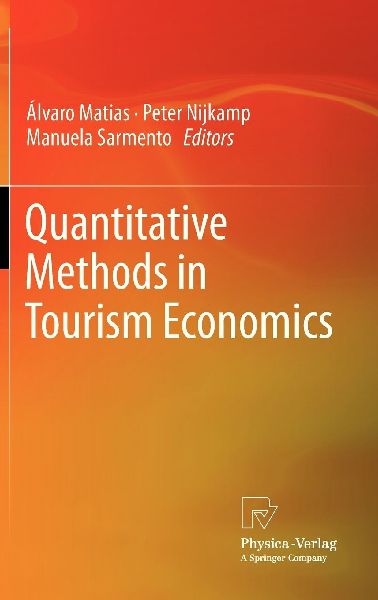
Quantitative Methods in Tourism Economics
Herausgegeben von: Álvaro Matias, Herausgegeben von: Peter Nijkamp, Herausgegeben von: Manuela Sarmento
- Einband
- Gebunden
- Seiten
- 360
- Sprache
- Englisch
- Erschienen
- Dezember 2012
- Verlag
- Physica
Buchbeschreibung
Tourism economics is partly based on established principles from the economics discipline, but it also incorporates elements from sociology, psychology, organization theory and ecology.
It has over the years turned into an appealing multi-disciplinary oriented approach to the understanding of the impacts of leisure time in a modern society, including cultural heritage, sustainable quality of life, and industrial organization of the hospitality industry.
Ganze Beschreibung lesenWeniger anzeigen
The increasing dynamics in the tourist industry and its worldwide effects will continue to attract the attention of both the research and the policy sector in the years to come.
Rather than speculating on non-observed facts, there is a clear need for evidence-based research in order to map out the complex dynamics of the tourist industry. The present volume comprises novel studies - mainly of a quantitative-analytical nature - on the supply, demand and contextual aspects of modern tourism. It contains a sound mix of theory, methodology, policy and case studies on various tourism issues in different parts of the world.¿
Inhaltsverzeichnis
- Editorial Introduction
- Behavioral Issues: Loyalty Measurement in Tourism
- Tourists Return Intentions
- Evaluation of the Interrailers' Satisfaction Regarding the Tourism Services and Activities in Italy, Greece and Croatia
- Forecasting Tourism Demand for South Africa Using a Single Equation Causal Approach
- The Importance of ICT for Tourism Demand
- Migration and Tourism Flows in New Zealand
- Supply of Tourist Amenities: How to Create a New Holiday Destination?- The Economic Impact of Social Tourism Programmes
Ganzes Inhaltsverzeichnis anzeigen (16 Einträge)Weniger anzeigen
- Cultural Festivals and Regional Economic Development
- Assessing the Spatial and Environmental Characteristics of Rural Tourism Lodging Units Using a Geographical Weighted Regression Model
- Yield Revenue Management in the Hotel Sector
- Macro and Sustainability Issues: Tourism Growth versus Economic Development
- Gender, Wages, and Productivity
- Territorial Differentiation, Competitiveness and Sustainability of Tourism
- Did the Financial Crisis and Policy Deregulation for Chinese Tourists Affect the Efficiency and Output Slacks of Taiwanese Hotels?- Institutional Analysis of Environmental Management Practices
- Market Segmentation in Tourism. ¿
Details
- Erscheinungstermin
- Dezember 2012
- Kategorie
- Fremdsprachige Bücher
- Einband
- Gebunden
- Seiten
- 360
- Sprache
- Englisch
- Verlag
- Physica
- Format
- 24,1 × 16,0 cm
- Dicke
- 2,4 cm
- Gewicht
- 653 g
- EAN / ISBN-13
- 9783790828788
Versand und Rückgabe
Standardversand: 1 bis 3 Werktage, 3,99 €, kostenlos ab 35 €
Liefergebiet: Deutschland
Rücksendung: 14 Tage Widerrufsrecht. Bei einem Widerruf tragen Sie die Kosten der Rücksendung. Bei einer Falschlieferung oder einem Fehler von uns erstatten wir Ihnen das Rückporto. Den Widerruf erklären Sie über den Knopf „Vertrag widerrufen“ im Fuß der Seite.
Hersteller und ProduktsicherheitSpringer Nature Customer Service Center GmbH
Springer Nature Customer Service Center GmbH
Europaplatz 3
69115 Heidelberg
Deutschland
ProductSafety@springernature.com
Mehr von Álvaro Matias
Impact Assessment in Tourism Economics
Álvaro Matias (Hrsg.)
Gebunden, Englisch, 2 Ausgaben
ab 149,79 €
Ähnliche Titel
Impact Assessment in Tourism Economics
Álvaro Matias (Hrsg.)
Gebunden, Englisch, 2 Ausgaben
ab 149,79 €
Trends and Issues in Global Tourism 2007
Roland Conrady (Hrsg.)
Gebunden, Englisch, 2 Ausgaben
ab 53,49 €

Development of Environmental Policy in Japan and Asian Countries
T. Terao (Hrsg.)
Kartoniert, Englisch, 2 Ausgaben
ab 106,99 €

The Sustainable Development Theory: A Critical Approach, Volume 1
Ion Pohoa¿¿
Gebunden, Englisch, 2 Ausgaben
ab 117,69 €
Bewertungen
Zu diesem Titel gibt es noch keine Bewertung. Bewerten kann, wer ihn bei uns gekauft hat.
So prüfen wir Bewertungen
Eine Bewertung kann bei uns nur abgeben, wer den Titel über sein Kundenkonto bei uns gekauft hat. Jede Bewertung ist fest mit der zugehörigen Bestellung verknüpft; anders kommt sie technisch gar nicht zustande. Deshalb trägt jede angezeigte Bewertung den Hinweis „Verifizierter Kauf". Wir zeigen positive wie negative Bewertungen und löschen nur bei Rechtsverstößen. Für Bewertungen gibt es keine Gegenleistung.
160,49 €Voraussichtlich 4. bis 8. Dez.