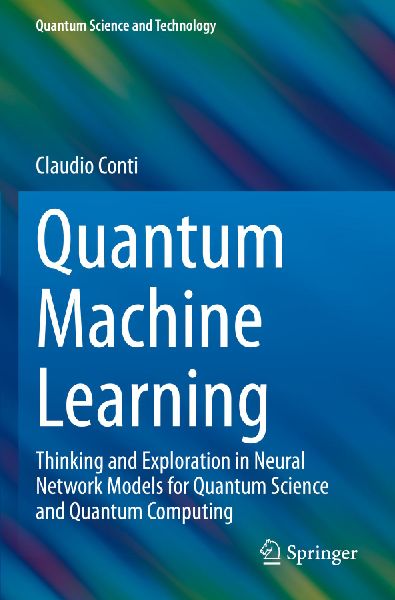
Quantum Machine Learning
Thinking and Exploration in Neural Network Models for Quantum Science and Quantum Computing
von Claudio Conti
Aus der Reihe Quantum Science and Technology
- Einband
- Kartoniert
- Seiten
- 404
- Sprache
- Englisch
- Erschienen
- Januar 2025
- Verlag
- Springer
Buchbeschreibung
This book presents a new way of thinking about quantum mechanics and machine learning by merging the two.
Quantum mechanics and machine learning may seem theoretically disparate, but their link becomes clear through the density matrix operator which can be readily approximated by neural network models, permitting a formulation of quantum physics in which physical observables can be computed via neural networks.
Ganze Beschreibung lesenWeniger anzeigen
As well as demonstrating the natural affinity of quantum physics and machine learning, this viewpoint opens rich possibilities in terms of computation, efficient hardware, and scalability. One can also obtain trainable models to optimize applications and fine-tune theories, such as approximation of the ground state in many body systems, and boosting quantum circuits' performance.
The book begins with the introduction of programming tools and basic concepts of machine learning, with necessary background material from quantum mechanics and quantum information also provided. This enables the basic building blocks, neural network models for vacuum states, to be introduced.
The highlights that follow include: non-classical state representations, with squeezers and beam splitters used to implement the primary layers for quantum computing; boson sampling with neural network models; an overview of available quantum computing platforms, their models, and their programming; and neural network models as a variational ansatz for many-body Hamiltonian ground states with applications to Ising machines and solitons.
The book emphasizes coding, with many open source examples in Python and TensorFlow, while MATLAB and Mathematica routines clarify and validate proofs. This book is essential reading for graduate students and researchers who want to develop both the requisite physics and coding knowledge to understand the rich interplay of quantum mechanics and machine learning.
Inhaltsverzeichnis
- Chapter 1: Quantum mechanics and data-driven physics
- Chapter 2: Kernelizing quantum mechanics
- Chapter 3: Qubit maps
- Chapter 4: One qubit transverse-field Ising model and variational quantum algorithms
- Chapter 5: Two-qubit transverse-field Ising model and entanglement
- Chapter 6: Variational Algorithms, Quantum Approximation Optimization and Neural Network Quantum States with two-qubits
- Chapter 7: Phase space representation
- Chapter 8: States as a neural networks and gates as pullbacks
Ganzes Inhaltsverzeichnis anzeigen (13 Einträge)Weniger anzeigen
- Chapter 9: Quantum reservoir computing
- Chapter 10: Squeezing, beam splitters, and detection
- Chapter 11: Uncertainties and entanglement
- Chapter 12: Gaussian boson sampling
- Chapter 13: Variational circuits for quantum solitons
Details
- Erscheinungstermin
- Januar 2025
- Kategorie
- Fremdsprachige Bücher
- Einband
- Kartoniert
- Seiten
- 404
- Sprache
- Englisch
- Verlag
- Springer
- Reihe
- Quantum Science and Technology
- Format
- 23,5 × 15,5 cm
- Dicke
- 2,2 cm
- Gewicht
- 610 g
- EAN / ISBN-13
- 9783031442285
Über Claudio Conti
Claudio Conti is an associate professor at the Department of Physics of the University Sapienza of Rome. He authored over 250 articles in many fields, such as quantum physics, photonics, nonlinear science, biophysics, and complexity.
Mehr über Claudio ContiWeniger anzeigen
His activity includes experiments and theory, such as the first observation of replica symmetry breaking mentioned in the scientific background of the Nobel prize in physics in 2021, the investigation of neuromorphic computing by quantum fluids, and the optical acceleration of natural language processing. Claudio Conti coordinates an experimental and theoretical group in Rome exploring the frontiers of artificial intelligence and physics.
Versand und Rückgabe
Standardversand: 1 bis 3 Werktage, 3,99 €, kostenlos ab 35 €
Liefergebiet: Deutschland
Rücksendung: 14 Tage Widerrufsrecht. Bei einem Widerruf tragen Sie die Kosten der Rücksendung. Bei einer Falschlieferung oder einem Fehler von uns erstatten wir Ihnen das Rückporto. Den Widerruf erklären Sie über den Knopf „Vertrag widerrufen“ im Fuß der Seite.
Hersteller und ProduktsicherheitSpringer Nature Customer Service Center GmbH
Springer Nature Customer Service Center GmbH
Europaplatz 3
69115 Heidelberg
Deutschland
ProductSafety@springernature.com
Mehr aus der Reihe Quantum Science and Technology
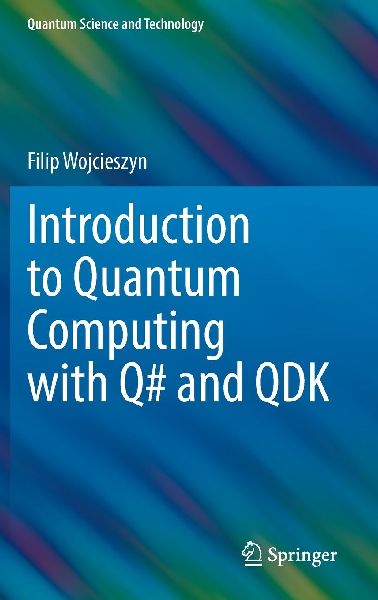
Introduction to Quantum Computing with Q# and QDK
Filip Wojcieszyn
Gebunden, Englisch, 2 Ausgaben
ab 64,19 €
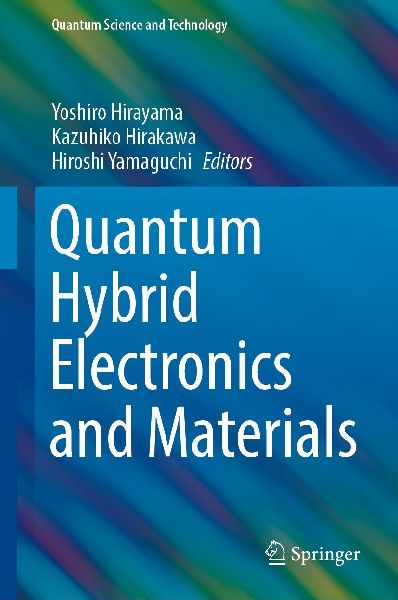
Quantum Hybrid Electronics and Materials
Yoshiro Hirayama (Hrsg.)
Gebunden, Englisch, 2 Ausgaben
ab 160,49 €
Ähnliche Titel
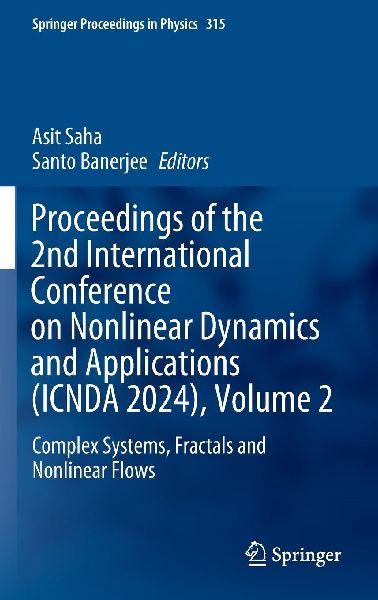
Proceedings of the 2nd International Conference on Nonlinear Dynamics and Applications (ICNDA 2024), Volume 2
Asit Saha (Hrsg.)
Gebunden, Englisch, 2 Ausgaben
ab 320,99 €

The Search for Supersymmetry in Hadronic Final States Using Boosted Object Reconstruction
Giordon Stark
Kartoniert, Englisch, 2 Ausgaben
ab 117,69 €
Bewertungen
Zu diesem Titel gibt es noch keine Bewertung. Bewerten kann, wer ihn bei uns gekauft hat.
So prüfen wir Bewertungen
Eine Bewertung kann bei uns nur abgeben, wer den Titel über sein Kundenkonto bei uns gekauft hat. Jede Bewertung ist fest mit der zugehörigen Bestellung verknüpft; anders kommt sie technisch gar nicht zustande. Deshalb trägt jede angezeigte Bewertung den Hinweis „Verifizierter Kauf". Wir zeigen positive wie negative Bewertungen und löschen nur bei Rechtsverstößen. Für Bewertungen gibt es keine Gegenleistung.
139,09 €Voraussichtlich 30. Nov. bis 2. Dez.