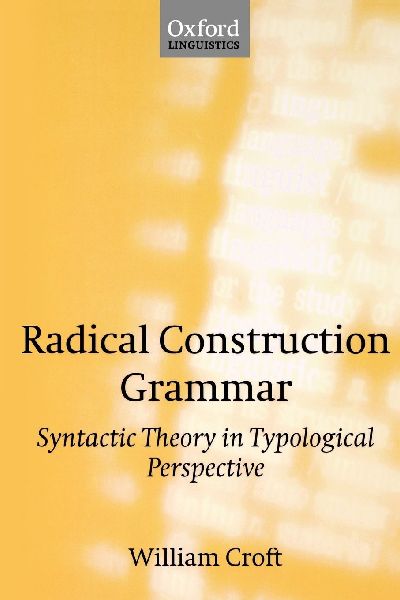
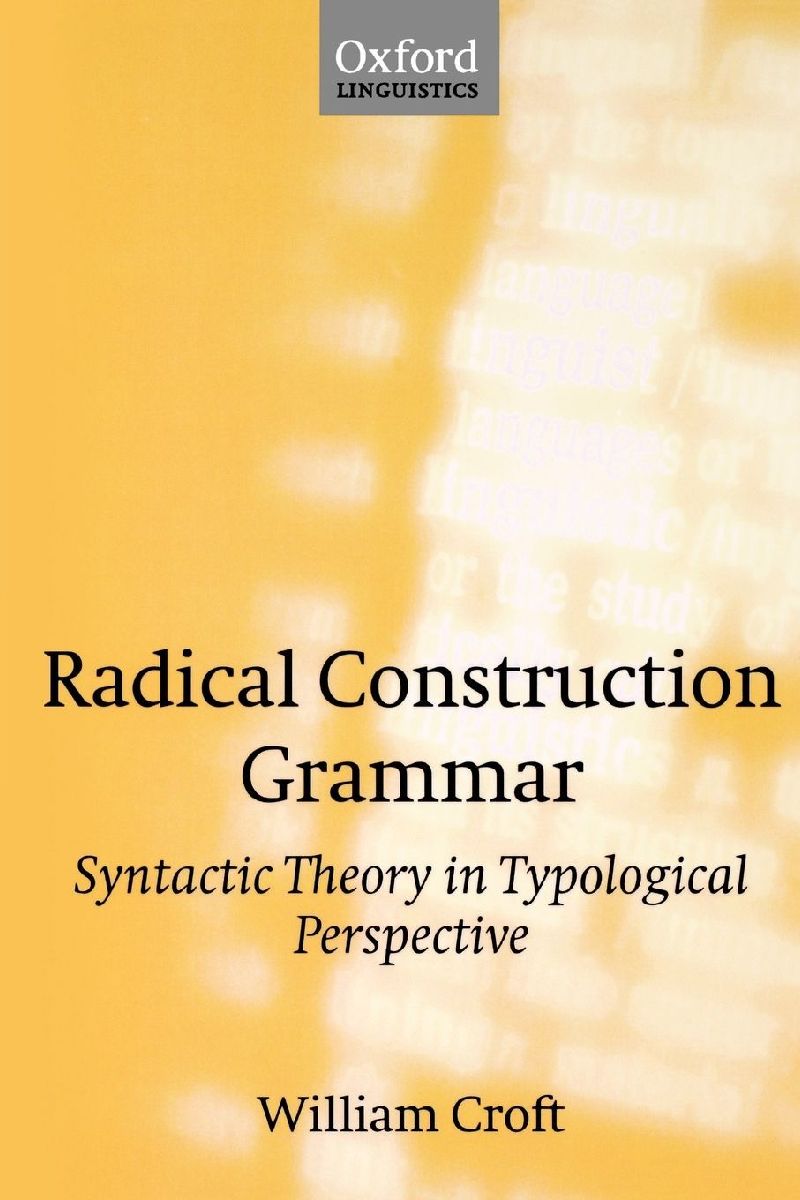
Radical Construction Grammar
Syntactic Theory in Typological Perspective
von William Croft
- Einband
- Kartoniert
- Seiten
- 446
- Sprache
- Englisch
- Erschienen
- November 2001
- Verlag
- OUP Oxford
Buchbeschreibung
Radical Construction Grammar presents a profound critique of syntactic theory and argumentation, and offers a genuinely new approach to syntax based on the fact of grammatical diversity.
Recent syntactic theories are essentially formal models for the representation of grammatical knowledge and posit complex syntactic structures in the analysis of sentences. The result has been a endless cycle of new and revised theories of syntactic representation.
Ganze Beschreibung lesenWeniger anzeigen
Radical Construction Grammar argues that this approach to syntax is incompatible with the grammatical variation found within and across languages. This book defends three fundamental theses: (i) constructions are the primitive units of syntactic representation, and grammatical categories are defined by constructions, not the other way around; (ii) the only syntactic structures are the part-whole relations between a construction and the syntactic elements that make it up; (iii) not only are grammatical categories construction-specific, but constructions are language-specific.
In other words, syntactic structure is almost entirely language-specific; attempts to find a universal formal model are doomed to failure.
Radical Construction Grammar integrates concepts from typological theory and construction grammar to uncover the genuine universals of grammar. Constructions are represented as complex symbolic units pairing form and meaning. The semantic map model of typological theory is used to map category distributions on a largely universal conceptual space. Universals of grammar are found in the mapping of meaning onto form.
Systematic patterns of grammatical variation provide evidence for the topography of conceptual space, which in turn reflects the geography of the human mind.
Inhaltsverzeichnis
- Part I: Against Syntactic Categories as Theoretical Primitives
- 2.: Parts of Speech
- 3.: Syntactic Categories and Semantic Relativity
- 4.: Grammatical Relations/Syntactic Roles
- Part II: Against Syntactic Relations
- 6.: A Radical Approach to Syntactic Relations
- 7.: Heads, Complements, and Adjuncts
- Part III: Against Universal Syntactic Constructions
- 9.: The Coordination-Subordination Continuum
- 10.: Syntactic Theory and the Theory of Language
Details
- Erscheinungstermin
- November 2001
- Kategorie
- Fremdsprachige Bücher
- Einband
- Kartoniert
- Seiten
- 446
- Sprache
- Englisch
- Verlag
- OUP Oxford
- Format
- 23,4 × 15,6 cm
- Dicke
- 2,5 cm
- Gewicht
- 673 g
- EAN / ISBN-13
- 9780198299547
Über William Croft
William Croft received his Ph. D. in linguistics at Stanford University in 1986. His publications include
Typology and Universals (1990), Syntactic Categories and Grammatical Relations (1991), Studies …
Mehr über William CroftWeniger anzeigen
Typology and Universals (1990), Syntactic Categories and Grammatical Relations (1991), Studies in Typology and Diachrony (coedited with Keith Denning and Suzanne Kemmer, 1990), Explaining Language Change: An Evolutionary Approach (2000), and a large number of scholarly articles. His current research areas include syntax, semantics, typology, and historical linguistics. Forthcoming books include Cognitive Linguistics (with D. Alan Cruse) and Verbs: Aspect and Argument Structure.
Versand und Rückgabe
Standardversand: 1 bis 3 Werktage, 3,99 €, kostenlos ab 35 €
Liefergebiet: Deutschland
Rücksendung: 14 Tage Widerrufsrecht. Bei einem Widerruf tragen Sie die Kosten der Rücksendung. Bei einer Falschlieferung oder einem Fehler von uns erstatten wir Ihnen das Rückporto. Den Widerruf erklären Sie über den Knopf „Vertrag widerrufen“ im Fuß der Seite.
Hersteller und ProduktsicherheitOUP Oxford
OUP Oxford
Europaallee 1
36244 Bad Hersfeld
Deutschland
gpsr@libri.de
Verantwortliche Person in der EU
Libri GmbHEuropaallee 1
36244 Bad Hersfeld
Deutschland
gpsr@libri.de
Mehr von William Croft

Ähnliche Titel
Bewertungen
Zu diesem Titel gibt es noch keine Bewertung. Bewerten kann, wer ihn bei uns gekauft hat.
So prüfen wir Bewertungen
Eine Bewertung kann bei uns nur abgeben, wer den Titel über sein Kundenkonto bei uns gekauft hat. Jede Bewertung ist fest mit der zugehörigen Bestellung verknüpft; anders kommt sie technisch gar nicht zustande. Deshalb trägt jede angezeigte Bewertung den Hinweis „Verifizierter Kauf". Wir zeigen positive wie negative Bewertungen und löschen nur bei Rechtsverstößen. Für Bewertungen gibt es keine Gegenleistung.
100,10 €Voraussichtlich 1. bis 3. Dez.