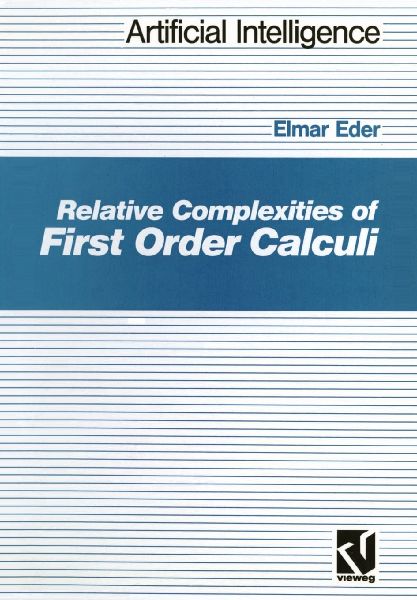
Relative Complexities of First Order Calculi
von Elmar Eder
Aus der Reihe Künstliche Intelligenz
- Einband
- Kartoniert
- Seiten
- 184
- Sprache
- Deutsch
- Erschienen
- Januar 1992
- Verlag
- De Gruyter Saur
Buchbeschreibung
In this paper, a comparison is made of several proof calculi in terms of the lengths of shortest proofs for some given formula of first order predicate logic with function symbols.
In particular, we address the question whether, given two calculi, any derivation in one of them can be simulated in the other in polynomial time. The analogous question for propositional logic has been intensively studied by various authors because of its implications for complexity theory.
Ganze Beschreibung lesenWeniger anzeigen
And it seems there has not been as much endeavour in this field in first order logic as there has been in propositional logic.
On the other hand, fOr most of the practical applications of logic, a powerful tool such as the language of first order logic is needed. The main interest of this investigation lies in the calculi most frequently used in automated theorem proving, the resolution calculus, and analytic calculi such as the tableau calculus and the connection method.
In automated theorem proving there are two important aspects of complexity. In order to have a good theorem proving system, we must first have some calculus in which we can express our derivations in concise form. And second, there must be an efficient search strategy.
This book deals mainly with the first aspect which is a necessary condition for the second since the length of a shortest proof always also gives a lower bound to the complexity of any strategy.
Inhaltsverzeichnis
- 1 Calculi for First Order Logic
- 1.1 Basic Concepts and General Remarks
- 1.2 Resolution
- 1.3 The Connection Method
- 1.4 Consolution
- 1.5 The Tableau Calculus TC
- 1.6 The Sequent Calculus
- 1.7 Natural Deduction
Ganzes Inhaltsverzeichnis anzeigen (34 Einträge)Weniger anzeigen
- 1.8 A Frege-Hilbert Calculus
- 2 Comparison of Calculi for First Order Logic
- 2.1 Known Results on the Complexity of Calculi
- 2.2 Transformation to Clausal Form
- 2.3 Complexity Measures for Resolution Refutations
- 2.4 Simulation of the Connection Calculus by Resolution
- 2.5 Non-Simulatability of Resolution in the Connection Calculus
- 2.6 Variants of the Tableau Calculus TC
- 2.7 The Method of Tableaux and the Connection Method
- 3 The Extension Rule in First Order Logic
- 3.1 The Extension Rule
- 3.2 Complexities of Formulas and Derivations
- 3.3 Occurrences in the Sequent Calculus
- 3.4 Application of Substitutions to Formulas
- 3.5 Transformation of Sequents to Clauses
- 3.6 Simulation of the Sequent Calculus in Extended Resolution
- 3.7 Gentzen's Transformations
- 3.8 Definitions
- 4 Connection Structures
- 4.1 Unifier Sets
- 4.2 From Resolution to Connection Proofs
- 4.3 Connection Structures
- 4.4 The Connection Structure Calculus
- 4.5 Splitting with Connection Structures
- 4.6 Extended Definitional Calculi
- Conclusion
Details
- Erscheinungstermin
- Januar 1992
- Kategorie
- Fachbuch
- Einband
- Kartoniert
- Seiten
- 184
- Sprache
- Deutsch
- Verlag
- De Gruyter Saur
- Reihe
- Künstliche Intelligenz
- Format
- 24,4 × 17,0 cm
- Dicke
- 1,1 cm
- Gewicht
- 329 g
- EAN / ISBN-13
- 9783528051228
Versand und Rückgabe
Standardversand: 1 bis 3 Werktage, 3,99 €, kostenlos ab 35 €
Liefergebiet: Deutschland
Rücksendung: 14 Tage Widerrufsrecht. Bei einem Widerruf tragen Sie die Kosten der Rücksendung. Bei einer Falschlieferung oder einem Fehler von uns erstatten wir Ihnen das Rückporto. Den Widerruf erklären Sie über den Knopf „Vertrag widerrufen“ im Fuß der Seite.
Hersteller und ProduktsicherheitSpringer Nature Customer Service Center GmbH
Springer Nature Customer Service Center GmbH
Europaplatz 3
69115 Heidelberg
Deutschland
ProductSafety@springernature.com
Mehr aus der Reihe Künstliche Intelligenz



Ähnliche Titel



Bewertungen
Zu diesem Titel gibt es noch keine Bewertung. Bewerten kann, wer ihn bei uns gekauft hat.
So prüfen wir Bewertungen
Eine Bewertung kann bei uns nur abgeben, wer den Titel über sein Kundenkonto bei uns gekauft hat. Jede Bewertung ist fest mit der zugehörigen Bestellung verknüpft; anders kommt sie technisch gar nicht zustande. Deshalb trägt jede angezeigte Bewertung den Hinweis „Verifizierter Kauf". Wir zeigen positive wie negative Bewertungen und löschen nur bei Rechtsverstößen. Für Bewertungen gibt es keine Gegenleistung.
54,99 €Voraussichtlich 1. bis 3. Dez.