Buch-OWLOnline-Buchhandel

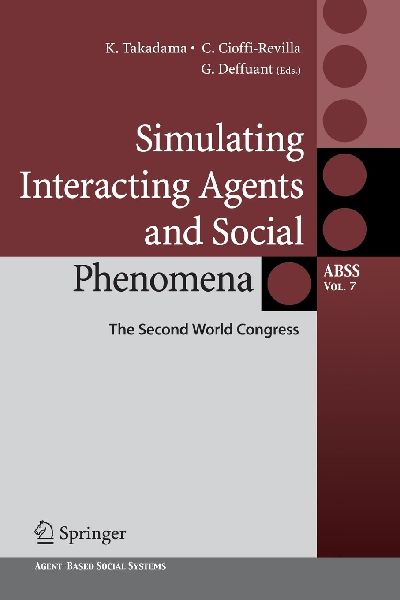
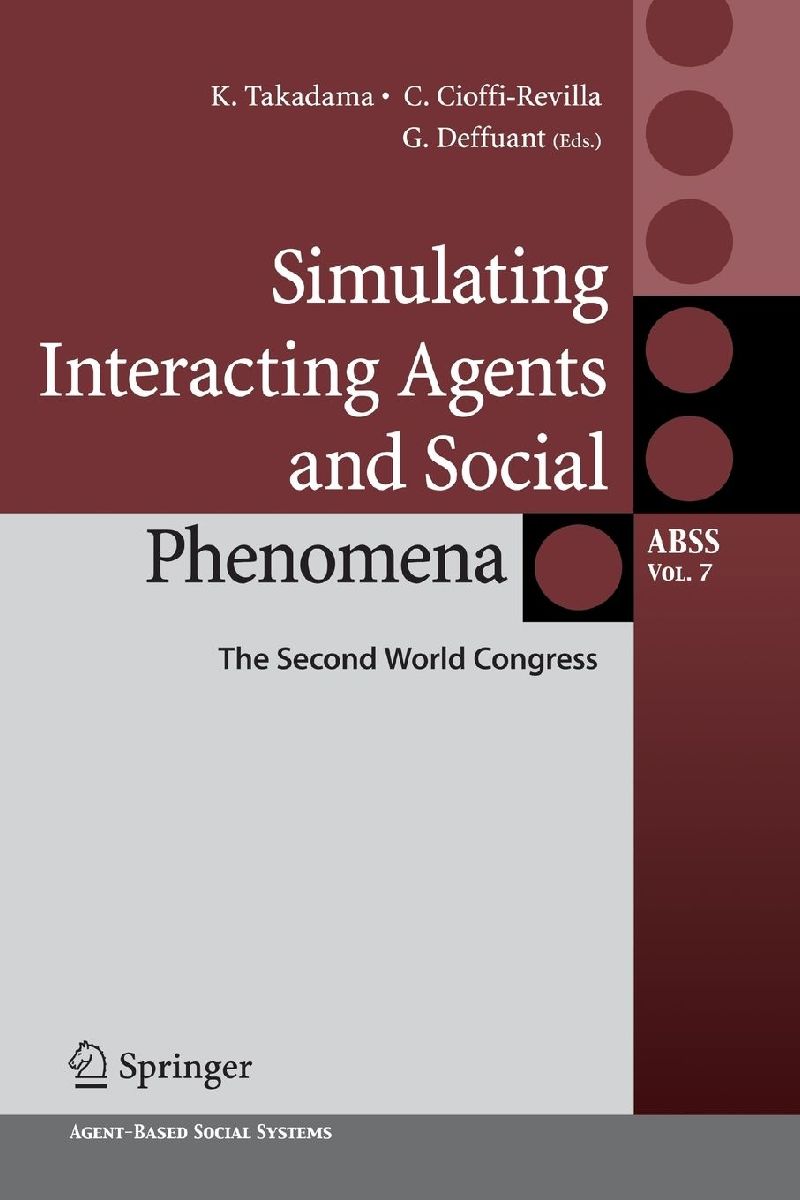
Simulating Interacting Agents and Social Phenomena

The Second World Congress

von Keiki Takadama (Hrsg.)

Herausgegeben von: Keiki Takadama, Herausgegeben von: Claudio Cioffi-Revilla, Herausgegeben von: Guillaume Deffuant

Aus der Reihe Agent-Based Social Systems

Einband
Kartoniert
Seiten
292
Sprache
Englisch
Erschienen
November 2012
Verlag
Springer

Buchbeschreibung

Agent-based modeling and social simulation have emerged as an interdisciplinary area of social science that includes computational economics, organizational science, social dynamics, and complex systems.

This area contributes to enriching our understanding of the fundamental processes of social phenomena caused by complex interactions among agents.

Ganze Beschreibung lesenWeniger anzeigen

Bringing together diverse approaches to social simulation and research agendas, this book presents a unique collection of contributions from the Second World Congress on Social Simulation, held in 2008 at George Mason University in Washington DC, USA.

This book in particular includes articles on norms, diffusion, social networks, economy, markets and organizations, computational modeling, and programming environments, providing new hypotheses and theories, new simulation experiments compared with various data sets, and new methods for model design and development.

These works emerged from a global and interdisciplinary scientific community of the three regional scientific associations for social simulation: the North American Association for Computational Social and Organizational Science (NAACSOS; now the Computational Social Science Society, CSSS), the European Social Simulation Association (ESSA), and the Pacific Asian Association for Agent-bBased Approach in Social Systems Sciences (PAAA).

Inhaltsverzeichnis

  • Part I Norms, Diffusion and Social NetworksA Classifi cation of Normative Architectures
  • Martin Neumann
  • The Complex Loop of Norm Emergence: A Simulation Model
  • Giulia Andrighetto, Marco Campennì, Federico Cecconi, and Rosaria ConteA Social Network Model of Direct Versus Indirect Reciprocity in a Corrections-Based Therapeutic Community
  • Nathan Doogan, Keith Warren, Danielle Hiance, and Jessica LinleyA Force-Directed Layout for Community Detection with Automatic ClusterizationP.J. McSweeney, Kishan Mehrotra, and Jae C. OhComparing Two Sexual Mixing Schemes for Modelling the Spread of HIV/AIDSShah Jamal Alam and Ruth Meyer
  • Exploring Context Permeability in Multiple Social Networks
  • Luis Antunes, João Balsa, Paulo Urbano, and Helder CoelhoA Naturalistic Multi-Agent Model of Word-of-Mouth Dynamics
  • Samuel Thiriot and Jean-Daniel Kant
Ganzes Inhaltsverzeichnis anzeigen (34 Einträge)Weniger anzeigen
  • Part II Economy, Market and Organization
  • Introducing Preference Heterogeneity into a Monocentric Urban Model: An Agent-Based Land Market Model
  • Tatiana Filatova, Dawn C. Parker, and Anne van der Veen
  • The Agent-Based Double Auction Markets: 15 Years OnShu-Heng Chen and Chung-Ching TaiA Doubly Structural Network Model and Analysis on the Emergence of Money
  • Masaaki Kunigami, Masato Kobayashi, Satoru Yamadera, Takashi Yamada, and Takao Terano
  • Analysis of Knowledge Retrieval Heuristics in Concurrent Software Development Teams
  • Shinsuke Sakuma, Yusuke Goto, and Shingo Takahashi
  • Reputation and Economic Performance in Industrial Districts: Modelling Social Complexity Through Multi-Agent Systems
  • Gennaro Di Tosto, Francesca Giardinia, and Rosaria Conte
  • Part III Modeling Approaches and Programming Environments
  • Injecting Data into Agent-Based Simulation
  • Samer Hassan, Juan Pavón, Luis Antunes, and Nigel Gilbert
  • The
  • MASON Households
  • World Model of Pastoral Nomad Societies
  • Claudio Cioffi -Revilla, J. Daniel Rogers, and Maciek Latek
  • Effects of Adding a Simple Emotion-Based Rule to a Reactive Simulation
  • Pablo Lucas
  • Applying Image Texture Measures to Describe Segregation in Agent-Based Modeling
  • Kathleen Pérez-López
  • Autonomous Tags: Language as Generative of Culture
  • Deborah Vakas Duong
  • Virtual City Model for Simulating Social Phenomena
  • Manabu Ichikawa, Yuhsuke Koyama, and Hiroshi Deguchi
  • Modeling Endogenous Coordination Using a Dynamic Language
  • Jonathan Ozik and Michael North

Details

Erscheinungstermin
November 2012
Kategorie
Fremdsprachige Bücher
Einband
Kartoniert
Seiten
292
Sprache
Englisch
Verlag
Springer
Reihe
Agent-Based Social Systems
Format
23,5 × 15,5 cm
Dicke
1,6 cm
Gewicht
446 g
EAN / ISBN-13
9784431540816
Maßstabsgetreu: Deckel und Buchrücken neben einer Hand (18 cm).
Versand und Rückgabe

Standardversand: 1 bis 3 Werktage, 3,99 €, kostenlos ab 35 €

Liefergebiet: Deutschland

Rücksendung: 14 Tage Widerrufsrecht. Bei einem Widerruf tragen Sie die Kosten der Rücksendung. Bei einer Falschlieferung oder einem Fehler von uns erstatten wir Ihnen das Rückporto. Den Widerruf erklären Sie über den Knopf „Vertrag widerrufen“ im Fuß der Seite.

Hersteller und ProduktsicherheitSpringer Nature Customer Service Center GmbH
Springer Nature Customer Service Center GmbH
Europaplatz 3
69115 Heidelberg
Deutschland
ProductSafety@springernature.com

Mehr aus der Reihe Agent-Based Social Systems

Ähnliche Titel

Bewertungen

Zu diesem Titel gibt es noch keine Bewertung. Bewerten kann, wer ihn bei uns gekauft hat.
So prüfen wir Bewertungen
Eine Bewertung kann bei uns nur abgeben, wer den Titel über sein Kundenkonto bei uns gekauft hat. Jede Bewertung ist fest mit der zugehörigen Bestellung verknüpft; anders kommt sie technisch gar nicht zustande. Deshalb trägt jede angezeigte Bewertung den Hinweis „Verifizierter Kauf". Wir zeigen positive wie negative Bewertungen und löschen nur bei Rechtsverstößen. Für Bewertungen gibt es keine Gegenleistung.
160,49 €Voraussichtlich 1. bis 3. Dez.

Inhalte ab 18

Cover von Titeln für Erwachsene, etwa erotische Romane, Manga oder Comics, bleiben unscharf, bis Sie bestätigen. Die Bestätigung gilt für alle Seiten und Tabs, bis Sie den Browser schließen.

Zurück zum Katalog